
Horror Stories from the Psychiatric Hospital (Part 1)
Episode 214October 29, 20261 h 23 minWith Luis Mena, Eduardo Lara
English version of an episode recorded in Spanish. · Leer en español
Short link: proyectochachalaca.org/ep214
In a nutshell
What is a psychiatrist doing with a tarot deck, a Tetragrammaton, and a Santa Muerte in his home? Psychiatrist Luis Mena and psychologist and behavior analyst Eduardo Lara sit down to chat about what really happens in our minds when we think we see or hear something from the great beyond. Weaving in hospital ghost stories—like the little girl with the ball in the elevator at the Bloom and the gargoyle that nurses swore they saw take flight—they break down the differences between illusions, hallucinations, and pseudohallucinations, why «se nos sube el muerto» (literally "the dead climbs on top of you," referring to sleep paralysis), and whether fear is something we are born with or something we learn. A first installment filled with childhood spooks and deep respect for our traditional legends.
Review
Review
A psychiatrist who collects what scares us
The episode opens around an unusual table. Psychiatrist Luis Mena brings out a tarot deck gifted by a patient, a tetragrammaton inherited from his father, and a Santa Muerte statue brought from Mexico—which he strung with guitar strings since it lacked a scythe. Why does a psychiatrist hold on to these things? Luis gives two reasons. First, to take them out of circulation, since they can trigger crises in vulnerable people. Second, to understand them: when a patient brings up grimoires or esoteric traditions, knowing what they are keeps the conversation from grinding to a halt. Joining him is Eduardo Lara, a psychologist and behavior analyst, who laughs as he introduces himself as “the buzzkill of the episode”—the guy who will always look for a rational explanation for everything.
Longer nights, closer fears
Between October 31st and November 2nd, are we more primed to see things? For Luis, the answer is yes. It is a mix of cultural heritage and the turn of the seasons: the nights grow longer, and nearly every culture has looked at the waning sun with a touch of dread. Eduardo adds that for centuries, humanity explained everything through what we could see and hear, even though our senses are often unreliable. He brings up the example of certain wildcats in the United States whose cries sound so uncannily human that anyone would rush to the edge of a ravine to help.
Listening comes first
If someone tells Luis they saw a deceased uncle, he doesn’t panic—he listens. What concerns him isn’t whether the explanation is magical or religious, but whether their speech breaks the rules of logic. After all, the only window we have into another person’s thoughts is how they speak. Eduardo approaches the same phenomenon from a different angle: hearing voices is a behavior, and as such, it should be analyzed based on when it happens and what function it serves, without dismissing it. This interplay between psychiatry and behavioral analysis runs through the entire episode.
Childhood spooks
Eduardo’s great-grandmother used to tell him war stories: soldiers swearing that guerrilla fighters turned into squirrels, roosters, or tacuazines (opossums), because they would surround an area only to find it completely empty. Luis’s father, who was Panamanian, grew up immersed in the lore of the Darién jungle and journeyed through almost every spiritual path imaginable. As kids, Luis and his sister saw a light drift into their bedroom and thought it was a cosmic guardian. Today, he explains it as hypnagogic and hypnopompic hallucinations: normal sensory experiences that occur as we fall asleep or wake up. Eduardo caps it off with a story about a cousin who pedaled his bike in sheer terror one night, convinced a whistling spirit was chasing him—only for the whistle to be coming from his own stuffy nose.
Stories told in hospitals
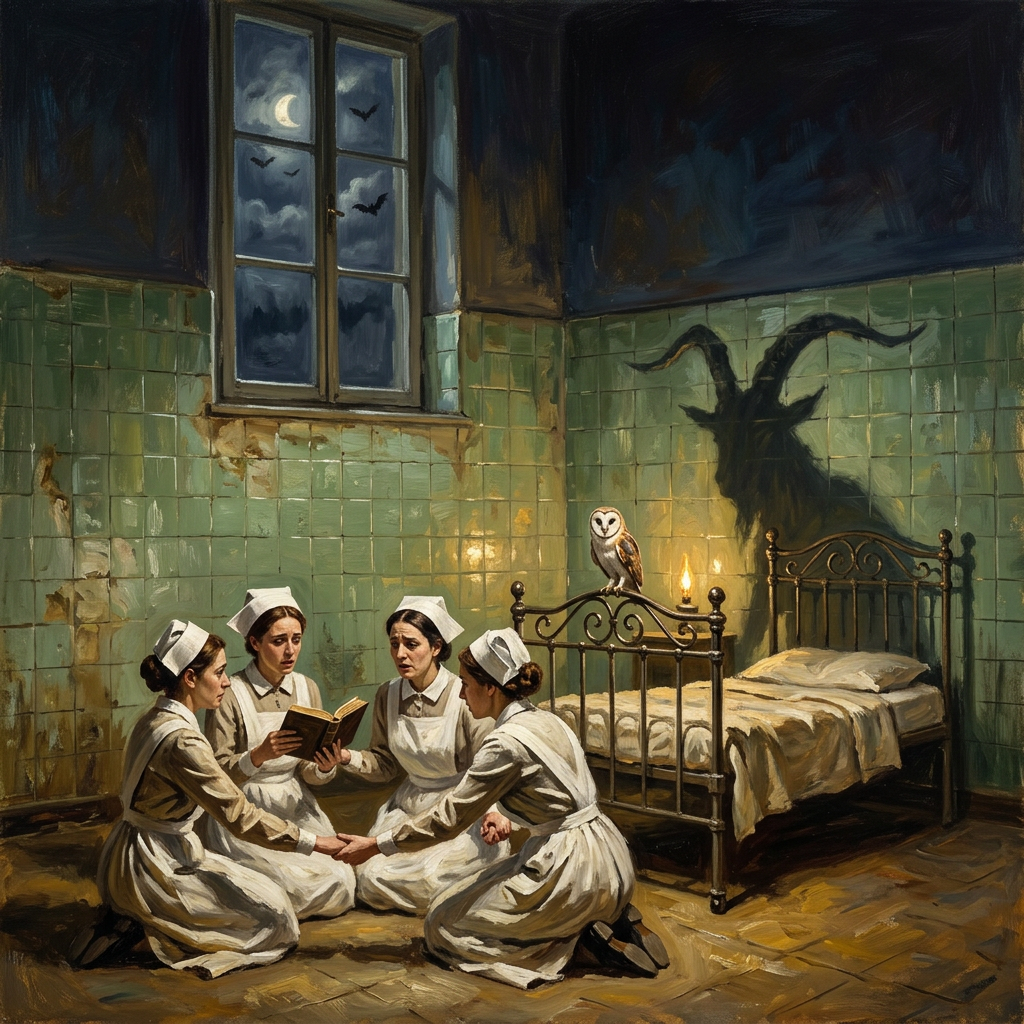
During his internship at Hospital Bloom, Luis was warned that the elevator might get stuck at night and that he would hear a little girl bouncing a ball. One of his colleagues ended up in tears, and no one was willing to go fetch the lab results. Years later, during his residency at the Hospital Psiquiátrico, he came across three nurses reciting the psalm of protection: they swore a gargoyle had flown right through the ward and that a patient had drawn a pentagram on her bed. The pentagram turned out to be a smear of refried beans. He never did figure out what the gargoyle was, though the hospital is surrounded by thick brush, tacuazines, cusucos (armadillos), and barn owls. Eduardo, meanwhile, recalls rumors of “the little girl” at Hospital Rosales, pointing out something curious: the people who claim to have seen something are usually the ones who already believed.
Illusion, hallucination, and pseudohallucination
This is the most educational part of the episode. A sense organ can fail—like eye floaters or a perforated eardrum causing popping sounds. The brain that processes that information can also misfire, or our emotions can distort something real. That last scenario is a catathymic illusion. Luis experienced this firsthand one night in the alleyway where his grandmother lived in colonia Libertad, during a tense, fearful period in the neighborhood: he thought he saw someone beckoning him over, but it was just a banana leaf blowing in the wind. A hallucination, on the other hand, means perceiving something when there is no sensory stimulus at all. Pseudohallucinations are rarer, where someone perceives something their physical senses could not realistically capture—like smelling from miles away that their house is on fire, or hearing a voice speaking from inside their stomach. Hallucinosis has an organic cause, such as a head injury or illness. Luis recommends Karl Jaspers for anyone wanting to dive deeper, and Eduardo mentions he is already reading him.
From the hammer of witches to the clinic
Luis throws out a provocative thought: the spiritual grandfather of modern diagnostic manuals might just be the Malleus Maleficarum, the Inquisition’s treatise against witchcraft. When you read the descriptions of certain afflictions blamed on demons, he notes, conditions emerge that we would now recognize as depression or dyslexia. The conversation then pivots into a lively discussion on ABA therapy and behaviorism’s controversial reputation. For Eduardo, punishment isn’t yelling; it is simply anything that decreases the likelihood of a behavior, and everyone uses reinforcement whether they realize it or not—starting with moms and the chancleta. Luis takes it further, arguing that our modern era has lost touch with the value of uncomfortable, negative experiences. Amaru adds some nuance, pointing out that the tool itself isn’t inherently good or bad; what matters is how it is used and what we build with it.
Are we born with fear, or do we learn it?
Both, Luis answers. We are wired with an amygdala and adrenal glands primed for danger: pupils dilate, mouths go dry, hearts pound. But every body reacts differently—some flee, some fight, and some freeze. He illustrates this with the 2001 earthquake: his sister bolted in sheer panic, while he, having never experienced an earthquake before, stayed completely calm.
When “se nos sube el muerto” (the dead climb on top of us)
The technical wrap-up centers on sleep. To fall asleep, our norepinephrine and body temperature have to drop, while melatonin rises. Next come deep sleep and REM, where the eyes dart while the body stays paralyzed. Whatever is happening in the outside world bleeds into what we dream—rain, a dog licking our hand, or a full bladder. That is where sleep paralysis comes in: we wake up with an active mind, but the body cannot move yet, and a heavy pressure on the chest transforms—depending on our cultural frame of mind—into a dead body, an incubus, or a shadowy figure by the door. In El Salvador, people say «se nos sube el muerto»; in Japan, it is called kanashibari.
Respect for our legends
To wrap up, Luis invites listeners to embrace healthy doubt and examine when magical thinking serves us versus when it keeps us from taking responsibility for our actions. Eduardo urges us not to demonize the Siguanaba, the Cipitío, or the Cadejo: they are part of our history and the explanations our people had at hand. And Amaru admits that, after four years of hosting these conversations, even biologists and sociologists have confessed to him that they believe in the nahual. The second part will tackle mass hysteria, pareidolia, and cases of trance and possession.
To go further
Our own context, to expand on or clarify what was discussed.
A clarification on the Malleus Maleficarum
The Malleus Maleficarum (1487) is a treatise on how to identify, prosecute, and punish witchcraft; it is not a catalog of demons. The list of 72 demons mentioned in the episode comes from a different text, the Ars Goetia, the first book of The Lesser Key of Solomon, a grimoire compiled in the 17th century. The idea that the Inquisition routinely mistook mental illness for possession is popular, but historians nuance this: period texts themselves often distinguished madness from demonic affliction, and most people accused of witchcraft did not have a psychiatric disorder. Seeing these treatises as precursors to modern diagnostic manuals is, above all, a retrospective reading from our own time.
Three terms often confused
In clinical terminology, an illusion distorts something that is actually there, like a leaf that looks like a waving hand. A hallucination occurs without any external stimulus. A pseudohallucination is a concept psychiatry still debates, as different clinical schools define it slightly differently. That is why Luis refers back to Karl Jaspers, whose General Psychopathology (1913) remains the foundation for these distinctions.
Sleep paralysis is more common than it seems
A review of studies across multiple countries estimated that roughly 8 out of every 100 people have experienced it at least once, with higher rates among students and individuals with psychiatric conditions. Research identifies three classic experiences: the feeling of an intruder’s presence, pressure on the chest, and the sensation of floating. Every culture dresses these sensations in its own folklore, which is why the Salvadoran “muerto” closely mirrors the Old Hag of Newfoundland or the Japanese kanashibari. The painting Luis was searching for on air is likely The Nightmare (1781) by Swiss painter Henry Fuseli (Johann Heinrich Füssli), rather than Hieronymus Bosch: a sleeping woman with an incubus perched upon her chest.
We are wired for certain fears
Luis’s point—that fear is both innate and learned—aligns with the “preparedness” theory developed by Arne Öhman and Susan Mineka. According to this model, the human brain learns to fear things that posed an evolutionary threat to our ancestors (like snakes, heights, or darkness) far more easily than things that did not.
An astronomical note
The longest nights of the year in the Northern Hemisphere arrive with the winter solstice around December 21st; the equinoxes occur in March and September. A few days after the winter solstice, once the days visibly begin to lengthen again, ancient Rome celebrated Sol Invictus.
The laws that changed institutionalization
Luis mentions finding hospital archives with records of patients committed by legislative decree—a practice long since abandoned. El Salvador passed its Mental Health Law in 2017, putting patients’ rights and community-based care front and center. To explore the history of these institutions, we recommend EP203, dedicated to the history of psychology and psychiatry in the country.
Get involved
Have you ever had an episode where «se te subió el muerto»? Or do you know a hospital ghost story that is still whispered on the night shift? Write to us at pro.chachalaca@gmail.com or reach out on our social channels. Some of your stories might just be featured in part two.
Further reading
- Cheyne, J. A., Rueffer, S. D., & Newby-Clark, I. R. (1999). Hypnagogic and hypnopompic hallucinations during sleep paralysis: Neurological and cultural construction of the night-mare. Consciousness and Cognition, 8(3), 319–337. View online
- Jaspers, K. (1993). Psicopatología general (R. O. Saubidet & D. A. Santillán, Trads.). Fondo de Cultura Económica. (Obra original publicada en 1913)
- Kemp, S., & Williams, K. (1987). Demonic possession and mental disorder in medieval and early modern Europe. Psychological Medicine, 17(1), 21–29. View online
- Öhman, A., & Mineka, S. (2001). Fears, phobias, and preparedness: Toward an evolved module of fear and fear learning. Psychological Review, 108(3), 483–522. View online
- Sharpless, B. A., & Barber, J. P. (2011). Lifetime prevalence rates of sleep paralysis: A systematic review. Sleep Medicine Reviews, 15(5), 311–315. View online
- Telles-Correia, D., Moreira, A. L., & Gonçalves, J. S. (2015). Hallucinations and related concepts: Their conceptual background. Frontiers in Psychology, 6, 991. View online
You might also like
Transcript
Automatic transcript (Gemini), translated from Spanish and partially reviewed: names and unclear words may contain errors. The episode opens with a chat recorded at the end of the conversation; the formal introduction starts at 5:37.
Read the full transcript
[00:00] Amaru: That was Proyecto Chachalaca number 214. Luis, Eduardo, what a fantastic conversation. I'm telling you right now: this is going to need a part two, because we couldn't cover all the topics we had in just one episode, so part two is coming soon. But anyway, Luis brought some paraphernalia here to show us. Before that, though, Eduardo, how was it being here?
[00:23] Eduardo Lara: Exciting! Honestly, it's intriguing to talk a bit about the explanations for things that didn't have explanations before and that we used to call paranormal, and how there are some we still don't understand today and keep believing in.
[00:34] Amaru: Okay. Luis, how was it being here for you?
[00:35] Luis Mena: A pleasure, an absolute pleasure. Talking with you guys, as I said, is going to become one of those things I hope happens regularly in my life, because I truly enjoy it.
[00:43] Amaru: Of course, you're always welcome. Well, tell us a bit about the paraphernalia you brought here.
[00:48] Luis Mena: I brought a couple of things here; they have a history. This one, the tarot cards—I have permission to share this. A patient gave this to me, a patient I still see, someone I've been following up with for almost two years now. She used to read tarot during a period of her life when she lived in Spain. And she told me, "You can't throw away a tarot deck; it has to be given away as a gift." So I told her, "I'll free you. Gift it to me." So she gave it to me, and that's how I got my tarot deck. And this is a Tetragrammaton, inherited from my father during his Gnostic phase.
[01:21] Amaru: Okay, that's for protection, if I remember correctly.
[01:24] Luis Mena: Yes, yes, yes.
[01:25] Amaru: That's a protection amulet that has various symbols, if I remember correctly.
[01:29] Luis Mena: Yes, the symbolism has to do with humanity, depending on how you orient it. And here's my favorite, which they brought me from Mexico: the Santa Muerte. They brought me the Santa Muerte without a scythe. So that's why...
[01:40] Amaru: You put your own...?
[01:41] Luis Mena: I put some guitar strings on it there, yeah. Here on the back, you can see...
[01:45] Amaru: Of course.
[01:45] Luis Mena: A couple of things from syncretism, right? There are several things we could talk about regarding this: paleros, palo mayombe, the cult of death in Mexico...
[01:55] Amaru: All those kinds of things, right? Social symbols that get built up over the...
[01:58] Luis Mena: Yes, yeah, exactly.
[01:59] Amaru: Okay, what leads a psychiatrist to collect this kind of stuff?
[02:05] Luis Mena: That question... For me, it serves two purposes: one, people might find it curious that I have these things in my possession; in a way, I take them off the street. Now, are you saying you believe in it? It's not that I believe; I know that this sort of thing can trigger certain mental health issues in vulnerable people. So having all this—and I have even more at home, like it's the Warrens' museum already—is like taking these things out of circulation. And also, for me—I can explain this later on—for a good chunk of my life, I felt psychological terror toward the paranormal. So it's like personal victories: knowing that I can have this in my house and knowing that, to me, they have absolutely no meaning. And in a way, studying them, too.
[02:51] Amaru: Yeah, that's what I was going to say—something really interesting about this, or about having them, is that you become familiar with the kinds of items a patient might turn up with.
[02:58] Luis Mena: Exactly. In fact, the reason why I... I have them right here, excuse me, I'm carrying a couple of grimoires. There was a time at the psychiatric hospital when a patient was... I had already sedated her, and suddenly I walk up to her, and she sits right up out of nowhere and hurls a curse at me. I don't remember exactly what she said anymore, but at that moment it really stuck with me—I even dreamed about it. I went on Google, and it turned out to be a phrase from the Book of Saint Cyprian. That was when I first came into contact with grimoires, and that's when I started exploring the Goetia, the 72 demons of Solomon, to understand the culture and where it actually comes from. So they're like symbolic victories; I don't believe in this.
[03:36] Amaru: Okay, but it also serves as material you can discuss with... Suppose a psychiatric patient who's been around comes in and tells you, "Look, I believe in this." Then you can already take it as an element of: well, they're using this to, let's say... Eduardo doesn't like this word—project certain things.
[03:54] Luis Mena: Exactly. Yes, it's useful. Knowing about this... A patient might come in who is very knowledgeable about these things, and knowing them helps us tremendously so that rapport isn't lost, and so they don't say, "I can't explain it to you because you won't understand." But once you tell them, "No, if you're talking to me about The Kybalion, Hermes Trismegistus, Aleister Crowley, Samael Aun Weor, or whatever..." Then it's, "Okay, the doctor knows." "And how is it that, even knowing all this, he thinks that what I... or can argue that what I'm thinking has another perspective I hadn't considered?" That's when the patient says, "Okay, I want to hear this person out."
[04:30] Amaru: Lower their guard a bit and understand that this can lead to a better state.
[04:34] Luis Mena: Exactly, you have one more tool to get the patient to let their guard down with you.
[04:38] Amaru: Well, let's begin this episode, and I assure you it's very interesting, you're going to enjoy it. Part two is coming, so let's get started.
[04:47] Locutor: This is Proyecto Chachalaca, a space to talk about who we are as Central Americans. And it's the little actions that keep this project going. If you liked anything in this episode, share it with someone. Also follow us on our social media so you don't miss what's coming next. And if you have a minute, leave us five stars wherever you're listening to us. Believe it or not, that helps us a lot to keep moving forward. And if you'd like to get involved in another way, collaborate with us, or suggest a guest, write to us; the door is always open. You can search for Proyecto Chachalaca or visit our website at proyectochachalaca.org, where you can also find additional material for each episode, as well as ways to contact us and support the project. Because remember: for a story to keep existing, it must keep being told. And now, let's begin.
[05:37] Amaru: Welcome to Proyecto Chachalaca. This is Horror Stories in the Psychiatric Hospital. Joining us in this episode are Luis Mena and, representing the project, Eduardo Lara. Here we're going to do a brief interview regarding these kinds of paranormal things that might actually not be so paranormal after all. But anyway, how's it going? How are you, Luis?
[05:56] Luis Mena: Very well, delighted to see you guys again. Here we are meeting again in the place that brought us together.
[06:01] Amaru: Yeah, it's a pleasure having you here. And well, Eduardo, how's it going? How are you?
[06:06] Eduardo Lara: Right here, debuting my broadcaster voice—quite fitting for a podcast, I think.
[06:10] Amaru: Yeah, a cold is a tremendous boost for interviews. But alright, let's see: we find ourselves at this time of year between Halloween and November 2nd, All Souls' Day. I'd like to ask both of you: what do you think? Is it this date—or rather these dates—that make us more susceptible to encountering paranormal things, or suddenly identifying something as strange? What can you tell me?
[06:37] Luis Mena: I think the blend of cultural heritage we have shapes the environment; it sensitizes us to be more receptive to these kinds of phenomena. Like you were saying: October 31st, November 2nd—I mean, the end of the year, nights get longer, days get shorter, the summer solstice, winter equinox, all of that. And then the correlation with solar deities, right? The fact that roughly around December 25th, days start getting longer again.
[07:09] Amaru: Sol Invictus.
[07:10] Luis Mena: Yeah, it's something all cultures perceived: looking at the sky, seeing how the sun set and disappeared. It's a heritage that would be very difficult to trace back, but it's a hodgepodge of things that I think does make the atmosphere a little more receptive to those kinds of phenomena.
[07:30] Amaru: What do you say, Eduardo?
[07:31] Eduardo Lara: You know, I really agree with what Luis is saying, because remember that before there was even a bit of science to explain things—and we have to admit science is counterintuitive—things were explained through intuition, right? So how could you explain to people back then that the sun wasn't going anywhere, that it wasn't hiding or rising, but rather that you were the one spinning on Earth, when people were seeing it with their own eyes? I mean, intuitively they saw the sun set and rise on the other side the next day.
[08:02] Amaru: They would've told you, "Bullshit, you can see it right there."
[08:04] Eduardo Lara: "Look, there it is, huh." It's precisely...
[08:06] Amaru: "Burn this guy."
[08:08] Eduardo Lara: Yeah, yeah, totally. They would've set me on fire already, I still think.
[08:13] Luis Mena: In some places more than others.
[08:14] Eduardo Lara: Yeah, definitely. So I do think there's this initial explanation of relying heavily on the senses we have to explore the world, when we've now realized our senses are very limited when it comes to explaining the world. But it's what we have, so off the bat, I'm going to pay attention to something I saw—even if what I saw was a mistake—or to what I heard, even if what I heard was a mistake, and it makes total sense. Not long ago, I was watching a wildlife show featuring some animals—they were wildcats in the United States, honestly. I mean, I hear them, and it truly sounds to me like a person screaming or... But they explained that evolutionarily, they had developed sounds to those levels as they drew closer to humans, because people would approach to see if it was really a human in danger, and then they'd take the opportunity to eat them. So, intuitively, we might hear a person screaming, right, out in the middle of a ravine where there's nothing, but later we get explanations that are a bit more coherent.
[09:16] Amaru: Definitely.
[09:17] Luis Mena: That's also where concepts like symbol, myth, and legend start coming in, which is like the inheritance of the spoken word—meaning, how stories get told, right?
[09:30] Amaru: That's true, yeah.
[09:31] Luis Mena: Yeah, yeah. Stories get told, a little bit gets added, and as they get passed down from generation to generation, a whole bunch of flavor gets mixed in, making it more interesting.
[09:41] Amaru: Yes, definitely. Psychoanalysis is interesting, right, Eduardo?
[09:43] Luis Mena: Isn't it?
[09:44] Eduardo Lara: Yeah. If you want to have a bad time, yeah. No, just kidding, just kidding. I find it to be a pretty common philosophy.
[09:53] Amaru: Well, let's see: from your perspective, Luis, when suddenly... Well, first of all, for anyone who might be listening to Proyecto Chachalaca for the first time, I'd like to mention: Luis is a psychiatrist, and on the other side we have Eduardo, who is a psychologist and behavior analyst. So we have two people here who can shed light on behavior and also on what happens in our heads when we suddenly come face-to-face with certain phenomena.
[10:19] Eduardo Lara: When you post the reel or the carousel for the episode, you really should use the song "Doctor Psiquiatra," you know.
[10:28] Luis Mena: Definitely.
[10:31] Amaru: Well, this might be an awkward question—not so much for you, but for the rest of us and the people who know you: if someone comes up to you, Luis, and says, "Hey man, you know what, I just saw something, I just saw a dead person," or, "I saw a deceased uncle," or something like that, what's the first thing that comes to your mind? Or if they suddenly tell you, "Last night something spooked me, I heard things." What's the first thing that pops into your head?
[10:54] Luis Mena: To listen.
[10:55] Amaru: Listen?
[10:55] Luis Mena: Listen without...
[10:57] Amaru: Judging?
[10:57] Luis Mena: Without... Yeah.
[10:58] Amaru: Doesn't a bit of... cross your mind?
[11:00] Luis Mena: No. Look, if active listening leads me down that path, yes, I start considering it. But right off the bat, if someone describes a phenomenon like that and the explanation their current cognitive resources offer is paranormal, magical, or religious, that doesn't set off any alarm bells right away. It puts me into active listening mode.
[11:21] Amaru: What does suddenly trigger an alarm when you hear it?
[11:24] Luis Mena: I'm going to get technical real quick.
[11:26] Amaru: Hit us with it.
[11:27] Luis Mena: One way of classifying thought, and therefore speech—because the only way we can access how someone thinks is through how they speak, since we can't get inside someone's head. So, if we want to analyze thought, we have to learn to classify and deconstruct a person's speech. Thought, according to... There are several ways to classify it: initially, we could break it down into the form, course, and content of thought, okay? According to form, it can be logical or illogical—and we'll explain the criteria for placing it into one of those categories shortly. According to its course...
[12:04] Amaru: Where it's going.
[12:04] Luis Mena: Where it's going and how many tangents or deviations it takes away from the communication goal. And the content is what the person is actually narrating. So here, what gives us the clue as to whether something is okay or not okay is if the person's speech can be categorized as illogical. And for that, we have to refer to Aristotelian logical thought. If the patient breaks one of the seven principles of Aristotelian logical thought, then there's reason to worry. I assume the next question is: what are the seven principles of Aristotelian logical thought?
[12:37] Amaru: No, no, no, we all learned that in sixth grade.
[12:41] Amaru: No, but the first one...
[12:43] Luis Mena: We'll stick with the first three, which are the simplest, because just explaining that would take me four podcasts.
[12:47] Eduardo Lara: Yeah, right, because that's a question on the PAES.
[12:49] Luis Mena: Yeah.
[12:50] Eduardo Lara: It was even on the UES admission test.
[12:52] Amaru: Exactly, man, on the Avanzo test.
[12:54] Luis Mena: So the first one is the—the first principle would be the principle of non-contradiction.
[12:59] Amaru: Not contradicting yourself in what you're saying.
[13:00] Luis Mena: But, but it's not that simple. For example, if I tell you: "I am here and not here at the same time," right? That something both is and isn't at the same time. I mean, you—you just can't. If we look at it as a formula—because logic has formulas that are kind of complex to... Like you were... Let's see, you, you, you've studied math and physics in depth; logic has formulas just like physics or math. The definition is a bit complicated, but basically it's that a thing cannot be and not be at the same time, right? That is the principle of non-contradiction. Then there's the principle of identity: that if you—if you can describe that a thing... For example, a glass: if I describe a glass to you as having to have a certain size, a shape, a material, but if I change one of those characteristics and make you a glass out of Styrofoam that's two—that measures two meters tall, I've already modified a characteristic, and it's no longer a glass. Maybe it's a work of art, maybe it's, I don't know, a prop for a commercial, but you can no longer use it for what it is, right? So the criterion of identity, or the principle of identity that defines what a thing is, cannot be broken either. And the other is the principle of the excluded middle. For example, if I tell you: "All cats are white... Excuse me, a cat can be white or black." So if I suddenly find a cat that is brown, that is tabby-striped, it automatically doesn't fit into my previous definition, so that third option is excluded. Then there are other criteria, which are temporality, for example, spatiality, right? Like, I cannot be—how can I put it?—older than my mother, right? So, when a person breaks any of those principles in their speech, that already points us toward thought that is out of touch with reality, or an underdeveloped intellect, or a severe disturbance of consciousness, which in legal terms is insanity. So, the very first thing is whether their speech breaks one of those principles, and then it is categorized as logical, illogical, or paralogical thought—describing paralogical is a bit more complicated, but to keep the podcast moving, if it breaks a principle, I can classify it as illogical thought, and right there we have to rule out that there isn't something...
[15:13] Amaru: One of the seven, and right here...
[15:14] Luis Mena: Yeah, and that's where we start racking our brains, because, like, what's going on here, right?
[15:18] Amaru: Okay, let's move on to the thought process.
[15:19] Luis Mena: The thought process, for example: if you have point A and point B and a person starts... For example, if I ask you a question: Salvador, how did you get here? "Oh, you know, Luis, I was walking in the rain eating an ice cream, and that ice cream was pumpkin-flavored, and pumpkins around this time of year, and..."
[15:37] Amaru: Like I start spinning my wheels on a topic.
[15:39] Luis Mena: And you start veering off in another direction—that's speech that goes off on a tangent; it's tangential speech. Or if it's suddenly circumstantial, where you start giving me a bunch of details that are completely and utterly unnecessary to what I just asked you, I start wondering how much their affect or emotional state is coloring the speech with what they feel, and they lose sight of the objective, which is to communicate the information I asked for with the question. So that's when I can start to worry, right? Or, as I was saying before, tangential speech, where the more it goes off on a tangent, the farther it gets from where it needed to go. Or then disjointed speech, which is classic, for example, of someone with schizophrenia, where things just don't connect anymore, or the highest degree of disorganization, which is jargonophasia, which is when it's pure, pure, pure sounds that make no sense at all—there isn't a single comprehensible word within the language we're using. So that has to do with the thought process. And content can be the type of ideas, which can be magical-religious, obsessive, obsessoid, paranoid, fixed ideas, phobic—and we could delve into each of those subcategories.
[16:45] Amaru: Yeah, that would definitely be a separate podcast entirely.
[16:47] Luis Mena: Yeah.
[16:47] Amaru: No, look, that's really interesting, you know, because sometimes when we run into people who suddenly want to tell us something and we see they're not getting to the point, they hesitate like that when telling a story, and then in that same story they go and modify a lot of elements, it's like we might be facing a situation, but it's always a specialist who's going to tell us: "There's something strange here."
[17:09] Luis Mena: And also the amount of time you talk with someone. Here, I don't know if I should tell them... No, I'm not going to say it. There's a timeframe—technically, there's an amount of time you have to hold a conversation with someone to be sure whether they're maintaining a lie or not. In other words, when you want to identify whether someone is lying to you, there are forensic techniques to see if the person can keep it up without fatiguing and changing their narrative, as well as the way you question them to see if they contradict themselves. So when it exceeds that timeframe, usually most people start making mistakes and mistakes and mistakes and mistakes, and that's where you start to see it—there comes a point where they break down. That technique can help you catch a liar, or try to logically counter the illogical thought of a psychotic person. The danger with that, as you might infer, is that if you start backing someone into a corner or pinning them down, whether they're trying to lie to you or they're psychotic, and you push what they're telling you to its ultimate conclusion, they're going to get angry.
[18:05] Amaru: It can lead to violence.
[18:06] Luis Mena: Exactly. So then they can become agitated. The psychiatric term is a person with psychomotor agitation, and psychomotor agitation is one of the few true emergencies we have in psychiatry. An agitated patient has to be mechanically restrained. First verbal de-escalation; if that's not possible, physical restraint; and if that's not possible, chemical restraint, which is practically sedating them.
[18:23] Amaru: Practically. The first is: be still, calm down...
[18:26] Luis Mena: Which, that alone requires a technique for how to...
[18:27] Amaru: Of course. Saying: yeah, yeah, yeah, if it starts blowing up.
[18:31] Amaru: The next is...
[18:33] Luis Mena: Physical restraint, yeah, which...
[18:35] Amaru: In the past, it was straitjackets, the jackets...
[18:37] Luis Mena: Yeah, yeah, yeah.
[18:38] Luis Mena: Now there are specific devices so they don't injure wrists; you can't strap down the chest, for example. There used to be a tie that went around the armpit area, but it damaged the brachial plexus, so there are several issues there.
[18:49] Amaru: Today the management has changed, so to speak.
[18:50] Luis Mena: Yeah, no, no, no, now it's a completely different thing.
[18:52] Amaru: And the other is being restrained and injected with some kind of relaxant.
[18:56] Luis Mena: That's right, sedated, and there are scales to measure the level of sedation as well.
[19:00] Amaru: Those are the...
[19:01] Luis Mena: The Ramsay Scale, by the way, it's called.
[19:02] Amaru: Would you like to add anything, Eduardo?
[19:04] Eduardo Lara: Always. No, not to stir up controversy. No, it makes total sense to me, it's just that from psychology we see it more as... well, no, from behavior analysis as a functional explanation of things—that is, not so much about getting alarmed. You know, I don't know what could alarm us as behavior analysts in that sense, because everything that exists is matter and a product of matter. So hearing someone who hears voices, for us it would be: okay, let's analyze this behavior functionally, because it's still a behavior, and if it's behavior, it's still normal; it can't be pathological. So, beyond thinking or fearing whether this person actually heard a voice or not, we're not going to question it, but rather evaluate it functionally. Not interpreting it as the real possibility that a spirit actually whispered in their ear, right?
[19:54] Luis Mena: Yeah, I assume when you said fears, you didn't mean fear of what they're telling you, like: "Damn! Something paranormal happened," but rather the fear that it's something serious clinically speaking.
[20:03] Eduardo Lara: I don't know if we could say clinically significant, because I was at a conference about a week ago where they discussed how tricky it is to call something clinically significant. But it's true that we don't get alarmed either, in the sense of: "Oh, this could be schizophrenia and they're hearing voices!" No, because even hearing voices is a behavior, and behaviorally speaking, we have to look at when it was paired, associated, conditioned, and what function it serves.
[20:26] Amaru: That's so interesting, you know, because they're two very different perspectives. In your case, Luis, I imagine you already see it as a sign that the person has a dangerous...
[20:35] Luis Mena: For me, from the moment a person describes a phenomenon like that, it's a yellow flag bordering on red like this—like this microphone, because the odds of that condition developing into something more complicated if proper intervention isn't provided are quite high.
[20:52] Eduardo Lara: You know, it's also worth clarifying that when we say it isn't pathological, it doesn't mean it's not a problem or that it shouldn't be given that level of priority. There tends to be this confusion sometimes in medicine where when we say, "No, that's not a disease," then they say: "Oh, so should we treat it..." No, we shouldn't downplay it at all; we're just saying that not labeling it as a disease doesn't take away or detract from the level of importance it must be given. It's not less important just because it isn't a disease.
[21:21] Amaru: Well, let's get back to something perhaps a bit more folkloric.
[21:24] Luis Mena: Let's do it.
[21:25] Amaru: Let's go back to a stage in Luis and Eduardo's youth. When you were little, was there someone in your family who told you horror stories, scary stories, or something like that? Eduardo?
[21:35] Eduardo Lara: Yes, I had the—the fortune, I think, very good fortune of knowing my great-grandmother, of knowing my grandmother. And my great-grandmother, even though she was very old, well, I loved coming home from kindergarten and listening to all the stories she had to... And she would tell me so many stories about people who turned into animals, or those typical ones, right?, about knowing—she knew people who were in the military, for example, during the war, and they swore that the guerrillas turned into squirrels or chickens or roosters because there was no way out, the whole place was surrounded, and when they got there, well, all that was left was a couple of animals or tacuazines, right? So I think that combination between this guerrilla warfare and Vietnamese-style tunnels that made it look like people disappeared out of thin air, and finding animals, really set the stage for... And yeah, she told me so many... I think she taught me more about the legends in El Salvador than school did.
[22:33] Amaru: And you, Luis?
[22:34] Luis Mena: Well, same here. I consider myself very fortunate, I think in a rather uncommon way here in El Salvador, because my father—may he rest in peace—he was Panamanian, and he had his grandfather, whom he visited during vacations, who lived in the Darién, right?
[22:50] Amaru: In the Darién Gap.
[22:52] Luis Mena: Right in the heart of the Darién, man. And we're talking about my dad who would have turned 82 this year. We're talking about him roaming the Darién jungle back in, what, the '50s, '60s, right? So, out there in the Darién jungle, there are a lot of—what do you call them?—ethnic groups, tribes, so to speak, that have their beliefs very, very deeply rooted. That was his background. Now, when my dad came here to El Salvador—he was a political exile from Panama, he was a Black Beret for the Panameñista Party who had to flee to Honduras and from Honduras moved to El Salvador—I've never met a person as curious about spirituality as he was. I think he went through every single religion under the sun. And when I was little, I remember he was in the Gnostic movement here in El Salvador. He was also in Misión Rama, he was also into that Deepak Chopra movement, he was into this Tefilo thing... People who know about Gnosticism might find those names somewhat familiar. Then he was also with the Hare Krishnas; he was into a ton of things that we'd consider esoteric nowadays, right? So, from an early age, I was exposed to a whole bunch of anecdotes and things, right? So yeah, I had that interesting experience with him.
[24:12] Amaru: Okay. Was there anything in particular where you said: "This is... this really scares me, this..."?
[24:18] Luis Mena: That he told me, or that actually happened?
[24:20] Amaru: Yeah, a legend...
[24:21] Luis Mena: There are several. I think there was one my sister and I shared, and that's where we can get into the anecdotal part: there was a reading about an extraterrestrial named Tefilo, and he had a bodily manifestation that was like... The way they drew him in the books was like a translucent being who had a sort of light right here on his forehead, like if you drew chakras, like different points of light in different colors. So I remember once, when my half-sister had come to visit us in El Salvador, my sister and I stayed in the same room, and we remember waking up at night and seeing a kind of orb entering the room—a light that hovered there and suddenly expanded and vanished. We both looked at each other and were like: "Did you see that?" "Yeah." And we both played dumb with each other, like: "Okay, we saw this weird thing, let's keep quiet and act like it was nothing." Sometime later, something else happened to us: we were asleep, and suddenly something wakes us up, and I look over to my left, and it's like there's a person... Well, I'm going to try to describe it for those watching: arms crossed, yeah, like they were lying down but levitating beside the bed, and they just sit up like this and look over to the right, looking toward where we were, right? And it had a body very similar to that alien I mentioned, Tefilo.
[25:35] Amaru: Almost translucent.
[25:36] Luis Mena: Exactly, kind of translucent with... And it's like it saw us and then went back to resting. The interpretation my sister and I had back then was that we had some sort of interdimensional, cosmic guardian, I don't know, watching over us at night. I'm telling you, I remember it vividly—I mean, these are things that, giving them an explanation now, right?, the context, the content of what I was hearing, right? There are certain phenomena called hypnagogic and hypnopompic hallucinations, which are physiological: hypnagogic are when we're falling asleep, and hypnopompic are when we're waking up, where we can see all kinds of things and it doesn't mean it's pathological, right? But, yeah, they were...
[26:19] Amaru: It's like the body's sensors, let's say, which could be the eyes, the ears, are practically in a moment of reactivation, and that's where there can suddenly be a sort of, let's say, misinterpretation of stimuli, could that be it?
[26:33] Luis Mena: It's the way the brain, so to speak, falls asleep and wakes up. So there are certain alterations that can explain those kinds of phenomena, right? But yes.
[26:43] Amaru: Okay, okay. And what about you, Eduardo? Have you had any story or anecdote where you look back right now and say: "That was really weird"?
[26:52] Eduardo Lara: Maybe as a kid when... I mean, I'm from a town where it was really common...
[26:56] Amaru: Guayocity.
[26:57] Eduardo Lara: Exactly. It was really common to leave school with my friends and head out to the river, into the brush, up the hill, to go look for mangoes, because out there it was already—yeah, exactly. So you could see things through the lens of childhood beliefs; you might suddenly, I don't know, hear a noise and see nothing, and try to find a paranormal explanation for things, or the darker it got, the faster you walked so you wouldn't be so scared, you know, getting stuck out there. But honestly, as an adult, I rewind that, look back, and say: well, no, honestly there isn't any single situation. I do remember one about a cousin, though—just, just for laughs, I hope he's listening...
[27:41] Amaru: The one the chubby guy fell on.
[27:42] Eduardo Lara: No, no, no, no, not him. In fact, that guy isn't even in the country anymore. But I do remember a time when he was little and we were messing around on our bikes, and one time he wandered off to a place that was pretty far away where we weren't allowed to go. On his way back, he was breathing hard because it was almost time for his mom to get home. He was pedaling full speed on his bike and he started hearing a whistle, a whistle following him. So there he was, in the pitch-dark, on a hill, out in the middle of a cantón, trying to pedal as fast as possible, and the harder he pedaled, the more he heard the whistle. Then came a point where he started crying from sheer panic—being all by himself, surrounded by darkness, unable to find an explanation for that whistle he was hearing, which the harder he pedaled and the faster he went, the more it followed him, the faster it got, and the closer it was. Well, in the end, when he reached the top of the hill, he realized he just had a booger stuck sideways in his nose, and that was...
[28:35] Luis Mena: It was wheezing.
[28:36] Eduardo Lara: That was what was whistling, and the more winded he got and the faster he pedaled, the faster... the more noticeable it was... Yeah, yeah, yeah. So I think a lot of times things like that could have happened to us that terrified us, which did have an explanation right there, but one that felt pretty far removed, I think, from our perception of reality.
[28:53] Amaru: Well, now let's move on to a stage you guys must have gone through at some point, whether in psychology or psychiatry, right? You were in a hospital, and in hospitals you usually hear stories about things that happen inside. What can you tell me, Luis? What did you hear? What did you see? What went down?
[29:10] Luis Mena: I can tell you two, two experiences where I can definitely say I was left thinking: God forbid. "God forbid" in the sense that it was kind of funny, but it gave me a bit of discomfort, annoyance, but anyway. One was back in 2012, when I was an intern. Those of us who studied medicine at the National University, at UES, rotated through all the tertiary hospitals back then. And I remember my Pediatrics rotation at the Hospital Nacional de Niños Benjamín Bloom; as soon as we started, people began saying: "Don't be scared if at night, when you go to use the elevator, it suddenly doesn't open and you start hearing a ball bouncing and a boy or a girl playing. Don't be frightened, that's common." So, I remember one day we were on shift and a colleague comes in...
[29:57] Amaru: In tears.
[29:57] Luis Mena: Bawling, going: "This and that, I heard the ball, the little girl, and I was pressing the button and, damn it, the elevator wouldn't open and she was getting closer and closer, but I couldn't see anyone!" And everybody and the nurses started panicking... And I was like: "Well, who's going to go fetch the lab results?" Because as interns, we're the ones who have to run around moving all kinds of things that, in hospitals, due to the high demand and patient volume, there's no one else to move. So for that entire night shift, nobody was at peace because there had been a "manifestation" of the child with the ball by the elevator. And the other one, which happened during my residency years at the Psychiatric Hospital—I remember one day when I was chief resident on call, and the nurse in charge of the female chronic ward calls me. In the Hospital Nacional Psiquiátrico, there are chronic wards for institutionalized patients who have been there, for instance, ever since the Asilo Sara suffered structural damage during the '86 earthquake, so several of them were transferred to the Psychiatric Hospital; and other patients who were there by legislative decree, who legally couldn't leave; and others who had been transferred from the prison ward after serving their sentences, but couldn't be released because of their potential for violence or their level of cognitive impairment, which made it impossible for them to leave. So they transferred them to the chronic ward. The point is, the nurse in charge of Female Chronic calls me while I was in the ER: "Dr. Mena, I need you to come right away, something really messed up is happening here in the ward." "Look, the ER is packed." "No, but you really need to come now, please, Doctor, come right now, this is really bad." Hearing how distressed she sounded, I went up, right?
[31:43] Amaru: You're going to have to split yourself in two.
[31:44] Luis Mena: Yeah, exactly. So I head over and start walking, right? Now, the psychiatric hospital is huge. To give you an idea, walking from the ER to Female Chronic would take me... and keep in mind my stride isn't short—to give you an idea, I'm 6'4", so my steps aren't short—it probably took me around 5 to 7 minutes to get to Female Chronic. In other words, the hospital isn't small. So when I get there, I find all the nurses holding hands—there were about three of them—along with one of the patients, with the Bible open to that famous psalm, I think Psalm... what, 91?
[32:19] Amaru: Psalm...
[32:19] Luis Mena: I don't know, one for protection, I guess. My Bible class memory fails me there. And they were all crying...
[32:28] Amaru: Religion classes.
[32:29] Luis Mena: Or praying, yeah, praying, and she starts telling me that a gargoyle had flown from one end of the ward to the other, and that a patient had drawn a pentagram on the bed and that I should go see it. When I walk over with my phone flashlight, I see that, yeah, on the bed there was this thing that looked kind of... interesting, complex.
[32:51] Eduardo Lara: She'd been watching Fullmetal Alchemist, I guess.
[32:53] Amaru: It was October 4th.
[32:55] Luis Mena: But made with... Made with refried beans.
[32:57] Amaru: Ah, but...
[32:58] Eduardo Lara: That's next level.
[32:58] Amaru: Wait, wait, wait. Are we talking actual refried beans, or...?
[33:01] Luis Mena: Refried beans.
[33:01] Amaru: Real ones.
[33:02] Luis Mena: Literally, blended beans, which was the standard meal served at the Psychiatric Hospital.
[33:06] Eduardo Lara: The law of equivalent exchange, exactly.
[33:07] Luis Mena: So the patient who did it—I don't want to describe too much of what she looked like for ethical reasons, but she had certain physical peculiarities: her size, eyes, face; she had certain deformities and syndromes that didn't make her look very aesthetically, how can I put it, conventional, right? So she was the patient they blamed for having strange behavior and drawing a pentagram. When I looked, I didn't see any pentagram; it was just a big smear of beans. Where did the patient get beans from? I don't know, maybe she saved them or a bag burst. The point is, that day I practically had to dispatch a male intern who was on rotation to stay there, because the nurses refused to stay there alone. So that was a phenomenon of...
[33:50] Amaru: And the gargoyle thing? A bat?
[33:51] Luis Mena: I have no idea what they might have seen. Due to that hospital's location and the fact that it's surrounded by a lot of vegetation, I saw tacuazines there, I saw cuzucos, there was an owl or as they call it, an aurora, right?
[34:05] Amaru: The aurora.
[34:05] Luis Mena: The aurora, which makes some interesting sounds too, yeah, yeah, yeah. So I don't know what it could have been, it could have been anything, but those are two experiences I can tell you I experienced firsthand, and it was kind of frustrating to a certain extent.
[34:20] Amaru: Man, that's crazy, definitely. And what about you, Eduardo? Anything you might have seen or heard in the hospitals where you worked?
[34:26] Eduardo Lara: You know, I think most of my hospital experience was at the Rosales—the old one, the historic one—though the building I was in, which was Specialties, was pretty...
[34:35] Amaru: Brand new.
[34:36] Eduardo Lara: No, it was nice, honestly it didn't even look like the Rosales; the elevators even worked. And you know, I always heard tons of rumors. There, I think after 3:00 everyone left—well, by 2:55 there was already a line at the time clock—but like any properly exploited psychology intern, you ended up staying much later. And I definitely heard tons of stories, just like Luis mentioned, right? About the little girl... I don't know what the deal is with little girls in hospitals, but that the little girl appeared, that even the guards lock up early there because of this or that. To be honest with you: it just so happens that the people I know who have—or rather, describe having—seen or heard things are people who believe in the paranormal. I don't know anyone who doesn't believe in the paranormal who's had that happen to them. I mean, on some occasions I stayed until later because, well, you had to fill out patient charts, you couldn't come back another day, it's not like you worked there 24/7, you had classes to attend. And honestly, I never saw anything, and whenever I heard noises, to me there could be a thousand different explanations for the noise, but it was never anything paranormal. But yeah, I mean, I had colleagues who would come running, or whatever—they'd be on one floor and we'd be on another, and they'd tell them: "Alright, you're the last one, turn off the lights when you leave." And these people would practically trip down the stairs because they'd turn off the light and run out because no, they really didn't want to run into the little girl or anyone or... So yeah, honestly, I did hear noises on a few occasions that could easily be attributed to or explained from another angle, another perspective that wasn't paranormal.
[36:10] Luis Mena: You know, I can share something with you there—well, with both of you—though I couldn't really tell it on the podcast, maybe afterward if you want, because I have it documented. There was a time in my life when I was looking into paranormal stuff, but I'd have to confess to some things that weren't strictly legal, so... I don't dare tell it here, but I have it on tape. I have it recorded that I had to go investigate the house—I'll just leave it at this...
[36:35] Amaru: Leave it hanging.
[36:36] Luis Mena: The house of a former president. A former president... Yeah, I really have to shut up, my tongue is itching to say more, but I have it recorded, and you can see what happened and the behavior of everyone who was there. I was directing the alleged investigation, and to this day I don't know what happened. I can show you off the air, because it does involve a...
[36:57] Amaru: I want to see it.
[36:58] Luis Mena: It involves a former president who is no longer alive, but still, I don't think it's wise for me to talk about that publicly. And the other thing, which I probably can share, because that was just a teenage antic when I was 17...
[37:09] Amaru: EVPs? Anything like that?
[37:11] Luis Mena: I broke into the Mansión Guirola.
[37:12] Amaru: Okay.
[37:13] Luis Mena: Obviously that wasn't strictly legal, so... In the end I ended up...
[37:17] Amaru: The statute of limitations must have run out... It's been 20 years already.
[37:18] Luis Mena: It's over, that much time has passed. To give you an idea, I ended up on my knees with the police... The police caught us and made us put our hands behind our heads, with the... Because the police showed up—the CAM showed up, excuse me. That video is on YouTube somewhere; I'll give you the URL later so you can watch it. But the other one, which actually has something paranormal recorded on it, I'll show you another day and we can talk about it off the air if you want, but I wasn't a believer back then, and to this day I don't know what happened there. I'm telling you, I have no idea what happened there.
[37:47] Eduardo Lara: Right, yeah, the only thing is that sometimes, I mean, just because we don't have the explanation today doesn't mean that...
[37:50] Amaru: Doesn't mean it doesn't have one.
[37:51] Eduardo Lara: Yeah, exactly. For example, I don't know if... Well, obviously you have, Luis, but I don't know if you've seen the posture people often end up in when they get tetanus, right? That arched back position, if I'm not mistaken.
[38:05] Luis Mena: Oh, yeah, yeah, yeah.
[38:06] Eduardo Lara: So obviously, imagine back in the day when we tried to explain everything using only our basic senses...
[38:12] Amaru: The arched back...
[38:13] Eduardo Lara: Exactly, so it really would look like that person just died while being possessed by something strange. Obviously later on we can explain it, we have more data and all that, so yeah. I guess I'm going to be the boring guy on today's episode, but... Yeah, yeah, yeah, but you know, I'm always going to look for an explanation.
[38:30] Luis Mena: No, I agree. The fact that I don't have an explanation to this day for what's recorded doesn't mean I believe something paranormal happened.
[38:36] Amaru: Maybe it has an explanation, but...
[38:38] Luis Mena: Sure, but what I mean is that something did happen to me that to this day I can't wrap my head around, and I wasn't a believer in the paranormal back then, nor am I now, and well, I have that blank spot in my life that I can't explain.
[38:47] Eduardo Lara: How exciting, how exciting.
[38:48] Luis Mena: So next time we get a chance, I'll bring my laptop and show you.
[38:50] Amaru: Done, that's a solid plan, definitely. Well, look, something I found really interesting in what you were saying was: by legislative decree. Keeping someone in the psychiatric hospital by legislative decree.
[39:03] Luis Mena: Yes.
[39:04] Amaru: What leads to that? I mean, do you have to be the Joker or something to get put in this psychiatric hospital by legislative decree?
[39:12] Luis Mena: You know, I can't get into details, I can't go into details for ethical reasons, because I'm not sure if the patient is still alive.
[39:18] Amaru: Okay.
[39:18] Luis Mena: I'm not sure.
[39:19] Amaru: But are there conditions to...?
[39:20] Luis Mena: Not currently.
[39:21] Amaru: Not anymore?
[39:21] Luis Mena: No, not anymore. What happened is, remember that the Psychiatric Hospital—let's see, the Psychiatric Hospital was originally located where INFRAMEN is today. I don't know if you knew that was the first psychiatric hospital, which I think was called Manicomio Central, if I'm not mistaken. My Salvadoran psychiatry history might be a little rusty there. But back then, the laws on how this was handled kept accumulating patients who became chronic or institutionalized in different ways. So there's one in particular that you can read... Well, since I was super nosy, I went and asked for Chart Number One, because these were charts that had, for example, supplement 1, 2, 3, 4 for a single patient; in the ward, there's just the thin chart with the latest orders you have to write, but by law, everything has been kept since the day they first arrived. So since I was so nosy, I went down to the hospital archives to dig up the very first folder, this massive thing, and that's where I found a couple of patients who had been admitted through an... There was an official order signed by the President of the Legislative Assembly at the time, by legislative order. So that's as far as I can go, but yeah, that used to happen back then.
[40:32] Amaru: It happened and it was a thing.
[40:33] Luis Mena: The Mental Health Law changed in 2000... let's see, 17, 16, 19, I can't remember. No, no, it had to have been earlier, because I was still at the hospital. In 2017 or 2016 the Mental Health Law changed, so yeah, it's not like that anymore.
[40:44] Amaru: Alright.
[40:45] Luis Mena: Not now.
[40:45] Amaru: Let's move on to something a bit more technical: how our brain registers, let's say, the things we see. Through our eyes, let's say we start taking snapshots of reality, or rather, what happens in the brain that causes that to get distorted? There have been cases, for instance, of people who after a head injury... I think there was a case study where someone suffered a blow to a region of the brain involved in facial recognition or something like that, and suddenly saw people with disfigured faces, as if they were demons, things like that—that's what he claimed. What happens in the...? How is reality registered?
[41:23] Luis Mena: Without getting too deep into it, because it would take quite a while, if we think of the five conventional senses—there are more, but let's stick with those five—as sensors of reality, you can understand how a sensor can fail, right? Or the sensor might not fail, but the part where the information is integrated might fail. So, that opens the door to phenomenology, right?, which is the description of the phenomenon by someone reporting that—that they experienced something, right? So, there can be neurological conditions that generate a—a reception of the stimulus, right?, that is already, so to speak, dirty or distorted; for example, an auditory problem, or an issue in the eye, that makes you perceive something that isn't there. A lot of people have this, for instance: there's something called eye floaters...
[42:14] Amaru: Floaters.
[42:15] Luis Mena: Yeah, which is the vitreous—the vitreous humor, if my eye anatomy serves me right, which are like proteins that break off...
[42:22] Amaru: Floating around in there.
[42:23] Luis Mena: Yeah, so when you look at a white wall and it's very bright, you start seeing this thing... And sometimes people will even swat at the air like this. Anyone would think, "Why is this guy twitching like that?" It's because I saw that—that little thing. That's a defect in the sensor, right? Other people might have, for example, a perforated eardrum and hear something like firecrackers: bang!
[42:41] Amaru: Almost real.
[42:42] Luis Mena: Right, and they get freaked out, because they can even tend to feel like they can pinpoint it in space—meaning, in a specific location, right? So, that would be like one stage of an error. The other would be when we already know from a neurological evaluation that the sensors are fine, but the brain itself—the part responsible for interpreting light signals, sound waves, touch, or smells and tastes—the integration part of the brain is the one with the problem. And the other is when certain emotional conditions exist that distort what otherwise has no pathology, which is where the phenomenon shifts as well, right?
[43:24] Amaru: How do you...? Give us an example of that last one. Like, say, you're deeply in love with someone and that alters something, or suddenly you're very upset or angry and that changes the way you interpret things? Or can you actually see things because you're in love, or upset, or feeling an overwhelming emotion? How do you see it?
[43:40] Luis Mena: Yeah, you can describe several phenomena there. There are several definitions we look at, for example: hallucination, pseudohallucination, hallucinosis, catathymic illusion, illusion... These are phenomena where each one needs explaining. For instance, regarding catathymic illusion, I'll explain it with a personal example: my grandmother, may she rest in peace, lived in one of those alleyways in Colonia Libertad across from the Miguel Pinto school—for those who know San Salvador, they're long alleyways, about 100 meters long or so, and my grandmother lived at the very end. So I remember I went to visit her one night, and back then there was still a huge gang problem, right? I think there had been an issue with the baker, whom they apparently had disappeared, so there was this sense of danger, right? So when I leave and say goodbye to my grandmother, I start walking down the alleyway and, at the end of the alley, I see someone motioning to me like this.
[44:34] Amaru: That motion of...
[44:35] Luis Mena: A motion like: come here, exactly. And I thought: "Oh, crap. I've got two options here: I turn back and freak out my grandmother—my eighty-something-year-old grandmother, whom I don't want to frighten—or I keep walking, see what's up, and face the danger." After hesitating a lot and continuing to walk, I start to realize there was nobody waving at me; it was a leaf, a banana plant leaf, swaying in the wind with that exact motion. Exactly, so that was a catathymic illusion I experienced. An illusion like an optical illusion, when you see, for example, you're driving towards La Unión and you see an oasis, you see light refraction, exactly. A catathymic illusion is when your emotional state causes you to distort a real object and project characteristics onto it that align with the emotional state you're feeling.
[45:29] Amaru: Okay. So, for example, what you were feeling in that moment due to the context in your grandmother's neighborhood was fear.
[45:33] Luis Mena: It was fear that someone might...
[45:35] Amaru: Do something to you.
[45:35] Luis Mena: So I was in an alley with only one way out, I had stayed longer than I wanted to, a murder had occurred there previously, so the whole context. My grandmother had told me earlier: "Mijo, be careful when you get into your car, check that nobody snuck inside, look around the corner, whatever, because they might..." So I already had that predisposition. Then I'm walking, there's this banana leaf blowing in the wind, and I think: they're calling me, "come here," right? And when I get closer, well, it was nothing; it was just a banana leaf.
[46:05] Amaru: Man, that's crazy. Well, that's like the...
[46:07] Luis Mena: Catathymic illusion, yes, exactly.
[46:09] Amaru: Catathymic, which kind of blends in with the context and environment, so to speak.
[46:12] Luis Mena: Yeah, that's it.
[46:13] Amaru: And then we have hallucination, which is like an... altered state, could we say, that makes you see something, or how would you describe a hallucination?
[46:20] Luis Mena: Let's see, a hallucination is when there is no object being distorted by the senses. That is, if I told you, for example, we're sitting at a desk and I have two glasses in front of me. If I told you: "Salvador, look at my cute kitten," and I start holding the glass as if I'm petting it, there's an object there that I'm misperceiving—that can't be a hallucination, because there is an object being distorted. A hallucination means there is no object and no stimulus to the senses, yet the person reports that a stimulus does exist and is interacting with their sensory channels. You know what I mean? So, the absence of an object stimulating those channels—that is a pure hallucination, or a primary hallucination, if we want to get a little more technical according to Jaspers' psychopathology, right?
[47:07] Amaru: So it would be like I'm seeing something that only I can see.
[47:10] Luis Mena: Exactly. And what you're mentioning are the elements that allow us to assess it: whether it's a shared phenomenon or not, right? Then from there, you have pseudohallucination, which is when the person says what they are perceiving is not accessible through their senses, or the way they describe it doesn't match the mechanisms through which reality is perceived. For example, if I told you: "Salvador, I smell my house stinking right now." How can I, if I live in La Miralvalle and we're here... well, I don't want to reveal where Chachalaca headquarters is, but we're far from La Miralvalle, so how could I perceive something that far away? But the person...
[47:50] Amaru: In that moment, you're experiencing it.
[47:51] Luis Mena: Exactly. "My house smells like smoke." Or if I say: "I hear a voice coming from my stomach telling me such-and-such and giving me orders." That phenomenon is something else entirely; it's a pseudohallucination. If we correlate it, a psychosis with pseudohallucinations is usually more severe than one with hallucinations; the clinical picture is usually more severe, or thought processes are more compromised, right?, in a patient experiencing those types of phenomena. And then there's hallucinosis, where the perceptual error is accounted for by an organic cause—for instance: a blow to the head, decompensated renal failure, or a patient with hyponatremia: when someone's sodium drops, they look schizophrenic, except the delusion isn't as tightly knit, isn't as well articulated, right? And the other cause of hallucinosis is the classic one: substance use. A person who gets paranoid—or paranoiac, depending on how we want to classify it—from using stimulants that boost dopamine, thereby distorting how their senses perceive reality, so they pick up on things that aren't there.
[49:03] Amaru: Look, I find it really interesting what you're saying—that, as such, a hallucination within a...
[49:09] Luis Mena: Psychotic.
[49:10] Amaru: Psychotic presentation, is less concerning than someone having a pseudohallucination, because it seems like a pseudohallucination is tied to more specific things—let's say, already established neural pathways, but which exist; whereas a hallucination can be free-floating, so to speak, not rooted in anything specific.
[49:27] Eduardo Lara: You know, right around where Luis, for instance, was explaining this phenomenon of... If I'm not mistaken, you told me to read Jaspers, by the way—never in my life did I think I'd be reading Jaspers. But, um...
[49:37] Luis Mena: But don't you find it fascinating? Because it has a philosophical element.
[49:40] Eduardo Lara: I'm just starting, I'm... Sorry, sorry, sorry. It was because of our recent conversations. In fact, yeah, if you have reading recommendations... Yeah, yeah, yeah. And you see, that's where we differ in behavior analysis, because many of the explanations that are sometimes given—and believe me, all the behavior analysts, Luis, I think they're going to refer clients to you after the conference, because they were thrilled with how we agreed. Luis was saying at the conference: "I know one of the biggest grievances you guys have with psychiatry is that you explain things and claim that we don't." And Luis says: "Yeah, and we aren't explaining anything either, nor do we want to." So, within that, when I hear, for example, explanations like: "Oh, this was induced by an emotion"—I mean, it sounds very logical, but in the end, what science demands from you are nomological explanations, not just logical ones, because logic relies on what seems coherent within a framework, but doesn't provide empirical evidence. And so, for us, saying: "Oh, this was induced by an emotion" falls very short when it comes to testing it, because how do you do that if each person's emotion is completely individual, and you can't build a science out of the individual? So look, from our side, there's a set of very good explanations that can be framed through classical conditioning—that basic concept we all know: remember the dog, the salivation, exactly that. So, while you experience a series of emotions happening at any point in your life, remember that you're constantly being conditioned. So while you're experiencing something tangible that triggers an emotion, and a neutral stimulus happens to cross paths randomly, the intensity of that emotion can cause them to become paired in that moment. And later on, without realizing it, that stimulus that was once neutral can randomly pop up while you're on a bus, and out of nowhere you start feeling immense distress, but you haven't learned to discriminate what got paired in that moment. So, a lot of the development of auditory hallucinations, for example, can be attributed to and explained very well by—and in fact, even induced—well, not anymore, but back then, yes—induced through classical conditioning. So that's where we also break away from the sole idea of: "Oh, no, this was induced by an emotion," because you can't make a science of the individual, but you can of learning principles, which are universal. Or what Luis was saying about that person seeing someone calling to him—we can also look at that through stimulus equivalence, which was actually framed through a mathematical model, and which I find very interesting. So when I listen to Luis, we agree on a ton of points, but on others, I do think we sometimes fall back on explanations that were already there, and it's quite interesting to hear them from another perspective as well.
[52:24] Amaru: Okay. Well, regarding those explanations, I think it's also worth noting that while they might have been there, accessing them requires specialization. And for everyday folks when it comes to psychology, it's not like: "Oh yeah, we had that approach." That's part of what happens across different fields of study, scientific branches, technological applications—like medicine, like psychology—suddenly there isn't a point where it's like: "Hey, let's share information and define virtually the same thing," but rather they are...
[52:57] Eduardo Lara: This big battle, instead of finding common, equal ground to talk about...
[53:04] Amaru: In fact, that's what we were talking about at one point, which was also a really interesting topic regarding the history of psychiatry and psychology in El Salvador: prior to that arriving, for example in France, well, in Germany, France, England, the same condition, the same behavior was treated under different names in different places, and it wasn't until they started creating these manuals describing behaviors that they began giving them labels.
[53:31] Luis Mena: Which, by the way, interesting fact: what's considered the father, or the—yeah, like the...
[53:39] Eduardo Lara: Precursor, let's say.
[53:40] Luis Mena: The—the spiritual grandfather, if you want to look at it that way, of the DSM is the Malleus Maleficarum.
[53:46] Amaru: The...
[53:46] Luis Mena: The Hammer of Witches, which for the—for the... I was going to say "Holy," but for the Inquisition, it was like the manual on how to identify different demons and how to contain them. And if you start looking at those descriptions, which, for instance, named demon so-and-so, demon so-and-so... I actually have a couple of grimoires with me, by the way, if you want to talk about that. So they had descriptions of these—there were 72 demons, by the way; I don't know if you're familiar with the Goetia, right?
[54:11] Amaru: I'm maybe familiar with...
[54:12] Luis Mena: Aleister Crowley...
[54:13] Amaru: Of course, Aleister Crowley and...
[54:15] Luis Mena: Okay, so...
[54:16] Amaru: What was his name? Pascual, the duck.
[54:18] Luis Mena: Oof, you got me there.
[54:19] Amaru: Yeah, the thing is... well, no, that's more from, let's say, the apprentices, but Crowley had a...
[54:25] Luis Mena: Pazuzu.
[54:25] Amaru: Pazuzu.
[54:26] Luis Mena: Pazuzu, which is a Sumerian demon, yeah, yeah, yeah.
[54:27] Amaru: Exactly, he had something to do with—let's say, a whole thing, but yeah.
[54:31] Luis Mena: Yeah.
[54:31] Amaru: I'm somewhat familiar with Aleister's story.
[54:33] Luis Mena: The point is that, for example, those demons described in the Malleus Maleficarum, if you actually read them, there were descriptions that said, for instance: "When such-and-such demon enters someone, they stop eating, they lose the desire to do anything, they no longer feel pleasure in things, they feel like killing themselves." They were describing a depressive episode. Or suddenly: "Demon so-and-so...!"
[54:53] Amaru: There was also a demon for procrastination.
[54:56] Luis Mena: Uh-huh, exactly. So that's why the Malleus Maleficarum is considered the first...
[55:01] Amaru: Check that out, how crazy—there was also a demon that made you write poorly and mix up the order of letters.
[55:06] Luis Mena: Dyslexia.
[55:06] Amaru: Dyslexia.
[55:06] Luis Mena: Exactly.
[55:08] Amaru: Cool.
[55:08] Luis Mena: So that was the interpretation...
[55:10] Eduardo Lara: Well, now I understand why, when they sent me to do school practicums at that private school, they made them say the prayer of chastity so the demon of temptation wouldn't possess them, they'd tell the poor girls.
[55:21] Luis Mena: No, but check it out, it's pretty interesting that, say, they identified the demon that made you write poorly, and let's suppose they argued that the way to counteract this demon was to put the person on a strict regimen to drive it out. I mean, there are therapies based on—for dyslexia, trying to get the kid into a very...
[55:39] Eduardo Lara: Trying to discriminate stimuli and be...
[55:40] Luis Mena: Yeah, I think it's called ABA therapy, I think, and there are places that are against that whole thing because they consider it a bit abusive.
[55:46] Eduardo Lara: ABA is the application of behavior analysis; it's Applied Behavior Analysis.
[55:50] Luis Mena: But, but there are certain places where it's a bit controversial because they feel it's too rigid and that it can cause...
[55:55] Eduardo Lara: Behavior analysis is controversial all over the world.
[55:57] Amaru: No, but behavior analysts are born getting kicked around like stray dogs.
[56:01] Luis Mena: Well, yeah, but they don't exactly make it hard for them either, brother.
[56:05] Eduardo Lara: Well, yeah, no, I know; when there's no defense, there are no ethics.
[56:09] Luis Mena: But specifically ABA therapy, I do think there are quite a few people who are just not into it, right? Because...
[56:14] Eduardo Lara: What happens is, yeah, it's like a misinterpretation, because ABA is basically the application of—it's the applied technological tool of behavior analysis.
[56:20] Luis Mena: Exactly, exactly.
[56:21] Eduardo Lara: But ABA...
[56:22] Luis Mena: It causes distress, you know, because they're...
[56:23] Eduardo Lara: Everyone loves ABA when we're talking about, for instance, autism issues, because: "Oh, the efficacy is higher!"
[56:29] Luis Mena: Of course.
[56:29] Eduardo Lara: But when you transfer it to other areas, which is the exact same thing: "No," right? Because they'll see people as robots and that people are conditioned, and I'm like: well, yeah, what did you think you were?
[56:37] Luis Mena: The thing is, I think there are people who, who, who, who...
[56:39] Eduardo Lara: Sure, but yeah, I understand that it's like the bad reputation that has developed as a result of...
[56:42] Luis Mena: Because there's suffering when something is imposed on you, and there's distress in experiencing what you're learning there. So...
[56:48] Amaru: That was high school and any...
[56:50] Luis Mena: Of course.
[56:51] Amaru: Education.
[56:52] Eduardo Lara: That's—that's—that's what we're getting at: I mean, you can claim you're a constructivist—because I had professors who said ABA was bad and that constructivism was the good thing here—but the strict pressure they put on you to punish or increase the likelihood of a behavior...
[57:06] Luis Mena: Uh-huh.
[57:07] Eduardo Lara: I mean, and no matter how much there are schools that claim to follow the Montessori model 100%, when the little kid doesn't listen to them, well, they apply punishments, and when they do, they apply reinforcers.
[57:17] Luis Mena: Of course.
[57:18] Eduardo Lara: I mean, I think it's the misunderstanding we have of ABA, but ABA is in everything, whether you understand it or not.
[57:23] Luis Mena: I, I think the problem...
[57:24] Eduardo Lara: And that's even the example I give: I sometimes tell people, my mom isn't a behavior analyst, but my mom knew the power of increasing or decreasing behavior depending on whether she picked up the chancleta or not.
[57:35] Luis Mena: Exactly.
[57:36] Eduardo Lara: And she wasn't an ABA specialist, but she knew what came with that...
[57:39] Amaru: She knew the power of the chancleta.
[57:40] Eduardo Lara: Obviously.
[57:41] Luis Mena: I think the problem with today's society is that we've lost the value of negative, uncomfortable experiences. We think that nowadays you can only learn in a soft, pleasant environment, and what's more, learning through positive reinforcement can sometimes even derail you—it can let the shit go to your head, you know? But learn—learning through things that are uncomfortable, negative...
[58:04] Eduardo Lara: And also, sometimes the association with the words, because when we talk about punishment, it's a process through which, as a consequence, people will decrease the likelihood of a behavior—decrease.
[58:13] Luis Mena: The mistake.
[58:14] Eduardo Lara: Yeah, not so much a mistake, because you can make a mistake and they can reinforce that mistake, and then the mistake will increase.
[58:19] Luis Mena: No, I mean the mistake in the educational context we're talking about—meaning, so you don't keep screwing up.
[58:22] Eduardo Lara: Exactly, exactly, but people think that punishing means you're going to yell at them, that you're going to be horrible, that they have to suffer. But a punishment can simply be telling a kid: "Uh, sorry, I explained it wrong to you; from now on I'll explain it better so you do it differently." And if that behavior decreased, great—you just punished a behavior even if...
[58:41] Luis Mena: You didn't slap them around, right?
[58:43] Eduardo Lara: Exactly.
[58:43] Luis Mena: With the switch.
[58:45] Amaru: Look, there's also another point: what happens is—and I can understand why behaviorism might have been given, let's say, a negative or even abusive connotation—because it must be said that it has been used not only during educational stages, but also in the workplace. For instance, you could interpret Charles Fourier in that period of eighteen-hundred-and-something, the early 1800s, who proposed workplace dynamics more focused on enjoying that work experience, creating environments where people felt comfortable, alternating work routines. Granted, many things might be difficult to implement at work.
[59:26] Luis Mena: Like in call centers, you mean.
[59:27] Amaru: Where they keep them...
[59:28] Luis Mena: Where they keep them supplied with PlayStations, with donuts, right?
[59:31] Amaru: But if you think about it, I believe behaviorism has certainly been a tool that allows for description, reaching a point where it does so in a mathematical and elaborate way, but the issue is: how is it being applied? What are we building with this? Because if we look at industry under capitalism, one would have to say that what someone seeks through behaviorism is to create a work machine that is profitable—as profitable as possible.
[59:53] Luis Mena: Of course, the logic of capital.
[59:55] Amaru: Exactly. But on the other hand, you argue: what we are shaping here are people, right? Human beings. So, I think that's where that dilemma or turning point might lie, between behaviorism and what we consider, what we want as human beings—I don't know, that's what I think.
[60:11] Eduardo Lara: Yeah, yeah, once again it's the misinterpretation that has arisen from it, because honestly, someone can tell you they're not a behaviorist, but...
[60:18] Luis Mena: But they know how to apply the technology, right?
[60:20] Eduardo Lara: Sure. For example, there's... Have you guys seen South Park?
[60:23] Amaru: Of course.
[60:24] Eduardo Lara: Have you seen the episode—have you seen the dog whisperer episode?
[60:27] Luis Mena: The Dog Whisperer.
[60:28] Eduardo Lara: Dogs, yeah.
[60:29] Luis Mena: Cesar Millan.
[60:30] Eduardo Lara: There's—they condition one of the kids, and it cracks me up when he says, "No, I'm not being rude, I'm being a behaviorist." Right there you start to see this poor association, but in reality, everyone uses it—whether they understand it or not. The label has a bad reputation, let's say, but really, no. Everyone does it, whether they get it or not.
[60:53] Amaru: Right, but you have to look at it this way: it's technology. Technology is neither good nor bad.
[60:57] Eduardo Lara: Exactly.
[60:57] Amaru: It's about how it's used, and the problem is that it has been used negatively. For instance, you can see behaviorism within narratives of violence and power established by governments, for example.
[61:08] Eduardo Lara: Yeah, exactly. And the government can say it's psychoanalytic, and a psychoanalyst can say they're not a behaviorist, but when they start carrying out a bunch of behaviors aimed at getting the person to show up for the next session, excuse me, brother, but...
[61:19] Luis Mena: Ooh, but...
[61:20] Eduardo Lara: You're reinforcing behavior.
[61:21] Luis Mena: Ooh, but let's see...
[61:22] Amaru: And in the end, it's not like behavior analysis didn't—I mean, behavior analysis as such comes along, establishes itself, and begins to describe a series of phenomena that were already being used in different fields, so to speak, because that's what it is; in the end, it's descriptive. So it's not like this behavior belongs solely to behavior analysis just because it describes it; rather, it was already present across various fields, it was already being applied, and the only thing is that sometimes there's a huge misunderstanding of these, let's say, dynamics of reinforcers and reward-punishment, I imagine.
[61:53] Eduardo Lara: "Reward-punishment"—Skinner just rolled over in his grave. No, but really, the fact is that behavior analysis... Yeah, no...
[61:59] Luis Mena: Literally.
[62:00] Eduardo Lara: It's tough, exactly. And the thing is, one of the problems is precisely that: people think that—well, let's start from the premise that this is a natural science, so we're not going to invent anything. In natural sciences, they don't invent anything, and those who do invent things are con artists, don't believe them. What natural sciences...
[62:15] Amaru: Wait, what—physics is behavior analysis?
[62:17] Eduardo Lara: Yes, what behavior analysis does is describe, through methodological processes, something that already exists, which is behavior. But when they come up with a bunch of new labels and things like that—the only thing behavior analysis has tried to do, and where it differs from other philosophies, is explain the "why." Meaning, sure, psychoanalysis said that if you do this, that happens, but it didn't know why. So what we try to do is explain that "why," not just stick to the description of the facts. Because even Freud reached moments of such desperation that when what he swore was a law, and that was just how it was, didn't work, he'd grab people and shake their heads around, claiming they had a weak brain. I mean, I don't know how... No, and it really happened; it's documented, really.
[62:57] Amaru: Ah, okay. Well, moving on with the topic, because we still have a few things to explore, otherwise we're going to end up with a part two of a part two. Um, I'd like to ask you: are we born with fear, or is fear learned?
[63:10] Luis Mena: Well, talking about fear, I think the answer is both, because we have brain structures specifically aimed at helping us adapt. That is, the brain's amygdala, which is the structure responsible for generating this anxiety response, connected to the adrenals, which are the glands that release norepinephrine, right?, and trigger the entire fear response in us—that's already something that isn't learned. That is...
[63:35] Amaru: Like we have a structure inside the body predesigned for fear, to be able to...
[63:41] Luis Mena: That's why the answer is both, because there is a specialized structure for that, which is the amygdala, connecting with other structures, which allows our pupils to dilate, our breathing to deepen, our mouth to go dry, our heart to race, our body to tremble, to feel nausea, to break into an anticipatory sweat whenever we're in danger or in a vulnerable situation. All those mechanisms are aimed at making you more efficient when executing an escape, a defense, or an attack until the threat is destroyed. All of that requires extraordinary physiological conditions, and that extraordinariness is provided by that response between the amygdala, the adrenals, blood vessels, ATP, glycogen, and a whole bunch of things that can make you more efficient at defending yourself or destroying something.
[64:25] Amaru: Okay, there are three responses that I at least recognize, right? It's escape and avoidance...
[64:30] Luis Mena: Yes.
[64:31] Amaru: Um...
[64:32] Luis Mena: Flight, defense, and attack.
[64:33] Amaru: Flight, defense, and attack. But then there's a group of people who freeze, just like fainting goats—you go scare them and bam!, they drop to the floor.
[64:41] Luis Mena: Yeah, Americans say freeze, fight, or flight. Meaning, staying frozen...
[64:45] Amaru: Uh-huh, frozen.
[64:46] Luis Mena: Or getting... "Flight" is like running away, or fighting, right? Yeah, yeah, yeah, yeah, yeah.
[64:52] Amaru: Why do we freeze?
[64:54] Luis Mena: Uh, that goes back to what we were discussing last time: there are different biological makeups. So there are people who, for instance, might have more reinforced norepinephrine pathways, right? Genetically, some people are more...
[65:07] Amaru: Tougher?
[65:08] Luis Mena: No, no, no, more sensitive to certain things. Uh, other people have certain sensory processing more inhibited, so their endophenotypic responses are different. So there are indeed people who freeze in the face of anxiety without having had any prior traumatic experience. I mean, for example, 2011... No, 2001, sorry, I remember that I had never experienced an earthquake.
[65:27] Amaru: Nor the...
[65:28] Luis Mena: Nor my sister, because my sister was born in '83 and I was born in '85, and I remember we were in the apartment on the second floor in Ilopango—in Apopa—in the morning: my mom, my sister, and me. And that violent shaking starts, brother, and I remember my sister—well, I pretty much had to hold onto her, because she was literally uncon... No, uncontrollable, she bolted, right? And how was I able to stay calm, having never been in an earthquake, right? Sure, there's prior exposure to situations where you learn to cope, right?, but when you start exploring it, you realize there are people who, even without an environment or a constant situation reinforcing exaggerated responses, just tend to react that way, right? So those are the people who tend to freeze when faced with fear, right? That's the screening they do, for example, to get into Green Beret or Navy SEAL training—I mean, they screen people there, right? They put the squeeze on them, and some people adapt while others don't. Those people who can't adapt, who hear a loud blast and only react two or three seconds later—if they keep progressing in training and you can't recondition that, those people either drop out because they can't take it, or they're told: "Look, you can't continue because you're not showing the learning curve we need," right? So yeah, those two variants exist, right?
[66:47] Amaru: Crazy, interesting. Well, another thing we want to explore—because I think we're definitely going to have to do more episodes on this. But you know? Something that often happens has to do with this stage of, like you were saying, right?, when we're falling asleep or waking up. But what happens in the brain while we sleep? What is this whole dream thing, REM?
[67:06] Luis Mena: Sleep architecture—to make it a little more accessible to the whole podcast audience: let's assume right now that we're awake; we're in a waking state, right? So, to go from wakefulness to the first stage of sleep, meaning you start to relax and your level of consciousness begins to drop, several things have to happen: first, there has to be an absence of norepinephrine, or an almost total absence of norepinephrine, which is what keeps you hypervigilant—like when you've been mugged and you can't fall asleep because there's an excess of norepinephrine. For you to transition from sleep—sorry, from wakefulness to the first stage of sleep, there has to be an absence of norepinephrine and melatonin has to rise, which is what...
[67:43] Amaru: What happens when we turn off the light...
[67:44] Luis Mena: Exactly, that's the...
[67:45] Amaru: In an environment...
[67:46] Luis Mena: The pineal gland, which is located more or less back here in the rear part, right? Once the retina of the eye detects that a certain wavelength of light is missing or that there's a complete absence of light, it releases melatonin. That, combined with the absence of norepinephrine and a drop of about 2 degrees in body temperature, right?, are the stimuli that... And the routine, too—the fact that you go to bed and do those seven steps that we usually all have without even knowing we have them, a routine we do before falling asleep. So, when you get into that dynamic, you start... you start drifting off, right? So, in that first phase, right?, which is light sleep, right?, you start—various phenomena can happen there, which is when your conscious awareness of your surroundings starts to fade. That's when you can experience certain phenomena where people say: "I saw my mom, I saw my dad, some thing appeared before me, the devil talked to me, something pulled my legs, I felt like I was falling." That's kind of how the brain's branches shut down, right?, so to speak, yeah. So you can experience things there that are a bit strange, right? That's where physiological hallucinations occur—and it's not that you're going crazy—which are hypnagogic hallucinations, right? You can see a ton of things there because your field of consciousness is kind of narrowing, and that's where you have—if we want to get... I know that guy over there is going to hit me—if we want to get psychoanalytic, it's like the realm of dreams, the realm of the abstract, the immaterial, of what...
[69:15] Amaru: What's left unsaid, what's between the lines.
[69:16] Luis Mena: Exactly, what's encrypted, where there are no laws of logic, that—that dream realm... Look at him squirming over there.
[69:25] Amaru: Squirming, man.
[69:27] Luis Mena: Exactly, that dreamlike realm, that thing that has no rules, that's pure fantasy, right?
[69:30] Amaru: Exactly.
[69:31] Luis Mena: That's where we have one foot in the dream world and one foot in reality, and they can bleed into each other. So you can, in a way, project the content of your thoughts onto reality, right?, and have an experience that... but all within normal limits. And the other thing is when we come out of that—I'll explain the middle part in a bit—which is when we're waking up, when we start to regain a bit more consciousness, which are hypnopompic hallucinations. Now, you mentioned REM sleep: after this first phase of sleep where we start nodding off, there comes a point where we reach the REM sleep phase, which in Spanish is MOR, meaning rapid eye movement.
[70:07] Amaru: Moving from side to side.
[70:08] Luis Mena: Yeah, not that you should be psycho enough to go watch a family member sleep, right?, because if they wake up they'll say, "Why is this guy staring at me?" But if you do that, you'll notice that around 40 minutes after someone falls asleep and is deeply asleep, you'll see their breathing becomes much deeper, they start kind of...
[70:25] Amaru: Slower.
[70:26] Luis Mena: Right. And you'll see that, if you lift the person's hand and let it drop, they won't wake up, because their senses are more suppressed. And you'll start to notice that after a few minutes, shortly after reaching that state, even with their eyelids closed, their eyes start darting side to side—that's when the person is dreaming. If we do a polysomnogram, right?, and correlate brain activity with vital signs, eye movements, and EEG tracings, there's a lot of activity—that's where the person is dreaming. And then, after this REM phase, there's another sleep stage, slow-wave sleep, which is where hormonal recovery occurs. That's what's known as restorative sleep—restorative because cortisol is reset, which, by the way, is what wakes us up at 3:00 a.m. and also gets confused with paranormal phenomena, right?
[71:12] Amaru: The witching hour.
[71:14] Luis Mena: The devil's hour. No, it's cortisol hour, right? Exactly, so that's when people wake up... For instance, a child or a teenager might have a night terror, or an adult might have a nightmare, or other phenomena that have a much stronger paranormal connotation, like sleep paralysis.
[71:30] Amaru: Which is what we're going to talk about in a moment.
[71:31] Luis Mena: Oh, yeah, of course, which are REM sleep disorders, right?
[71:37] Amaru: Okay, okay. Look, well, look, this tends to happen: suddenly you're waking up at 3:00 in the morning, you can't move, you feel this weight on your chest, and suddenly you kind of see something around you, you look toward the door and see someone standing there, things like that, right? In El Salvador we say "se me subió el muerto," but even in Japan it's called kanashibari, in Newfoundland it's known as the Old Hag. What's really going on with this? Is this sleep paralysis?
[72:04] Luis Mena: Yes, sleep paralysis, exactly.
[72:05] Amaru: Why, and what happens?
[72:06] Luis Mena: Here I want to refer back to two phenomena that I think most of us have experienced: do you remember any movie or show where a guy is dreaming he's about to kiss his crush, right?, and right as he's kissing her, they suddenly cut the scene to him asleep in bed and his dog is licking him, either on the mouth or on the cheek? Why can we all relate to that situation? Because when we're asleep, although our senses are dampened, what's happening outside—the stimuli your senses register—gets integrated into the dream. For example, the movie Inception...
[72:41] Amaru: Yeah.
[72:41] Luis Mena: When it was raining, the rain got integrated into the dream, right? So if your...
[72:47] Amaru: And bodily movements, like the zero gravity during the fall and all that, manifested in the dream.
[72:51] Luis Mena: The kick, exactly! That's why the scientific advisor for that movie was magnificent at integrating all of that, right? So, what point am I trying to make? A lot of people say: "If I sleep on my back with my hands on my chest..." In other words, even though you're asleep, that afference, that interoception—exactly, that pressure on your chest or you hugging something...
[73:11] Amaru: Like in a casket.
[73:12] Luis Mena: Yeah, that stimulus—when you're coming out of deep sleep and regaining a tiny bit of consciousness, in that phase where those afferent signals are feeding information to your brain, you integrate it into the content of your dream, and that's when you start perceiving that something is pressing down on you. If you've watched horror movies or people have told you about a dead person climbing on you, or a succubus or an incubus, depending on whether you're a man or a woman, well, you might integrate that concept and think: something is climbing on top of me, something is choking me. There's a—a painting, I think it's by Bosch, I think, where there's a demon sitting on top of a woman, right? A really dark painting; I'll look up the title in a second, because we've all experienced that in one way or another.
[73:54] Amaru: And suddenly, in pop culture, there was this—and it also showed up in Malcolm in the Middle, for example, where someone talked to a sleeping person and started saying, "Reese is good, Reese is the best."
[74:04] Luis Mena: Yeah.
[74:04] Amaru: Or maybe you... if there are three or four siblings, the mom says: "Leave the inheritance to Salvador," things like that.
[74:12] Eduardo Lara: Right, except it had to be with a cassette tape that had...
[74:14] Amaru: Yeah, exactly, NLP, I think it was, yeah.
[74:17] Luis Mena: Neuro-linguistic programming, yeah.
[74:19] Eduardo Lara: I had a professor who explained this sleep paralysis thing, and you can tell me or...
[74:25] Luis Mena: I'll look up the exact name of this painting in a second, go ahead.
[74:26] Eduardo Lara: ...it's a bit better. Look, what he explained—and I've had some really great professors, and others where I have no idea where they came up with stuff. So he explained sleep paralysis through the process where parts of... Which I'm really against, this idea of compartmentalizing every specific brain region for each part of the...
[74:48] Luis Mena: Oh, no, not that, not that.
[74:49] Eduardo Lara: There's some activity, sure, but it's not like everything is strictly channeled right there. But what he explained was that the last thing to wake up in us were the neurons involved in...
[74:59] Luis Mena: Yeah, the prefrontal cortex, that's true.
[75:00] Eduardo Lara: Right, which is why sometimes you'd regain consciousness, quote-unquote...
[75:03] Luis Mena: Exactly.
[75:04] Eduardo Lara: You were awake, but some of your neurons hadn't woken up enough for you to move.
[75:09] Luis Mena: That's right.
[75:10] Eduardo Lara: So that's where the massive panic would set in—that you were paralyzed, that you'd never move again, or that a dead person had climbed on top of you—when really it was like: calm down, breathe, eventually you'd either fall back asleep...
[75:20] Amaru: It'll pass.
[75:21] Luis Mena: It's exactly that. Yes, and while we're on the subject, that's also why the eyes in REM sleep can move even though the rest of the body is paralyzed, because it turns out the oculomotor nerve originates in the brainstem, while the rest of voluntary movements come from the motor cortex, the prefrontal cortex. So that is asleep, but the brainstem can never go to sleep, because if the brainstem goes to sleep, you die. That's where temperature regulation happens...
[75:48] Amaru: Hypothalamus, hippocampus...
[75:50] Luis Mena: The hippocampus is right there, the limbic system, a whole bunch of structures, the ascending reticular activating system—which is what keeps us alive—the 12 cranial nerves are there... I mean, there are several things there that cannot go to sleep. That's where the oculomotor nerve comes from, and that's why when we're looking to the left in the dream, in theory—sorry, when our eyes look to the left, in theory we're looking at something to the left in the dream. And for example, people with REM sleep behavior disorders, who act out their dreams, right?, it's because they have an issue where that part of the motor cortex doesn't shut down enough, and they have a REM sleep disorder, like restless legs syndrome or sleepwalking: that person is asleep and acting out their dream, making contact with reality.
[76:28] Amaru: Or, for instance, someone touches you, a cat touches you or something like that, and you react.
[76:31] Luis Mena: Yeah, or the classic one: you have a full bladder—like what just happened to me a moment ago—you have a full bladder and that stimulus doesn't just stop sending afferent signals to your brain.
[76:40] Amaru: And then you start dreaming that you're peeing.
[76:41] Luis Mena: That you're peeing, and you actually start peeing. I mean, that's the classic one: a stimulus that gets integrated into the dream, so you start, and suddenly you're actually pissing yourself in bed, right? So...
[76:52] Eduardo Lara: That sucks.
[76:53] Luis Mena: Exactly. So yeah, the brain is kind of fickle when it comes to falling asleep and waking up.
[76:58] Amaru: Well, due to time constraints, we're going to have to leave this... well, leave a part two where we'll talk a bit about mass hysteria, because this is something really fascinating that has happened several times throughout human history. Also, how we find shapes and patterns in stains, on tortillas, on random things—faces, even in electrical outlets we see faces. In other words, this is, let's say, a pattern recognition mechanism our brain does. So those are things we'll discuss down the road, specific cases like the Tanganyika one, and we'll also talk about some that happened in Europe, where people danced uncontrollably...
[77:37] Luis Mena: Of course.
[77:38] Amaru: And all those kinds of things.
[77:39] Luis Mena: Diagnoses, too, like trance and possession disorder—that's in the DSM-5, and I have a couple of experiences with possessed patients at the National Psychiatric Hospital, so yeah, there are still plenty of things we can talk about.
[77:51] Amaru: There's going to be a second episode on this, because I think there's a lot worth discussing on the subject. Well, to wrap up this episode, to put that final stamp on it...
[78:02] Luis Mena: Mhm.
[78:03] Amaru: Is there anything you'd like to touch on, Luis? Anything you'd like to add to close out this episode? An experience, or maybe a final thought?
[78:10] Luis Mena: I think my takeaway is mostly about maintaining healthy skepticism and a healthy relationship with magical-religious thinking, because maybe in the next episode or on another occasion we should also discuss when magical-religious thinking increases the likelihood of engaging in behaviors in our daily lives that don't serve us, right?—dodging responsibility for our actions and interpreting everything magically. So my comment is geared more toward that: having these interpretations, this world of the spiritual and religious, is intrinsic to human beings, but my invitation is to cultivate a healthy balance with it, right?
[78:52] Amaru: Like doing a sort of metacognitive exercise: observing how you're acting, your thoughts, and asking yourself: "Am I making a sound interpretation of what I consider doing good?"
[79:02] Luis Mena: And also: how does this serve me? Because sometimes these spiritual, religious, or magical explanations just lead us to keep justifying our thoughts, what we want to believe, and what we do, making it harder to course-correct, right? So it's more about that: the realm of magical-religious thinking is very delicate to address clinically, but we have to find the healthiest way to engage with it, right?
[79:30] Amaru: Okay. Eduardo, anything you'd like to add? An experience or a reflection on the topic?
[79:35] Eduardo Lara: Just that we embrace our culture. I know we all—mostly in El Salvador—have certain religious beliefs, but embracing our culture by talking about strange folklore beings like the Siguanaba or the Cipitío doesn't mean it's the devil. Let's not look at it as something demonic, because at one point in my life I did hear a lot of religious people demonize these beliefs. Instead, let's understand them as part of El Salvador's historical process, where we come from, something to preserve, rather than... Yeah, exactly, explanations people had for how things might be don't have to mean something is satanic. So to that aunt who thinks Shakira or the Teletubbies were from the devil...
[80:15] Luis Mena: That era.
[80:17] Eduardo Lara: That—that's not of the devil, and neither is the Siguanaba, nor the Cipitío, nor the Cadejo. Exactly. I think we can reclaim this by seeing it for what it is: a part of our culture, a part of our history, without using it as an actual scientific explanation. So the next time I get really worried because I saw, heard, or experienced something I can't explain, let's take a breath, remember that there is an explanation. Just because we don't have it on hand at that moment, that day, or we don't have it ourselves, doesn't mean it's paranormal. And when we hear about these kinds of legends, let's celebrate them as part of our history.
[80:49] Amaru: All right. Well, I think for my part, I find these topics really interesting. I've had the opportunity across several episodes—now four years of Proyecto Chachalaca where we've been able to talk about this in particular—and I find it really interesting: biologists or scientists who do research have told me, "I even believe in nahualismo, brother," because they tell me, "I've seen things and met people that, I'm telling you, I... Unbelievable, to me it's just crazy." Also sociologists, people in political analysis who have told me several times, "Yeah, look, I believe in this kind of thing because it's happened to me; I've collected conversations from people, uh, samples, people who have told me, for example: 'Look, this happened to me: I saw a translucent person walk into the room, and the next day, that was the person I saw in the coffin wearing those exact same clothes, and I had never seen them before,'" things like that. Things that to this day make me say: this is really strange, it's very, very curious because these are people who I know aren't trying to lie to me. And suddenly there are connections between people who have seen the same thing or the same phenomenon at different times—for example, people telling me they've seen a soldier on the riverbank who always asks for water, and someone else being told, "A soldier appeared around there and asked for water, he was thirsty," and things like that, and it's a recurring thing. I don't know, for me—I can't tell you paranormal things exist, maybe, and I say: they are things we just can't explain right now.
[82:17] Luis Mena: Right.
[82:18] Amaru: But what I can definitely say right now about it is that it fascinates me; I find it very interesting.
[82:23] Luis Mena: It is fascinating, it truly is fascinating.
[82:25] Amaru: Very interesting. And well, that brings us to the end of this episode. There will be a second episode on this, so look out for it soon. Until next time.
Topics: paranormal, mental health, psychiatry, behavior analysis, hallucinations, sleep paralysis, Malleus Maleficarum, Salvadoran legends, Día de Difuntos