
Tanate del Terror Vol. 1: burletas, cadejos and listener stories
Episode 007October 27, 20221 h 20 minWith Rubén Guerra, Carlos Silva
English version of an episode recorded in Spanish. · Leer en español
Short link: proyectochachalaca.org/ep7
In a nutshell
The very first Tanate del Terror, from October 2022. Joined by Rubén Guerra and Carlos Silva—three self-proclaimed skeptics—we share our own experiences along with stories sent in by our listeners: a tenant with black candles in Santa Tecla, a procession of bones in Cuscatlán, burletas clapping in the hills of Chalatenango, and a nurse from another era in a San Miguel hospital. A conversation caught between fear and the search for rational answers, where there’s always a good story at the heart of it all.
Review
Review
Three Skeptics and a Bundle of Stories
This was the very first Tanate del Terror, recorded in October 2022, back before we knew it would become a tradition. Rubén Guerra, Chalatecus, and Carlos Silva—who volunteered to collect and write up the stories sent in by listeners—all claim to be skeptics. Amaru does too. But, as they say right at the start: between the skeptic and the believer, there’s always a story.
The Tenant with the Black Candles
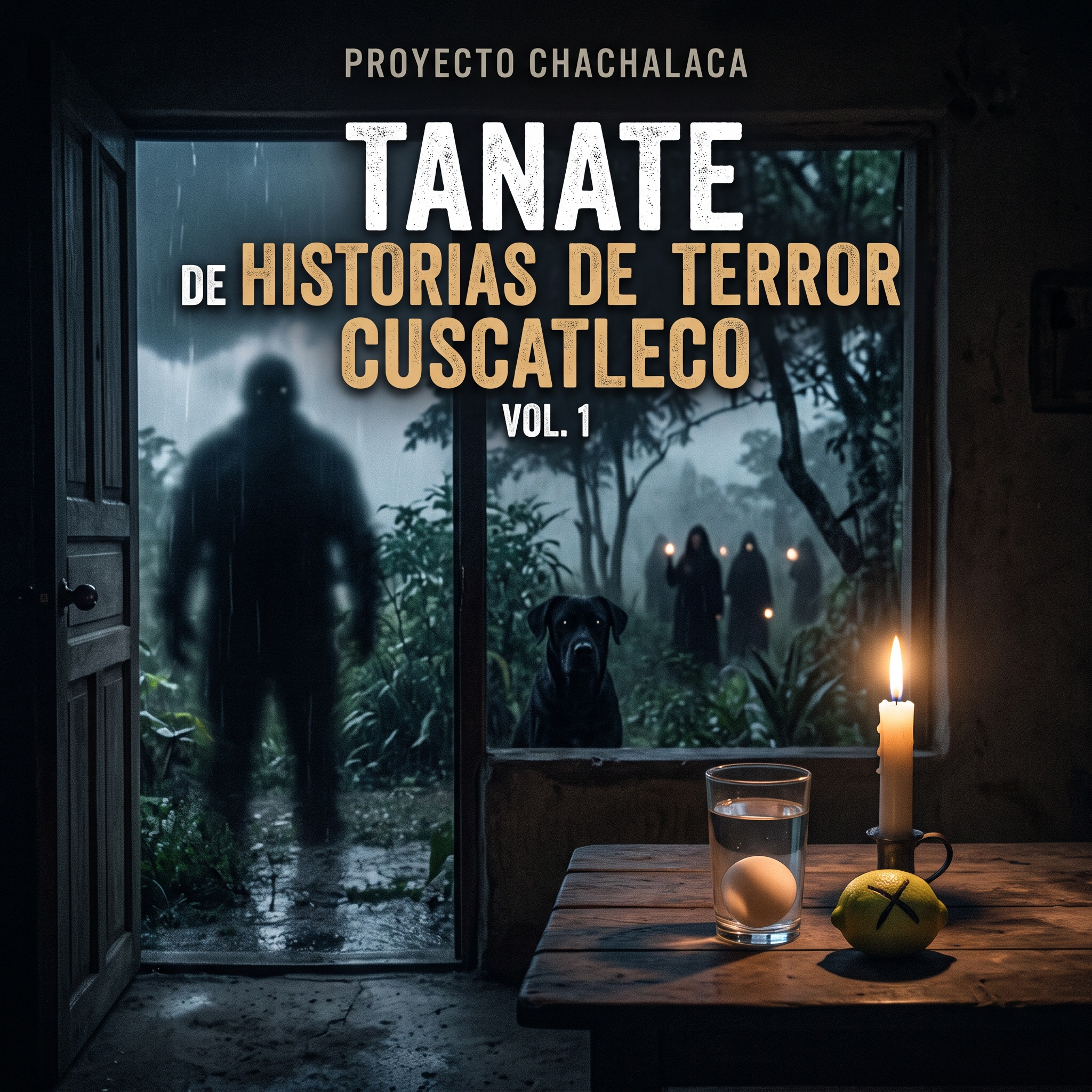
The first long story comes from Rubén. In Santa Tecla, he rented a room to a young guy who worked nights and was rarely seen. When a heavy storm flooded the house, they went in to bail out the water and found a small table with an egg in a glass, black candles, and a lime carved with a cross. Days later, at three in the morning, Rubén saw a burly silhouette peering down from the stairs. A driver from work gave him his diagnosis: an unpaid pact with the devil.
Stories from the Inbox
Carlos reads through the accounts sent in by listeners. One woman shares how her pregnant mother, living out in the countryside, heard heavy footsteps and crunching bones right outside her house. In a town in Cuscatlán, two sisters stepped out at midnight and crossed paths with a silent procession dressed in black; they were handed candles that, by morning, had turned into human bones. There is also an operating room where a gurney rolled around on its own, a nurse in an old-fashioned uniform inside an elevator at the Hospital San Juan de Dios in San Miguel, electrical workers hearing a little girl’s sobs in Las Pilas, and a listener who, as a child, saw her uncle—who had been killed in the war—staring at her through the window.
Burletas in the Hills of Chalatenango
Rubén shares stories from his family in Concepción, Chalatenango. His grandfather once explained what burletas (trickster spirits that mimic familiar voices to lead people astray in the hills, or simply mock travelers) really are. Rubén himself heard clapping and the wet thud of laundry being washed at a waterfall no human could possibly reach. He also recounts the story of a local young man who accompanied an unfamiliar woman into the night and never came back alive, as well as the black dog that barged into his wake.
The Explanations We Always Search For
The conversation sways back and forth between genuine chills and doubt. Were they coyotes, packs of dogs left abandoned when the war emptied out the villages, or something else entirely? Carlos brings up pareidolia, the brain’s habit of seeing recognizable patterns where there are none; Amaru recalls the sound of galloping horses in his grandmother’s yard in Morazán and traditional Nahua conceptions of the soul. In the end, nobody convinces anybody, and the episode wraps up by announcing the next one: the culture of death in El Salvador.
To go further
A bit of our own context to expand on the conversation.
The Souls of the Ancient Nahuas
When Amaru mentions that the Nahuas recognized multiple entities within the soul, he is referring to the work of historian Alfredo López Austin: the tonalli, the teyolía, and the ihíyotl, three vital forces residing in different parts of the body. This idea of a soul that can wander off, get lost, or linger behind helps us understand why so many legends feature roaming spirits or entities that lead the living astray.
Unconfirmed Legends
Spirits like burletas, the Cadejo (a mythical spectral dog of Central American folklore), or the Siguanaba (a shape-shifting spirit who lures men into dangerous ravines) don’t need to exist to hold real power. A recent study on Salarrué’s early short stories shows that the Salvadoran writer drew upon these folkloric figures without ever confirming whether they were real, using them instead as mirrors of rural life. Something similar happens in this episode: what truly matters is what these stories say about the people telling them.
Doubt as a Genre
Having three skeptics spend an hour and a half sharing unexplainable events isn’t a contradiction. Literary theorist Tzvetan Todorov defined the fantastic as precisely that: the hesitation of someone who cannot decide whether what they experienced has a natural or supernatural explanation.
Towns Emptied by the War
The idea of abandoned packs of dogs roaming the hills has real historical roots: during the armed conflict, many communities throughout Chalatenango were displaced, as documented by the 1993 Truth Commission.
A Quick Correction
At minute 77, a local clinic is mentioned as being on the Chalatenango border with Guatemala. Chalatenango actually borders Honduras to the north.
Get involved
Do you have a story about burletas, cadejos, or apparitions from your hometown? Send it to pro.chachalaca@gmail.com or tell us on Instagram at @chachalaca.pro. We might just read it on the next Tanate.
Further reading
- Comisión de la Verdad para El Salvador. (1993). De la locura a la esperanza: la guerra de 12 años en El Salvador. Naciones Unidas.
- Davisson, B. (2025). El mito y la posición del héroe en los cuentos tempranos de Salarrué. Káñina, Revista de Artes y Letras, 49(1), 1–18. View online
- López Austin, A. (1980). Cuerpo humano e ideología: las concepciones de los antiguos nahuas. Universidad Nacional Autónoma de México.
- Martínez González, R. (2006). Sobre la función social del buen nahualli. Revista Española de Antropología Americana, 36(2), 39–63. View online
- Todorov, T. (1970). Introduction à la littérature fantastique. Éditions du Seuil.
You might also like
Transcript
Automatic transcript (Gemini), translated from Spanish and partially reviewed: names and unclear words may contain errors. The episode opens with the after-recording chat; the formal introduction starts at 1:34. The stories Carlos Silva reads were sent in by listeners.
Read the full transcript
[00:00] Amaru: Okay. Rubén, what did you think of the episode?
[00:04] Rubén Guerra: You know, it was really interesting. I mean, I think the topic of the burletas really caught my attention, especially because I think there are way more types of burletas than I thought there were. So, I think it's a case study we can look into out in the field to see what manifestations they have. I found that really interesting.
[00:22] Amaru: Okay. Carlos, what—what do you think?
[00:25] Carlos Silva: I think what I enjoyed most about all this is, first, well, that they shared their experiences with us, and second, uh, it's this kind of broader perspective from people who are sensitive to—to certain strange circumstances, to put a name to these—to these pretty bizarre occurrences. Um, keep sending them in, always.
[00:45] Amaru: Of course, of course, of course.
[00:46] Carlos Silva: And I loved the part about the burletas too, but from the perspective of thinking they could very well be collective hallucinations.
[00:53] Amaru: Mass hysteria. Well, maybe one thing I'd also like to highlight about this episode is how—how something always happens and we always try to look for the logical side of things, and it's kind of a necessity beyond just an intention, because it gives us a certain peace of mind, instead of arguing with the fact and saying, "What happened? What was that we dealt with?" So I hope you enjoy this episode, which is, let's say, also thanks to you, who shared your stories with us. These are your stories, from the listeners of Proyecto Chachalaca, about scares, burletas, things that can't be explained. So here we go. Welcome to the seventh episode of Proyecto Chachalaca titled "Tanate of Cuscatleco Horror Stories, Volume 1." Joining us today is Rubén Guerra, how's it going, how are you?, known as Chalatecus.
[01:56] Rubén Guerra: Right here, you know, all good, eager to see what horror stories people are sharing with us.
[02:01] Amaru: Okay. And joining us for the first time is Carlos Silva, who, uh, volunteered to write up all the stories you sent us during this time. How's it going, Carlos? How are you?
[02:11] Carlos Silva: Pretty good, I hope the reviews aren't too harsh on the other side. And spoiler alert, the stories are pretty fun.
[02:20] Amaru: Wait, fun or terrifying?
[02:23] Carlos Silva: Ah, well, that's a matter of perspective, right? If you like being terrified, then they're fun.
[02:28] Amaru: Do you—do you like horror, Carlos?
[02:30] Carlos Silva: Yeah, obviously, who doesn't? Ah, well, no.
[02:33] Amaru: Yeah, no, no, it's like a taste... No, maybe it's morbid curiosity, right?
[02:35] Rubén Guerra: It's an acquired taste.
[02:37] Amaru: Yeah, of course, of course.
[02:38] Carlos Silva: It's an acquired taste.
[02:39] Amaru: Okay, and—and what about you, um, Chalatecus?
[02:41] Rubén Guerra: Honestly, yeah, I mean, I do like it. I really like listening to horror stuff like that, although I'm also really skeptical, pretty skeptical.
[02:49] Amaru: Decepticon?
[02:50] Rubén Guerra: Decepticon, yeah, Transformers. That's right. It's tough for me.
[02:54] Amaru: Okay. Alright, let's see then, have you ever had a scare, Rubén?
[02:59] Rubén Guerra: Specifically, uh, yeah, several times, which I just ignored. I mean, I always, always try to give it some logical explanation, but there was one where I definitely couldn't. I mean, it was definitely something—something out of the ordinary, so that's the one I'm going to tell later on.
[03:16] Amaru: Okay, and you, Carlos, have you ever had a scare?
[03:20] Carlos Silva: Hm, an actual scare, I don't know, because, well, we're in another state of consciousness, right? I mean, being sleep-deprived, Okay. usually you're not—not—not conscious of whether it's—whether it was real or not. Right. Remember pareidolia, it's serious. Hm.
[03:36] Amaru: Okay. Well, but that's precisely why we're going to talk about those stories that leave us wondering. Let's remember that between the skeptic and the believer, there's always a story in between that's always called into question, and that's what this episode is all about. Well, in my case, let's see, I don't—I don't know, really, if—if I've actually had a scare. I've felt like I'm lying in bed and suddenly it's like something gets up— Sleep paralysis? No, no, no, no, no, like something got up from the bed. Oh yeah, that's—that's happened to me too, right? Like it moved. You know, in fact, I had one of those old-style, um, wooden beds, you put a mattress on top and, well, there you had a bed. A country bed. Yeah, and it was kind of high, so back then I had a little dog, a dog named Coley. Coley would get under the bed and spend time there, she slept there, but, um, sometimes she'd be restless and, well, shake the bed a little. So the door faced—sorry, the bed faced the door, and suddenly I was lying there, there was only a light left on in the hallway in front of the room, and, um, I felt the bed moving, so I said, "It must be Coley." But right then, I mean, I was looking kind of through the shadow at the edge of the bed and—and I saw it like moving, right? "It must be Coley under there." But right then, I see Coley walking down the hallway. Mhm, mhm. And so I said, "Well, I think I'd better go get some water and talk to my brother for a bit," right? I looked under the bed, there was nothing there, and, well, what? I must have been maybe 16.
[05:12] Rubén Guerra: Yeah, it's one of those things where sometimes you're left wondering like: "Fuck, what the hell? What happened here?", right? And sometimes, just to protect your own sanity, you try, like I said, to ignore it or look for a logical explanation, even when sometimes it's obvious there isn't one, right?
[05:28] Amaru: Yeah, or at least we don't—we don't—we don't have it. We don't know the whole... We don't know it, yeah. Well, so, um, if you want, Rubén, go ahead and tell us.
[05:39] Rubén Guerra: You know, maybe just to warm things up, something did happen to me once that was like—kind of unexplainable. It wasn't that serious in itself, but I do think I had evidence to think it could be something paranormal. Uh, three of us college buddies were living together renting a two-story house—two rooms upstairs and two rooms downstairs. I lived in the room downstairs; there were four of us guys back then. One of them left, the other guy who was downstairs with me, so the dude, uh, left and the room became available, right? So we asked everyone: "Hey, look, we have a room," and everyone was already settled, nobody wanted to move, so it was like: "Well, let's put it on OLX," right? Because back then OLX was still around. We put it up, several people came to see it,
[06:22] Amaru: OLX isn't around anymore.
[06:23] Rubén Guerra: No, it's not around anymore, it doesn't exist.
[06:25] Amaru: What?
[06:25] Rubén Guerra: I think now it's called Encuentra24 or something like that.
[06:27] Amaru: Ah.
[06:28] Rubén Guerra: Yeah, I don't know, maybe they rebranded, I really don't know, I don't know. Sorry. Go ahead. But that was also something that hit me recently, you know, feeling that old.
[06:35] Amaru: Yeah, I was looking for a car on there. Okay.
[06:37] Rubén Guerra: Well, the thing was we put it on OLX and suddenly this guy told us he was from Soyapango and that he, uh, worked in Santa Tecla, at a bar. So this guy, uh, said he started work around 2:00 or 3:00 in the afternoon and got off around 2:00 or 3:00 in the morning, right? Something like that. So when I got home from work, the guy was already gone, and when I left in the morning, he was asleep. So in the year he was renting there, I never saw him, never—I mean, I literally never saw him in a whole year. So, well, cool, everything was chill. The guy was—he was kind of like a rocker type, I'd say. I mean, he had this really particular build, kind of short, stocky, like—he looked pretty muscular, I'd say, he wasn't tiny, right? The thing was, I remember one day there was this massive storm—well, one of those many massive storms where Santa Tecla flooded and everything turned into a huge fucking mess—and those little houses there were the kind that have the patio way in the back, right? Like, they have a little patch of a patio, right? So much water was pouring down that the patio drain couldn't keep up, so the water came in and flooded the living room—well, first it got into my room, and then it got into the living room, and then it started getting into the other guy's room. And so I panicked, right? Fuck, and I called the other guys: "Fuck, look, come downstairs!" and we started putting everything up on the beds and on top of the tables so it wouldn't get wet, because the house was flooding, right? Great. So, uh, I even remember that since the house was split-level—first there was the living room and then steps down into the garage—there was even a really nice waterfall inside the house, looked pretty cool.
[08:14] Amaru: You had your own water park right there.
[08:15] Rubén Guerra: A water park. So, uh, what I want to tell you is, okay, once I saw the water getting into the guy's room, I told—I mean, a guy who, like I said, had lived there for a year, but I'd only seen him like twice: the day he moved in and by chance some other day. So, you know, right? Just so he wouldn't say: "Fuck, you opened my door," or whatever, but I told my other buddies who were there with me: "Look"—parenthesis, this was around 6:00 in the evening, so the guy was supposed to be at work, it was a Wednesday, I remember clearly. So, look, when I told them: "Look, I'm going to open his door to make sure he doesn't have anything important getting wet on the floor," right? And as soon as I open the door, man, the first thing I run into right in front of me was a little table where he had, like, an egg dropped into a glass of water, some black candles, and a lime that had like a black cross on it, but upside down, right? It was right in the middle of the candles, right? So, fuck,
[09:12] Amaru: Even I would have said, would have said: "What a bizarre air freshener!"
[09:16] Rubén Guerra: Look, but—I mean, no, but the thing is—look, I don't remember clearly, I mean, because I saw it and it was like: "What the fuck?" Right, like, "Fuck that shit," and suddenly I closed the door, right? And my—and my buddies asked me: "What happened, man?" "Guys, come see this," I told them, and then I opened it for them, right? Fuck, and those guys started panicking: "Fuck, let's kick him out! Blah blah blah!" I mean, and then afterwards it was like: "No, fuck, but if we kick him out he's going—he's going to put a hex on us," or I don't know, I mean, they—
[09:43] Amaru: I'm going to squeeze the lime in his eyes.
[09:44] Rubén Guerra: Yeah, fuck, I mean, no, and they got like... You know, I was kind of chill, I mean, it was just like: "What's—what's the deal, man?" you know.
[09:50] Amaru: Calm down, guys, he just has different beliefs.
[09:52] Rubén Guerra: Yeah, exactly, I said: "Well, whatever, whatever," right? I mean, like that. What I'm trying to tell you, uh, is that, yeah, sure enough, water had gotten into his room, so I told the guys—since they didn't really... what was best for us was not to play dumb, right? Because we didn't want something to happen, right? Cool. So a little later the guy arrived, man, out of nowhere, I mean, and it was really weird because he never came home, especially on a weekday and at that hour, right? And so when we saw him, I was like: "Oh, look," I told him, "just so you know, water got in and all that, check in there to make sure none of your stuff got wet." "Alright, I'll go check," he told me. He locked himself in his room and didn't come out again all night, right? And I saw there was water in his room, right? So I said: "Fuck, this dude is weird," I mean, he stayed inside the room with the water in there, but whatever, I was like: "Fuck, that's weird," right? Well, the next day I went to work, right? And I went and started telling everyone, right? Fuck, and all my female coworkers were like: "Fuck, kick him out, blah blah blah," and others were like: "Nah, it's bullshit, whatever," right? Like, totally random. The thing was that, uh, that was a Wednesday, like I said, cool, nothing much happened. I remember clearly, the following Wednesday of the next week, just like that, but truly, completely out of nowhere, I remember I woke up, I had to use the bathroom, right? Cool. So I left my room, and to give you an idea of the layout, say, when you walked into the house, first there was like the hallway with the stairs going up to the second floor, then there was that guy's room, and then there was my room, and across from my room was the bathroom. So it was 3:00 in the morning on the dot, dead on, dead on, dead on—I remember checking my phone, I opened the door, and I wanted to go to the bathroom, and the light inside his room was on. He only had those louvered glass windows—solaires—he didn't have curtains at that time, right? So since the light in his room was on, the light kind of spilled into the bathroom, so to speak, right? So I went, and since I was half-asleep I didn't want to turn on the light, right? I just went to the bathroom like that, and while it was quiet, I remember—well, then I flushed the toilet, right? And I turned around, and I remember seeing through the solaire that, right on cue, he walked over, turned off the bedroom light, and then I saw what looked like a computer screen through the solaires, right? And I saw him walking back toward the bed, and I saw the light shift position, like he lay down with the screen, right? Cool. And I went—like I said, I think I tend to see pretty well in the dark,
[12:23] Amaru: No, and also, I was going to say, for a trip to the bathroom around 2:00 or 3:00 in the morning, you were seeing pretty well through that solaire.
[12:29] Rubén Guerra: Yeah, no, I mean, you know, in fact I have very good, very good night vision, right? What I'm trying to tell you is—here's the weird part. Okay, when I walked out and went, like, between those two rooms, where I had the water jug, and I was getting water... You know, I feel like standing up and going over there just to show you an example of what I saw. I'm going to do it—well, but the audio will pick it up. The thing was that— Okay. I was, I mean, I was looking toward, like I told you, toward the living room, where the stairs to the second floor were, and suddenly someone peeked out from the wall, like this.
[13:01] Amaru: Wait, and the dude was already in his room?
[13:04] Rubén Guerra: Yeah, exactly, and someone clearly peeked out like this, you see? And I drank some water and just stood there like: "That's weird," I said. Dude, look at how I get just remembering it.
[13:12] Amaru: For those listening to us, he—he's got goosebumps, he's got goosebumps. Totally, right? We all know that feeling.
[13:20] Rubén Guerra: Fuck, okay, look, the thing was that, I mean, when I saw it, it was like: "What the fuck?" I said, and I didn't pay much attention to it, I said: "Fuck, I'm—I'm seeing things," like my grandma says. I went to get more water, dude, and right then I saw it slip back behind the wall again, like behind the hallway, right? Toward—toward, like I said, toward the stairs to the second floor. When I went to get more water, dude, it came all the way out—I mean, now I saw its full body, and it had a build, how can I describe it, kind of similar to this roommate guy, like kind of stocky, but it was a little taller, right? Look, and I just remember that I stared at it like: "What the fuck?" right? I put the glass down on the little table, went into my room, and locked the door. And once inside my room it was like: "Wait, if I saw the dude turn off the light in the room and—and lie down, who the fuck was the one outside? Fuck that shit," I said, and that's when the paranoia hit me and I was like: "Fuck, what the fuck did I just see?" Because look, I mean, I didn't really see a face, but I did see a very clearly defined silhouette, and since the house door was one of those doors with glass panels, right? Mhm. The streetlight filtered through, so you could definitely see the silhouette clearly. So I looked, I mean, I was like: "What the fuck?" I mean, and believe it or not, I went back to sleep, you know? Because I was like: "No, fuck, maybe—I mean, really, I'm just being an idiot, blah blah blah," and I kept lying to myself like: "No, it can't be, I'm making it up, it's all in my head," right? The thing was that the next day when I woke up, that feeling lingered with me again, right? And: "Fuck, blah blah blah." So, uh, I remember that day at work I was heading out to Oriente, and so I was riding with a driver. And you know company drivers—they know more than the devil himself, they know everything, they're as hardcore as they come.
[15:08] Amaru: No, no, first cab drivers, who—
[15:10] Rubén Guerra: It’s pretty much—pretty much the same vibe. The thing is, I went and told him everything I just told you guys, right? And that guy tells me: "Look," he says, "my mother-in-law is a witch," he says, "and that kind of stuff happens for two reasons," he says, "one, he made a pact and hasn’t kept it, or because he’s being—or because he kind of offered someone to—he offered a sacrifice and hasn’t kept it either." "Cut the crap," I tell him, yeah, "what the fuck am I supposed to do with—with—with that guy in there?", right? The thing was that he told me, right?, like: "If—if you see that figure again," he tells me, "talk to it." "Cut the crap," I tell him, "what the fuck am I gonna say to it? 'Good afternoon!'", I mean.
[15:53] Amaru: "Hello! How's it going? How are you? Just passing through?".
[15:57] Rubén Guerra: "How’s everything on the other side?", I mean.
[15:59] Amaru: "Yeah, excuse me, and how’s hell doing?".
[16:01] Rubén Guerra: "Damn," I mean, look, and: "Cut the crap," I tell him, "what the fuck am I gonna say to it?". "Ask him what he wants," he told me. "No fucking way," I told him, "and if it tells me it wants my soul, what the fuck am I gonna tell it?".
[16:12] Amaru: No, I mean, without consent it can’t, Rubén.
[16:16] Rubén Guerra: No, look, I mean, so then I went and the thing is that in the end he told me: "Look, but tell your other," the—the only reasonable thing he told me was to tell my other housemates, right? I went and told the guys, fuck, why did I even bother?, they panicked more than I did, right? And then they started going: "Fuck, that white guy, and I don’t know what," and then the conclusion was like: "Well, we better not," right? One of them told me about a week later, the following Wednesday, because those three events were on Wednesdays, that he says he was right there working in the living room and I don't know if it was because of the paranoia the guy already had, but he says he saw that same shadow again, just like I described it to him, right there walking upstairs.
[16:50] Amaru: And did he ask it: "What do you want?". Did he ask it?
[16:53] Rubén Guerra: No, but he says he just saw it like slip inside and that he panicked, right?, that was it, I mean, he didn't—didn't ask it. The thing is, man, strangely, about a week later the guy said: "Look, so I’m changing jobs, whatever, I’m leaving, thank you very much," and he left, and he left out of nowhere, right? And the thing is the room just sat there, you know, then, well, we put it back up on OLX, like two other people lived there afterwards and no one ever said anything to us, no one ever told us they had seen a shadow or anything, and I didn't tell them the story either because folks would panic, right? But you know, honestly, I mean, I am absolutely sure that I did see that shadow and I don't see any logical explanation for it, because it makes no sense that there was another person outside the room, and if there had been, they wouldn't really have a reason to hide either, or I don't know, I don't know, I don't know, but—but I don't think it was maybe a
[17:46] Amaru: Yeah, like someone was living there, I mean I'm saying, or like he—I mean if you try to make sense of it, that means there's—there's him and there's another person there.
[17:56] Rubén Guerra: Well, it would've seemed that way, you know, but imagine that maybe he had brought another buddy over, right?, Yeah. but why would the buddy hide?, would he come out?, I mean, and if he wanted to scare me, I mean, I don't know, it was kind of weird, right?, Mhm. because you're not gonna scare the roommate of the person who invited you to their house like that, I don't know.
[18:14] Carlos Silva: I don't know if he was friends with a guy who had an egg and a cross in a lime, I mean.
[18:18] Rubén Guerra: Could be, yeah, yeah, damn straight, I mean, could be, but—but the fact is I saw it, I saw it, I mean.
[18:25] Amaru: Yeah.
[18:26] Rubén Guerra: But—but maybe, you know, I think out of several things maybe that’s been like the most intense thing that’s happened to me, right?, I mean. What this—this driver told me was that, right?, that maybe he had uh promised something that he hadn't fulfilled and that's why—well, that he told me the lime meant protection and that's why the cross and the candles too, I mean, that whole deal, like he was looking to protect himself from something. And once he left, we never had any other incident like that in the house again, right?, so I think it might go along those lines, you know.
[18:55] Amaru: That's crazy. Mhm.
[18:56] Rubén Guerra: Maybe it's along those lines.
[18:57] Amaru: Maybe, right?, yeah.
[18:59] Rubén Guerra: Mhm.
[19:00] Carlos Silva: Yeah. Bad, weird mixes for drinking tequila.
[19:03] Amaru: Yeah, yeah, I mean. It's really interesting. It's—of course, I mean, weird air freshener.
[19:07] Rubén Guerra: Could be that too, yeah, could be that too, but Yeah. But, like I tell you, I mean, I haven't found like a logical explanation for it, honestly, I mean, it doesn't—it doesn't make
[19:18] Amaru: Where it comes from, where it pops out of, no, it has no real
[19:19] Rubén Guerra: it doesn't make that much sense to me, so, that I think has been like my most explicit experience, you know. Mhm. Somewhere around there.
[19:26] Amaru: Right. Okay, yeah, it's just that—it's just that if you try to find an explanation for it, it's weird at the end of the day, right?
[19:35] Carlos Silva: One of your housemates sleepwalking maybe, but
[19:37] Rubén Guerra: Thing is, it wasn't, because it didn't look like the silhouette of—of the other two buddies, the other two were tall and skinny, like that, and this one did have a build very similar to the—to the little dude's, right? In fact, I almost would have sworn it was him, you know, I mean, except he looked like a little bit bigger, bigger, I mean, sturdier, I'll tell you, right? Right. So, that's kind of how it went.
[19:57] Amaru: How—how—how crazy, how crazy.
[19:59] Rubén Guerra: Yeah, you know, I think it’s been the most intense thing that’s happened to me.
[20:01] Amaru: Well, Carlos, do you have something here to tell us?
[20:05] Carlos Silva: It's—it's not—it's not authored by me and it's not my property either, right?, but uh the people who—who listened to the previous episodes uh took on the task of sharing their anecdotes, and I'm going to read one from—from one of the young ladies who shared one of her experiences with us.
[20:20] Amaru: Or it might not be a young lady because it's anonymous, Carlos, it's anonymous.
[20:24] Carlos Silva: Yeah, that's true, it's not a young lady. But anyway, what can I do? The story starts with an "ever since I was a little girl." Ah. So, yeah, yeah, sorry. I ruined the—I ruined the anonymity. Yeah, you already said it. Miss, if you're listening to us, it was an accident, I just wanted to keep the mystique. the essence of—of—of the story. Well, she tells us that since she was very—since she was very little she always had like a peculiar gift, uh she encountered paranormal things, but she takes it back and says that maybe not paranormal, but rather different, just strange occurrences, Yeah. she describes them that way. And—and—and her narrative starts from a very young age, honestly, uh she recounted this whole bunch of experiences. In—in the story, uh from her perspective, narrated as an anecdote, I'm going to read it that way so—so that it keeps the—the essence of—of what she—she shared with us. "I remember how my grandmother would stress that this business of attracting strange events had been happening ever since my mother was pregnant with me, and every time that phrase appeared on mamita's lips, she would tell an anecdote to prove it. This is one of those stories: On one occasion my mom came to visit my grandmother's house; back then she must have been about 8 months pregnant. My grandmother lived in a mountainous area, uh with her neighbors' houses very far from hers; like I said, it was mountain, meaning, it was the countryside. Night fell and my parents decided to stay and sleep at my grandma's house. It was an hour before midnight and—and very curious noises began to be heard outside the house; they sounded like footsteps on grass and—and like the sound bones make when being crushed by some animal's teeth. Hearing those deeply unsettling noises that were getting louder and louder and felt closer, my aunt's husband yells at my father: 'Go out and check, it's probably a coyote or some mutt.' Uh my cousins, who were still very little back then, remember that when my dad went out to scare off that mysterious animal, those strange noises began to get louder and louder and higher in volume. Uh that night was a night where nobody could get to sleep. My grandmother always maintained that dark and evil presences exist, and the most sensitive people can perceive their manifestations in the realm of the living."
[22:37] Amaru: Strange.
[22:38] Carlos Silva: Sounds—sounds a little bit like—like the cadejo thing, right? I mean.
[22:42] Rubén Guerra: Yeah, you know, that’s what I was gonna tell you, that it reminded me of the cadejo.
[22:45] Carlos Silva: Except without the whistling, but with a sound that's a little bit more disturbing apparently, because bones crunching and footsteps that seem to get closer.
[22:53] Rubén Guerra: You know, in fact, not long ago with that whole Halloween theme, a post popped up on my Instagram where they explained to me that a lot of the sightings that people sometimes say have been the chupacabras, I mean, a lot of the incidents and the animals like that, have actually been coyotes with rabies, because they alter their behavior, they tend to act more aggressively, they attack livestock and all the rest, right? So, suddenly trying to find a logical explanation for it, maybe it could be along those lines, right? Coyotes, if it's a mountainous area, it could be coyotes, right?
[23:28] Carlos Silva: At least those are the ones we have classified; other than that I don't know, stray dogs could be, that go out to the Yeah, because mutts sometimes in the woods, I have noticed they do that, that they go out on their nighttime prowls, right?
[23:41] Amaru: Actually, you know there was a period during this—well, you know that during the war some towns in Chalatenango uh displaced themselves, they left their—their residences, and the dogs were left behind in those areas. They—they were telling me that when the war ended, the Peace Accords are signed and people, well, try to return to their—to their homes, to the towns where they normally lived, they would find packs of dogs, which with the passage of time, the years that they were out there, were already large packs, they were already wilder dogs, more, so to speak, more feral; having had no contact with humans, it became a matter of hostility every time they saw a person.
[24:23] Rubén Guerra: Yeah, how interesting, that.
[24:24] Amaru: Yeah, it's uh let's say it's a behavior that if you think about it: "Okay, uh the humans left, the dogs stayed behind in the area, they ate, they hunted, they reproduced, and at the end of the day when they came back it was already an issue of—of territory, they already lived there and, well, they saw people as—as the enemy that wanted to."
[24:45] Rubén Guerra: Yeah, mhm, yeah, it could—I mean, it could be a valid explanation for that phenomenon, right? However, it's also true that there are a lot of people who are much more susceptible to that whole kind of phenomena, right? And if starting from the pregnancy it marked a—I mean, a beginning of a series of events, well, even more suspicious that it's along—along those lines, right?
[25:05] Carlos Silva: Oh, it's very peculiar that she mentions that when someone went out to scare off this canine, uh actually the noises instead of decreasing or seeming to move away, started increasing in volume and—and got closer.
[25:19] Rubén Guerra: Because you know I've also heard, I don't remember, in Mexico I think they have like some belief over there about an animal, I don't remember what it's called, but that also kind of like the closer you hear it, it's like better, because they say that the closer it sounds it's because it's further away, and the further away it is the more— I mean, something like that, right?, I don't remember how, but like they have that—that—that quirk, right? I don't know, maybe it could be an animal like that too, mythological.
[25:44] Amaru: Yeah, I mean, but never having been seen at all, and it's just like way too strange.
[25:50] Rubén Guerra: Yeah, and you know this story just reminded me of one that like an—an aunt of my grandmother used to tell, uh because over there in Chalate maybe uh well, Chalate has 33 municipalities, right?, and it's a ton of tiny little towns scattered around, I mean, there aren't really big concentrations, but rather life in Chalate, so to speak, is more rural, right? And there are like hundreds, I don't know how many thousands of cantones. So you know uh for those who are from Chalate or if anyone knows around that area, the thing is that there's the town of Concepción, which is kind of where my family is from; in the middle of Concepción there are two cantones, one called El Pepeto and then there's La Junta. To give you an idea, imagine that Concepción is downtown San Salvador, uh El Pepeto it's called there, it's like it was in Soyapango, let's say, and there's another one called La Junta, which is like in Ilopango, just like in a straight—a straight line, right? So you know my grandmother used to tell like there was an older guy named Juan, it seems they say he was, I don't know, maybe he turned out to be family of mine I think, because he was uncle whatever, I don't know, something like that. The thing is that this older guy, like they say that he was—like he had done bad things, right?, like he was bad, she says.
[26:58] Amaru: But by bad do you mean like a—a cattle rustler person or do you mean?
[27:02] Rubén Guerra: Yeah, like a person who did wicked acts to—to others, right?, I mean. Ah, okay, okay. I don't know if he was Yeah, like a thug person, something like that. So you know they say that supposedly he—I mean, like he was still kind of a kid, right? So back then everybody just—just traveled on foot, so leaving the town of Concepción they say a really pretty girl caught up with him, right?, who they say that she told him like she was heading toward La Junta, which La Junta, I insist, is further along, right? Like I tell you, like let's say he lived in Soyapango and the girl was heading toward Ilopango, I mean, just like in a straight line, right?
[27:34] Amaru: They could walk together, something like that.
[27:36] Rubén Guerra: Yeah, so like they say that on the way they started talking and I'll tell you they became sort of sweethearts during that—during that walk, like an hour and a half maybe that it could have been, right? So they say that when they reached this cantón, since it was already dark, uh this older guy's mom, I mean, that—that the girl was saying to—to this older guy's mom, right?, like: "Look, do me the favor of having him walk me home because I have to go from here to over there by myself and whatever, whatever," right?, and that the woman tells him like: "Alright, go on and walk her," and they say the girl told her: "I'll send him back to you on the first bus tomorrow," she says she told her. So they say the girl
[28:13] Amaru: Looking weird already, Carlos.
[28:15] Rubén Guerra: No, you know—you know it does, I mean, it looks kind of weird, yeah, sounds like an episode of Cheaters.
[28:20] Amaru: Yeah, or more like suddenly she's gonna say to him: "I'm your cousin," she's gonna say to him.
[28:23] Rubén Guerra: Look, the thing is that's what they say is weird, because you know that in small towns everybody knows each other, even between one cantón and the next, right? And with that girl, like they couldn't place her and couldn't find any reference to what family, nobody—nobody had ever seen her, and—and I insist, from the cantones people know each other, right? Right. So the girl, they say she told her like: "Look, I'll send him back to you on the first bus tomorrow, let him go walk me," right? They say that as soon as he stepped out of the house, already in the dark of night, like all the mutts in the cantón started to—to bark, right?, and to howl and whatever, and they say that it sounded like they were dragging a big heavy chain along the rocky road, right?, and that it sounded like a chain dragging along. Well, the next day came and the first bus came by, right? So they say that a man got off and told her that: "Look, you should know they just found him dead," right?, uh over by—by Chorosco, whatever. So then they say that what happened was like he had—had run off because he was like in a pasture and like he had shot himself, I mean, because—and they say his face was like disfigured from terror, from what they say. Nobody had any reference to the girl, I mean, they tried looking for her and no, that girl around here nobody—nobody knows her, right? So people were gossiping like it was an apparition that came to get him and that when the moment came she transformed, and he got terrified and preferred to just shoot himself. So they say that when he was at the wake, I mean, they were holding a wake for him, and back then there was no electricity, right?, so with—with some candleholders. So they say that when the moment came at the—and well, they mostly made like the—the oil lamps, right?, with kerosene for light, so they say that suddenly like a really big black dog got into the living room where they were holding the wake for him, and they say that it knocked over the coffin, the coffin fell, and it knocked over the lamp and caught fire, man.
[30:11] Amaru: Meaning, the dog came in and knocked it over.
[30:13] Rubén Guerra: It knocked the box over, the box fell, hit the oil lamp, the oil lamp spilled all over it, and it caught fire. So they say, I mean, it was something pretty shady up to a point, right? Like, I mean, like, there were already so many strange facts surrounding Too strange. that incident, right? So it catches my—I mean, it reminded me of it because of what you mentioned about the dogs, right?, making noise at night, and I don't know, maybe out of nowhere if it was some mysterious thing, maybe there's some connection between these two stories, right?, out of nowhere, right?
[30:45] Amaru: The black dog, always like the cadejo, right?
[30:47] Rubén Guerra: Could be.
[30:48] Amaru: It's just that there's that—that belief that when dogs bark, um, it's like something is happening, something is going on around there.
[30:55] Rubén Guerra: When they howl, when they howl most of all, I mean, well, at least in town it's not so much when they bark, but you know, like, there are beliefs that get drilled into you since you're little. When I, uh, I mean—sometimes at night, at midnight, I'd hear dogs howling; if they bark I don't get scared, but if they howl I do, you know? If they howl, I'm wrapping myself up in my doctor-prescribed holy blanket so nothing happens to me, but yeah, when they howl, yeah, I've heard it's because something—something weird is lurking, right?
[31:22] Amaru: Yeah, you know, it's been a while since I heard that, but here in the neighborhood, when I was little, I remember hearing from time to time, like all the dogs, man, all, all, all, all the dogs in the neighborhood would start barking and you could hear it everywhere, something that really made you stop and think: "What—what could it be? Why are they barking? What could be happening?", right?
[31:45] Rubén Guerra: You know, at one point in Chalate they told me about this belief—it's gross, but taking it into practical terms—supposedly dogs can see things that we can't, right? Mhm. So there was this legend—I don't even remember who told me because I was really little—where they said that if you put the eye boogers that come out of dogs' eyes on yourself, you can see what they see.
[32:06] Amaru: I'd heard that before.
[32:07] Rubén Guerra: Uh-huh.
[32:08] Amaru: Yeah, it's true, but that— I heard it when I was little.
[32:10] Rubén Guerra: Because, you see, in the town there was this crazy guy apparently, in San Luis La Herradura, he passed away now, but people mentioned that he'd gone crazy from something like that. I remember—but I'm talking about when I was around 5 years old—I asked why he was crazy and they told me something like that, that he had done that, right? From then on he saw something and lost his mind, which is like another—another origin of madness itself, right?, suddenly like that in small towns, that someone went mad because they saw something.
[32:36] Amaru: I'd heard that too, that people could suddenly end up messed up, like— A traumatic experience. Yeah, yeah, of course, of course.
[32:43] Rubén Guerra: Yeah, right, a traumatic experience, right? So, like I'm saying, I mean, maybe dogs really do have that—
[32:50] Amaru: Ability to see.
[32:51] Carlos Silva: Like a sensitivity.
[32:53] Rubén Guerra: Yeah, like being—like how they react to tremors, to the onset of tremors. For example.
[32:58] Amaru: That's true, that's true. The same thing I'm telling you, that the dogs would start barking, not barking like they were talking to each other, but suddenly it was maybe because cats were passing by, but still it always gives you that feeling of, "What could be happening?"
[33:13] Carlos Silva: It's very unsettling.
[33:14] Amaru: It really is, it makes you feel really uneasy.
[33:16] Rubén Guerra: Yeah, it's very unsettling and at—I mean, up to a certain point also, well, inexplicable, I mean, it leaves you like: "What's going on?", right?
[33:23] Amaru: Rubén, have you heard of burletas? Do you know what a burleta is?
[33:28] Rubén Guerra: You know, one actually appeared to me once. I mean, once one appeared— I mean, that time was really, really, really—
[33:34] Amaru: Wait, a burleta happened to you?
[33:36] Rubén Guerra: Yeah, a burleta appeared to me once, it's just that, look, my grandfather does mention that burletas can be of several types. Mhm. I've heard that—I didn't remember that time with the burleta, About the burletas, yeah. Yeah, alright, what happens is that burletas, according to my grandfather, right?, and I imagine this must vary across the country, there are like two types: there are some that they say want to make you get lost; according to my grandfather, suddenly you're up on the hill and you hear your mom calling you: "Amaru, Amaru!", and you hear her over there, you go to look and then you hear her further and further away until suddenly you get lost, right? Mhm. And others that just kind of laugh at—at you, right? So, well, I remembered once that—
[34:09] Amaru: Or that one about laughing, you know, I also have—let's say in my memory—a couple of stories related to burletas, and it seemed to me more like they were related to scaring you away.
[34:21] Rubén Guerra: Well, yeah, rather, because look—well, I want to tell you this one that happened to me, right? I mean, in my town I really like going for walks up the hill, right? And, you see, uh, there was a—there's a hill where you walk and you pass above a waterfall; it's a waterfall that drops maybe about 15 meters down. Look, I've looked for a way to climb down to that waterfall, but there are ravines and thick brush everywhere, so to this day I haven't found a way down, right? So one time I was coming down with a little cousin of mine who was littl—well, he was little back then, he was maybe about 10 years old, right? Back then I must have been around 25. And as we were coming down, below the waterfall it sounded as if—first, look, I think it was a burleta, well, yeah, according to my grandfather it was a burleta, because at first it sounded like when you slap a wet shirt against a rock.
[35:09] Amaru: Like when they're washing clothes on a washing stone.
[35:10] Rubén Guerra: Yeah, smack! So I just stopped there and told him, "Listen, do you hear that?", I said. "Yes," he told me. And right then they started clapping, but like—
[35:24] Amaru: Like in a sequence.
[35:25] Rubén Guerra: Yeah. Look, look, I got chills again, honestly. So, you know, I just went and stood there like— But I insist, I mean, I would have thought something else,
[35:37] Amaru: Me too, right now I'm thinking something else, honestly.
[35:39] Rubén Guerra: but—but the thing is, there's no way to climb down to that waterfall, and it made no sense—
[35:43] Amaru: No, I don't know, you see, I'm going to—I'm going to tell you, I feel, I believe, I think that certain urges can overcome anything, even physics, I don't know.
[35:52] Rubén Guerra: I've tried it myself and I know for a fact you can't, I know for a fact you can't, you see, but—but look, the thing is that the clapping was also, like, really rhythmic, I mean, very, very repetitive.
[36:06] Amaru: Look, Rubén, one can be an artist in those moments too.
[36:12] Rubén Guerra: No, no, no, but the thing is it was— No, but you know, also, I mean, that waterfall has some visibility because it's not like a sheer drop, I mean, you can see the bottom, but I didn't see anything. Mhm. And so I just told him, "Listen, let's go," I said.
[36:26] Amaru: Rubén, a question: there's the drop, 15 meters, but can you get there from another side? Mhm.
[36:33] Rubén Guerra: I mean, you'd have to head down the ravine, but—but it's another way that's really far, I mean, and it's really overgrown, I mean, it's very overgrown there, you'd have to go machete in hand cutting a path, I mean, it's really complicated.
[36:45] Amaru: Well, sometimes I don't know, I—I think there are— Look, it's just that there are—there are explorers all over the country. Explorers, exactly.
[36:53] Rubén Guerra: But I don't think so, you see, maybe not to that point, no. What I'm trying to tell you, and I think this was what finally convinced me the most, right?, Mhm. I was left with that feeling like, "Fuck, that's weird," I said, and we got to my grandfather's place: "Listen," I told him, "this and that happened to us," I said, "it sounded like—like clapping, oh!, and didn't it go like..." And my grandfather imitated it identically, and I was like: "No fucking way," like, "Yeah," I tell him. "Ah, then it was a burleta," he told me, and I was just like: "Okay." Okay. I mean, but—but you know, it really— I didn't ask him anything more, right?, he just validated that it had been a burleta, and since for me whatever he says is gospel, right? Yeah, yeah, yeah. So, uh, I was really surprised that he made, like—I mean, that he really knew the sound, you know? And he does say that all the time a whole bunch of things like that happened to him. So, uh, I think, for example, that—that time I really was left like: "Fuck, that's weird," right?, I mean, because it's the only time—I've camped tons of times and I've climbed that hill by myself 40,000 times, and I've never seen or heard anything except that one time, which just seemed like a weird, Mhm. curious occasion, right? And I insist, I mean, from that—I mean, at least at that point it makes—it makes no sense for anyone to have been down there.
[38:09] Amaru: It would have been very, very difficult to reach— It really would, I'm telling you, I've tried because I've wanted to take photos of that waterfall.
[38:14] Amaru: And—and do you see a pool at the bottom? What do you see? What can you make out? I don't know.
[38:18] Rubén Guerra: The thing is I don't know, I mean, I can't see right where it ends, I—I couldn't even see it Mhm. because, like I'm telling you, it really is very rough, and the trail is like kind of a V-shape, let's say, so you see a certain angle from here, a certain angle from here, but you don't see the drop itself, and because it's full of trees too, so it's not easy, I mean, that's why I'm telling you, it seemed weird to me.
[38:36] Amaru: It takes some skill to get there.
[38:37] Rubén Guerra: It really does, it really does. And you know, my grandfather, I mean, like all grandpas— They have plenty of stories, and mainly grandpas who live out in the country. Out in the country, you know, he also has one that I think is pretty good, right?, where he says that back then they were building the town's school, right?, so he says they had dropped off a shitload of materials, bricks, iron rebar, and all those things at the site where they were making the school, and my grandfather says that they had built like a small tin shed, right?, and that they paid him to sleep there, just to watch out so people wouldn't steal the materials at night, right? Just to have a presence there. So he says that—well, and in fact that mango tree is still there at the school, you know—so he says that the tin shed was right next to a mango tree, an enormous mango tree that's there, and you know, he says that suddenly he heard as if something was up in the mango tree, right?, and he says it sounded like they were violently shaking the branches up there around 2:00 in the morning. Today the school is maybe about 1 km from town, you see, so it was in a very remote place, so he says he wasn't with a single soul, right? Mhm. So he says that when he went out, man, uh, around 2:00 in the morning, he started shining his flashlight up, right?, into the mango tree, and dude, he says they were lowering a coffin down from the mango tree, and that the box was coming down, like, he says almost dropping, that it was banging against the branches and who knows what, right? I just got goosebumps all over again. Yeah, yeah. So, holy shit, he says he took off like a rocket, dude, I mean, he says he took off like a rocket toward town, and he knocked on the first house he saw, at Niña Lula's, I think he said was the old lady's name back then, and once there he almost knocked her door down, and he told the lady, and she even gave him a little chicken soup to help calm his nerves A little broth. at 2:00 in the morning, something like that, right?, but—but anyway, those are, like I tell you, one of the occurrences he tells, right?, which also seems pretty Curious. pretty curious, honestly.
[40:43] Amaru: I think someone already sent us a story about a burleta, right, Carlos?
[40:46] Carlos Silva: Oh, yeah, someone shared a story about a burleta with us. Um, I can read it. Um— Well, another listener— Is it—is it—is it another listener?
[40:55] Carlos Silva: Yeah, because— Yeah, yeah. Oh, I can't keep it anonymous because it depersonalizes the story. Oh, okay, okay, okay.
[41:06] Carlos Silva: Uh, she tells us that: "My grandma told me that when she was little, her mom would go to the rosaries, vigils, and novenas held at the church. They lived in a town in Cuscatlán, so she and her sisters sometimes stayed home alone until dawn. Since they lived in a village house—one of those that have a pit latrine out in the yard, and the yards were huge—they had to walk for quite a while in the dark to get there. The other option was the banana grove, but both places were in total darkness. So they decided to go out onto the sidewalk in front of their house, out on the street. Since it was already past midnight, they decided to all go together in a group. There was no one on the street, and the only light was from a lamppost, so they did their business right there. As they were going back into the house, or well, trying to go back into the house, they saw several people with little lights turning a corner in the distance. Since processions and prayer services were common at night in town, they thought they could stay; maybe their mom was among them too. So they waited. When the procession drew close, they saw that all the people were dressed in black with mantillas covering their faces, all carrying candles of all shapes and sizes. Not a single word was heard, nobody said anything; the only sounds were their almost shuffling footsteps. As they passed in front of them, they handed each of them a white candle without saying a word. When they reached the corner of the next block, the people were disappearing into the darkness. My grandma and her sisters started to feel sick, their bodies felt heavy, they couldn't move or speak, and after that, they don't remember anything from that night. The next day, their mom told them that she had found them all pale, shivering with fever. When one of them regained consciousness, she told her what had happened and wanted to show her the candles; when she checked, there were bones instead of candles. Her mom called the priest, and he prayed over them and told them that what they saw was one of the burletas that passed through that town at night. After that, they never went out into the street past midnight again."
[43:01] Rubén Guerra: Damn, but there are no burletas like that in Chalate, man, I mean— Yeah, yeah, it's very elaborate. that burleta is way more intense.
[43:07] Amaru: Yeah. You know, uh, well, at one point my dad was in charge of a property, a—a plot of land. There was someone there, um, who was the one who did like the—let's say took care of it, he was like the night watchman. That person was murdered, murdered right on that property, so something very peculiar happened: after the person passes away, the investigations take place, and the case moves along. But suddenly, when new people moved in to live there, it was a thing where burletas were happening constantly, things were happening that wouldn't let them sleep, that scared them at night, so it was really such a peculiar thing, Rubén, and firsthand one of the men who was there told him—and he was one of those people who had lived through the war and, well, let's say that, uh, he wasn't afraid of many things. Now, I knew the house; the house was on a plot of land, let's say, there were lots of trees, stairs to reach the house, and a dirt walkway to one side, but it was small, I mean, the space is—is minimal, I mean, for what I'm about to tell you, it was like a minimal space. So what he recounted was that one night he woke up because he heard an incredible number of horses, something just—just wild, like you can imagine at least 200 horses running through there.
[44:46] Carlos Silva: It was quite a roar then.
[44:47] Amaru: Yeah, it was something intense, I mean, for it to have woken him up, and—and so he says he went outside, right?, and he saw the horses running around the house. I mean, and he—what can I tell you?—I mean, he had no reason to lie, he didn't say it out of fear, like: "Oh, this, that, and the other." So over time, from what they tell me, it was something where they ended up doing a kind of ritual, like, in the Catholic liturgy to perform a purification process. Still, it always leaves me with doubt, I mean, regarding burletas, let me tell you. When I was little, we went to stay at my grandmother's house, it's in Morazán, in a town called Sociedad, in the—well, in what used to be my grandmother's house. So I remember one night I was lying down and suddenly I opened my eyes, looked at the window, and through the window there was like a light, street light was hitting it, a lamppost, and then I could hear a bunch of people in the yard, because it had a big yard on that side, right? H-how? I don't know what you call that kind of layout, but it's as if you had a house and had small structures along the edge of the fence of—of—of like a city block, Mhm, mhm. I wouldn't know how to describe it, and in the center there's like space where you can park vehicles, Yeah, uh-huh, uh-huh, uh-huh. It—it—it was, let's say it's very nice, but it was like a kind of estate compound, I wouldn't know how to tell you, Mhm. so I heard people shouting: "There it is! There it is! It went up on the roof! It went up on the roof! It's over there now! It jumped to the barn! It jumped to the—!", and something like that, like a whole bunch of people chasing something. Mhm. I remember it, and I remember it knowing I wasn't asleep; I remember it and I was trying to understand what it was they were trying to hunt down. The next morning I asked, and nobody could tell me a thing.
[46:39] Rubén Guerra: You know, sometimes I also, uh—well, I don't know, I'm going to tell you, I think this is like a theory of mine or something I made up, I don't know how to put it, but you know, sometimes I feel like there are sounds that get kind of trapped in time. Like suddenly you hear—I mean, maybe nothing is happening at that moment, but rather it happened at some point, and it's like a cassette tape playing back, right?
[47:01] Amaru: Like it was recorded there.
[47:02] Rubén Guerra: Because, you know, I've also been like all alone in the house sometimes, and suddenly I hear my mom calling me and my mom isn't there, right?, and it's like: "What the hell?", right? I mean, I insist, I try not to pay too much attention to it, I think to myself: "Fuck, am I the one hallucinating? I don't know," right? Or sometimes even out in the brush, you know, out in the brush I've also heard, like suddenly you hear—I mean, like that, right?—like someone's walking around, or someone suddenly speaks: "Ow!", something like that, right?, and then nothing. Mhm. So, I don't know, I don't know how sound works with time.
[47:35] Carlos Silva: Yeah, thanks.
[47:36] Amaru: Yeah, it's just strange because, in fact, it's not the first time I've heard that, you know, that suddenly— It's just that maybe—at least two, three, four people have told me that: "It's—it's like sound gets stored in a place, as if suddenly certain conversations or certain events remain in that place, in that environment." I'm not that much of a believer, I'm another Decepticon, Rubén, sorry, but nevertheless I do give the—the—the benefit of the doubt, you know? What could they have seen? What could other people have heard? For me, like I said, a couple of things have happened to me that I can't explain, but I don't go as far as saying: "It's a paranormal event." For example, I've been lying in bed and suddenly I wake up and look in a certain direction of the room and see a face, it's looking at me, a body, and—and—and I see a body, uh, there that—what do you call it?—as if there were a—a human being or something with a certain height, let's say supernatural, you know, like way above normal height. So I stare at it, and suddenly the image morphs, and I'm, let's say, looking at a—at the wardrobe.
[48:51] Rubén Guerra: Yeah.
[48:52] Amaru: And—and you know? You know when? When I had COVID, I had the Delta variant, and that thing was brutal, Yeah. the fever made me hallucinate, Mhm. to the point that I was staring at the bedroom wall, which is one of those that's—how can I explain it?—one of those prefabricated ones that look like bricks, but they aren't, Textured, exactly, like They're textured. the ones all over San Salvador, houses with that—that texture. So I remember that since you can't sleep because of the pain, your chest hurts, because of—because of the very circumstance that you can't sleep, the desperation, I mean, it's something where even at night you lose track of time, I mean, you're looking at, say, the moon through the window and suddenly it's daytime, something like that, but you don't rest, you—you don't feel it. So I remember I was looking at the wall and then I started seeing how—how the shapes—shapes started forming, how people started taking shape there, like a hallucination, and I was consciously thinking: "I'm hallucinating," because it's nothing else, I'm sure that's not happening, Mhm, mhm. that thing dancing there isn't real, it isn't happening, but nonetheless you're seeing it, it—it triggers feelings in you, it's a really, really complicated thing.
[50:05] Rubén Guerra: Yeah, sometimes they're just misinterpretations, because you know, my mom still tells me that once she— Well, my grandmother, she was really skinny and tiny, so even though she already had her five kids, she almost looked like a little girl herself, right? So my mom says that once she was walking with my grandmother, around 9:00 at night, heading home, but to get to their house you had to pass an empty street where the cemetery was, right? So she says my grandmother, wh- when they were walking, I mean, outside the cemetery, she saw a man coming, right?, walking in their direction. So she says my grandmother took her by the hand and they stood near the entrance of the cemetery, right?, waiting for the man to pass, you know, so he wouldn't do anything to them or something, right? So she says the man walked past and left. They went home. Years later, my mom was talking to an older man who lives around that same area, and the man told her that once he was walking alone and saw two little girls coming out of the cemetery holding hands. So my mom says she was just like: "Ah," I mean, it was my mom and my grandmother, right?, Yikes. in that—in that very event where they had crossed paths, but I mean, they were scared because of that man, the two of them alone out there, and him, well, when he saw them coming out of the cemetery, especially since my mom says they were both dressed in white, they're pale.
[51:26] Amaru: Oh, of course, I mean, I would've shit my pants right then and there.
[51:30] Rubén Guerra: Yeah, so—so the man was really, really terrified because of that, right? So, like I tell you, sometimes they're just misinterpretations, I mean, maybe anything from all the stuff we've told has its simple, logical explanation, but in the moment you don't see it.
[51:42] Amaru: In fact, you know, talking to other people, now, and still regarding this culture of death, which is what we're going to be talking about in the next episode, it's rumored, they say that in the '90s, uh, inside the cemetery— Well, we know the '90s in El Salvador were years— No, they were years after the signing of the Peace Accords, but in one way or another they were, so to speak, a bit turbulent in history And tragic. and tragic, there was always, always tragedy. So, within these same circumstances, there were people living in the cemeteries, in Los Ilustres Cemetery, for example, because I think it was when the San Salvador mayor's office regained control, so to speak, of the cemetery around the 2000s. Source: Arial 12 for now, but it's something we'll talk about later, because have you ever done dark tourism? That atmosphere you feel. Only once, you know, just once. Yeah. It—it—it gets in your head, you—you're there, you feel a certain dread, and going back a bit to the topic of what we were talking about, that maybe some things linger, uh, in the environment, maybe sounds or—or feelings, perhaps one of the places where you can find the most sensations of that kind, intense feelings, is in hospitals, and I think, Carlos, you have a couple of stories sent to us about that.
[53:09] Carlos Silva: Yeah, there's like—like a trio of stories, but they're short, they're short and, honestly, I think they're pretty mild, uh, but they still generate a lot of intrigue and—and get quite curious. Uh, this time they practically summed it up in one sentence. Uh, this person tells us that one early morning in the emergency OR, while he was resting, lean—leaning back on a gurney outside that room, he heard a heavy object moving all across the room inside, and an iron partition curtain by the operating table was swaying. And I mean, it was early in the morning and there was nobody in the—in the hospital room, and obviously a draft wasn't going to move that heavy curtain.
[53:57] Amaru: Yeah, and—and let's say a draft in an op- operating room is— Illogical, completely. Yeah, no, not at all.
[54:04] Carlos Silva: So that incident, even though the night lends itself to all those kinds of things, right? I mean, I imagine that for him— I'm thinking he could have been half-asleep and there was a tremor, it could be, yeah, for him. Ah, he didn't feel the tremor, but he perceived what the tremor caused, right?, which was the curtain moving.
[54:22] Rubén Guerra: Could very well be, yeah.
[54:23] Amaru: Could very well be, maybe.
[54:25] Carlos Silva: Yeah, because, well, we're full of Decepticons in this room, and— So it's obvious I'm always going to think of the most logical option or make up the most logical option, right?
[54:38] Amaru: Yeah, may- that's going to give us a bit more pea- peace of mind, right? What other ones are there, Carlos?
[54:44] Carlos Silva: Okay, this one is like—this is a "dare you," right?, something in the style of The Hoster. Uh: "If you decide to take the elevators at the San Juan de Dios Hospital in San Miguel past midnight, you're likely to run into a nurse in a peculiar uniform, with a vintage look, as if she had been transported from another era. She'll greet you politely, ask what floor you're going to, what your department and patient are, and what duties you're heading off to do, just as if she were your supervisor."
[55:12] Rubén Guerra: What the fuck. I mean.
[55:14] Amaru: Yeah, that's.
[55:15] Carlos Silva: And—and totally out of place because, I mean, there's already a standard uniform, right?, for nurses, for staff.
[55:21] Rubén Guerra: She would look very much, in any case, like someone straight out of another era.
[55:26] Amaru: Yeah, maybe the—the explanation one would try to give is someone cosplaying, something like that, but—but what sense would that make, right?
[55:35] Rubén Guerra: Yeah, that's wild, I mean.
[55:36] Carlos Silva: Yeah, cosplay in a hospital at midnight.
[55:38] Amaru: It's performance art, a very elaborate performance, maybe, I don't know, I'm just saying, but—but— Props to them, then. Yeah. What commitment. the effort, right?
[55:49] Rubén Guerra: In fact, I think maybe people in the medical field—the medical field would probably be the ones with the most things to tell us, right?
[55:57] Carlos Silva: Yeah.
[55:58] Amaru: That's true.
[56:00] Carlos Silva: But no offense, how much can you trust someone who hasn't slept in 48 hours, right? I'm exaggerating, obviously, yeah.
[56:06] Rubén Guerra: Could be that too, I mean.
[56:08] Amaru: Could be something, but she—we trust our lives to those people and they spend an entire career seeing—I mean, I'd say maybe their judgment is reliable, because it's not life—I mean, their entire career is based on people trusting lives to their abilities, their judgment, their emotional state. Other people—you know who I think have very peculiar stories to tell? Building security guards.
[56:38] Rubén Guerra: Yeah, without a doubt.
[56:39] Amaru: You know, when I studied at a place called Joya de Cerén, the school—maybe I'll bleep out the name, I mean, because—but some security guards there, I mean, they always— While we were waiting to get picked up or for the dad of—of a classmate of ours who gave us a ride, we'd start talking to the security guards, and he'd tell us—I mean, hey, a buddy would come up and say: "Hey, guard, have you ever been spooked, or have you ever heard weird things here?" And you know, they're things that are very, very, very—let's say shared by other security guards I've talked to about this, because, well, I mean— Yeah, Yeah, you strike up a conversation, anything, and it's one of the first things you ask. So they— "You know, sometimes I prefer to stay right here at the gate," he'd say, "but we have to do our rounds." So he said that suddenly he'd see like white sheets passing by way over in the distance, right? He wasn't about to go over there. Suddenly he'd hear a door slam at high speed, as if there were a huge gust of wind, which could be, which could be, but they also say—and this is something shared among several security guards at schools and at the University of El Salvador—that they hear what sounds like desks being dragged. And there's one—and just to finish, a guard told me: on the—on the fourth floors of the engineering buildings, the desks are welded down, this was so nobody could take them—take them to other classrooms and they'd all stay attached, right? So, he heard what sounded like they were dragging whole rows. Well, yeah, I mean, the buildings are open-air, you can walk up to the fourth floor, and a lot of times those doors weren't locked, but who—whoever might have come to spend the night there—would want to make noise, create sound, let's say, so that someone would discover they were there? It's, let's say, really, really strange.
[58:38] Carlos Silva: A drunk person.
[58:39] Amaru: Which at the university—which at the university can happen, it can, it can.
[58:44] Rubén Guerra: It could happen.
[58:46] Amaru: Statistically speaking, it can happen.
[58:49] Rubén Guerra: It could happen. Yeah, you know, so well, if anyone also knows stories like that, right?, doctors, security guards, people who have talked to guards, too, send us your—
[59:00] Amaru: Yeah, yeah, these—these bundles of terror that we're going to be sharing, the goal is for you to—to tell us what you've experienced. Go ahead?
[59:11] Rubén Guerra: Are there more stories?
[59:12] Amaru: Yeah, yeah, yeah.
[59:13] Carlos Silva: Oh, yeah, we have more stories. Here—here's one from—from some workers who, if I'm not mistaken, are—are electrical technicians. They mention that when they were working in Las Pilas, in Chalatenango, there were nights when the cold wouldn't—wouldn't let them sleep, the temperature sometimes dropped to 1 °C on occasion, but that wasn't the worst part. The worst part was that when they managed to ignore the cold and started falling asleep, they would hear from within the work compound a little girl crying at the top of her lungs, and at other times it sounded like someone was tossing bowls of water, and that was the weirdest thing of all because there were no water containers in that area, that's what they say, and between the lights of the compound, right in the distance, they could make out shadows like people standing, and when they walked over to check what it was, they never found anyone or anything.
[60:03] Rubén Guerra: You know, let's think—since we've gotten into the habit of over-explaining the story—maybe because of the cold, right?, but yeah, it's—it's like really inexplicable.
[60:13] Amaru: Yeah, I mean, the worst thing I could think of is that the parents were dousing a little girl with bowls of water as a form of—of punishment, but that would be absurd.
[60:21] Carlos Silva: Yeah, at night and in the freezing cold.
[60:24] Rubén Guerra: But I don't know, you know, I mean, it's what I'm telling you, I mean, I don't know.
[60:29] Amaru: I don't know, I mean, what sense would it make? It seems like it's another burleta.
[60:34] Carlos Silva: And this person mentioned that, I mean, there was group evidence, because everyone who was at the site noticed those—those nighttime occurrences.
[60:44] Rubén Guerra: Right, because that—that's the kicker, I mean, when it's not just you anymore, I mean, but other people—I mean, they back you up, you know? Because, you know, this might not really be to the point, but I don't know if you guys have heard about glitches in reality.
[60:58] Amaru: Like the little cat in the Matrix, have you seen the movie?
[61:01] Rubén Guerra: No, no, I haven't seen it.
[61:03] Amaru: You haven't seen the Matrix? No. No, no, wait, what? You haven't seen the Matrix, really?
[61:06] Rubén Guerra: No, no, I haven't seen it.
[61:08] Amaru: Okay.
[61:09] Rubén Guerra: Anyway. What I wanted to tell you is that, see, supposedly just like everything in the world has its rules, what we know as reality also has its own rules, right? So, look, something really weird happened to me once, I mean, uh, so supposedly, like I said, reality, uh, has its rules and like anything else, sometimes it glitches, right? See, I remember some missionaries from Colombia had come to church and they gave out these little crosses made of metal, but the cross was completely solid and just had a little hole where they put the cord through so it would hang, right? I mean, because usually some have a little ring with a twisted wire and they thread the cord through that. No, I mean, this cross was solid and it was just like pierced at the top. Like drilled, yeah, like the part where the head of the cross would be, as if they pierced it ear to ear, and that's where they threaded the cord, and that's how the little cross hung, right? Look, it was such a random thing, but to this day, for example, I still can't explain it. We were at the beach with some buddies and I was about to go for a swim, and so I took off my shirt and the little cross went flying, man, and the cord stayed around my neck, and look, all the other guys were like... I mean, I was like, it's absolutely impossible for the cord to have passed through the solid iron of the cross, right?, but the cord stayed around my neck and the cross hit the ground, you know, when I took off my shirt.
[63:41] Amaru: And you checked it, and I mean, was it intact?
[63:43] Rubén Guerra: It was completely solid, the cord too, I mean, there's just—look, there was no way, no way, no way, and all my buddies were like, yeah. So, look, and we were all just left like...
[63:56] Carlos Silva: Have you ever thought about getting into magic?
[63:58] Amaru: You're Chalateco, I mean, you've already got all of that going for you.
[64:02] Rubén Guerra: Look, let me tell you something, I mean, I feel like maybe I could, I mean, not that I'm putting on airs or anything, but you know, I feel like sometimes I am a bit susceptible to that kind of stuff, it's just that I ignore it, but I feel like if I got into it... I've already heard several people say, you know: "I see things, I hear things, but... I hear and see things, but I prefer not to, I prefer to ignore them." Exactly, I prefer to ignore them, honestly, you know, but several things like that have happened to me.
[64:28] Amaru: Rubén, uh, excuse me, going back to previous episodes of Proyecto Chachalaca, uh, discussing it with someone who listened to it, they were telling me that the composition of—of, of the human being according to the Nahuas was made up of three entities, which are the—the yolo, Mhm. the ají—the iji—the iji—the ijiyoc, and I don't remember the other—the other entity, but that one is like the—the mind, the spirit, and I don't remember what the—the other one is, I mean, I—I'd be lying to you, I'd be lying to you. Yeah, so it's as if certain people had an aptitude for identifying certain things, because, for example, take my mom. My mom sometimes, uh, back before cell phones and all that existed, the whole family knew that if someone was about to call on the phone, my mom would come in and say, "Uh, did someone just ca—call, or are they about to call?", she knew it was going to happen. Or she’d suddenly go and open the door because she felt someone was about to arrive, and they'd arrive right at that moment. She saw things like, for example, uh, my mom would be studying and she says what she sees in her mind, or what she saw back then, was, uh, temporary, like a movie playing in her mind. So, uh, she'd suddenly see that someone died, that someone passed away, and then while she was studying, she'd get a call or an aunt would come over and say, "You won't believe who died," and she'd say, "So-and-so died." My mom would say, "I preferred saying, 'Oh, somebody already told me,' rather than saying that I saw it." Like a certain sensitivity, I mean... Yeah, like a certain sensitivity. I have at least three acquaintances who tell me: "You know, I experience certain things, I see or hear things out of nowhere, or while I'm asleep I identify other things." It's really, really curious. Personally, it's never happened to me, I'm somewhat skeptical, but it also seems to me like there is... I mean, when there's suddenly a certain connection to what you're experiencing, to what you're seeing, it kind of makes you think: "What is going on?".
[66:42] Rubén Guerra: Yeah, look, I mean, there's—there's like a certain... Well, I mean, exactly, like a certain sensitivity, and maybe suddenly a lot of people do have it and take advantage of it, while many others just play dumb—or we play dumb, right?—I mean, but I've also known several, several cases like that, and even then there are people who, even having things right in front of them, don't see them, I mean, because it's like they lack that capacity to...
[67:04] Amaru: That sensitivity.
[67:05] Rubén Guerra: Yeah, that sensitivity too, right? So this topic is really multifaceted, I mean.
[67:10] Amaru: It's long and complex. Carlos, do we have anything else?
[67:15] Carlos Silva: Oh, yeah, we still have several stories lined up from our friend from the first story. She's had a lot of experiences throughout her life. Okay. Uh, she tells us another one; she says that her family says when she was born, she had a tooth—she was born with a tooth, a small incisor in the front of her mouth—and when she was three months old, it disappeared. Like, it vanished completely. It didn't fall out, she didn't swallow it—because there would’ve been evidence that she might have swallowed it or that it came loose from her gums—no, it was just poof!, and it was gone. So she mentions that her grandmother maintained this meant she had certain gifts, Mhm, mhm. and that for those very reasons, uh, at times, um, uh, she was going to feel like she was being stalked by "identities"—that's how she put it.
[68:12] Rubén Guerra: Well, we'll have to invite her on for an episode.
[68:14] Amaru: Yeah, could be.
[68:15] Carlos Silva: Oh, yeah, I'll tell you, because she has plenty of material to share. Uh, she writes: "When I was 5 years old, by terrible misfortune my grandmother became bedridden and was practically on her deathbed. She rested in a small room while she was recovering, and next to the bed there was a window. Sometimes, when I went in to keep her company, I could make out the figure of a man on the other side of the window, solemn and serious; it seemed like he was staring at my grandmother. The second time I saw him, it felt very strange to me, so I mentioned it to my family. Nobody believed me that a man was on the other side of the window with his gaze fixed on my grandmother. Then I started describing him, and one of my aunts, who was paying a little attention to me, was startled and told me that was the description of one of her brothers who died during the war. After that, the matter was settled with a: 'Stop looking at him.'"
[70:03] Amaru: "Stop looking at it."
[70:04] Carlos Silva: Such little faith.
[70:06] Amaru: You know, a friend of mine told me something similar; she told me this story a while ago, and this totally reminded me of it. She told me that when she was little, when she was really little—she was already old enough to understand at that age, um, I think she must have been between 4 and 6 years old, I don't know, I couldn't really say, but she told me she was already aware of what was going on. Her mom and her brother, my friend's uncle, had had a falling out, they were having some conflict, and so for that very reason he never met my friend—meaning, the uncle never met his niece—but by a twist of fate, he passes away. So, um, the sister goes back to the house, she takes her two kids, my friend and her brother, and takes them; they arrive late at night because they didn't live, um, very, very close, it was out in the interior of the country, so to speak. So, um, she mentions that at night, the night before what would be the burial, someone came into the room, someone sort of light blue, she said, or pale, I mean, she told me she could see him, and he would play with her at night, wearing certain distinctive clothes. So, um, the next morning when she saw her uncle's body, she saw his clothes, she recognized that he was the one she had played with the night before, Mhm, that she finally got to meet him. And that's what she told me; she also used to see certain things, um, she told me that in the house she would suddenly see a little girl in the yard, and if I stop and think about it, knowing her, she's probably one of the most serious people I've ever met in my entire life, who would never make up this kind of story, and who wouldn't do it under any circumstances or in any sense just to get attention.
[72:22] Carlos Silva: Listen, it's extremely impressive that that without having a prior image of a person, they can they can reproduce it, huh? I mean, it's not not something that that that memory is going to fabricate, right? Mhm. Especially if you haven't even seen them in photos. Mhm.
[72:36] Amaru: In fact, we can't—I mean, we can't just make up a face. Yeah, exactly. We have to have seen it to—I mean, to be able to remember a face, we have to have seen it beforehand. What else do we have, Carlos?
[72:47] Carlos Silva: Ah, we have another story from our friend, who has had many different experiences, as people like to call them. Uh: "In time my grandmother recovered, and I never again saw that serious man standing behind the window of my grandmother's room. Some years went by; I was eight years old when I had my first physical encounter with the inexplicable, this entity, whether a who or a what. I remember that at night, while I slept next to my grandmother, I could often feel someone kiss my forehead. It was warm, and I could hear breathing and feel a soft, neutral breath. It startled me awake; I would open my eyes and fight the haze of the darkness to search the room, but my grandmother was still asleep and no one else was there. Sometimes I dared to wake her up and say: 'Mamita, look, did you kiss me?' She would grudgingly answer: 'Go to sleep, child.' More years passed, I grew up, and these strange situations grew with me. Those shy kisses turned into longer sensations, as if an adult hand were passing over my face. Over time I learned to ignore these situations, and they stopped happening, until one time, already a teenager, I was hanging out and watching a movie at home. I was sharing the sofa with my boyfriend, and the house was empty except for my sister, who was in her room. We had just finished eating; he had his arm around me, I had my arms on his chest and was leaning on him, his right hand reached my shoulder and his left hand was resting on his own leg. We were very absorbed in the movie when suddenly I felt a caress on my left leg. I looked to where I remembered my boyfriend's hands were, and both were in the same place. For a second I was lost in what had just happened. My boyfriend looked at my face and asked me what was wrong, that I looked worried; then I came back to myself and could only exclaim: 'It touched me, it touched me.'"
[74:39] Amaru: Well, I know we're all thinking it, yeah.
[74:41] Rubén Guerra: Yeah, but but but how creepy, man.
[74:43] Amaru: How weird, yeah.
[74:45] Rubén Guerra: Yeah, I mean.
[74:46] Carlos Silva: A spasm? But she describes it as a gentle touch, and even warm.
[74:53] Rubén Guerra: You know, I mean... I mean, that's happened to me too, where I've felt like someone touches me at night sometimes, you know, and I've woken up and sure enough there was nothing there, you know. That's definitely happened to me too.
[75:05] Carlos Silva: Right, because she, well, she mentions that her first experience—
[75:07] Rubén Guerra: That happened to me last night. That happened to me last night, you know. I—sorry, just to add to it, it's the first time I feel like it's happened to me because I just moved, and it's the first time I feel something like that happening, you know, and I still remember thinking, like, because getting into this house now, it's a private street, and I said: "Fuck, there's no way someone broke in when now you even have to go through like two gates before getting here to the house," I mean, I don't know, but someone definitely touched me last night, it was pretty creepy.
[75:34] Amaru: Hey, that's really messed up. I mean, two things from what you just shared: first, what a fancy place you live in, Rubén! Second, there's no explanation for you feeling like someone is there.
[75:47] Rubén Guerra: Because, you see, exactly, I mean, the way they touched my leg, the same thing, but it was just like, like, like just in passing.
[75:52] Amaru: Do you live alone in the house or do you have a roommate?
[75:54] Rubén Guerra: There are two, two other people living there, but I don't even see them either. I've chosen to lock myself in. Exotic, that. Yeah. Yeah, great.
[76:03] Carlos Silva: But the—the first cases were understandable, let's say, right? I mean, you're asleep, and between dreams and reality you have that—that feeling that there are sensations, right? But the next example where she was already wide awake... Strange. What else do we have, Carlos?
[77:24] Carlos Silva: Um, those were all of them, man, I think. Let me see. There's one... There's one, but I don't know whether to read this one out of respect for who shared it, um, but it doesn't... doesn't have that exciting of an ending. Mhm. Yeah. Still, uh, thanks for sharing it. Uh, this other story is one of those that happened at the health clinic where renovation work was going to be done. Uh, a pre-inspection was required before the construction work, and because of this, they would travel to the health clinics to carry out the assessment of the work. That day, we arrived a bit late according to our schedule, uh, this health clinic was located in the border area of Chalatenango with Guatemala. We were finishing up our work almost around midday; our last area to assess was a laboratory space, my supervisor was finishing up the measurement work on-site, and by that time almost all the medical staff had already left the health clinic. We noticed there was an area left uninspected and unmeasured; the laboratory was much larger on the inside than its facade would suggest. I did that remaining measurement and got ready to leave the lab while my supervisor was finishing taking measurements from where she was and was also heading for the exit. Out of nowhere, coming from the area I had just checked, we heard someone turn on a faucet and let the water run. My supervisor asked me if I had been the one who turned on that faucet, and when I said no, she decided to hurry out of the laboratory. The next day, talking to the nurses who work there, they told us it was normal for those kinds of inexplicable things to happen in that health clinic.
[78:52] Rubén Guerra: The thing is, you know, that really takes it to another level, especially the last thing it says, the fact that sometimes people just get used to it, I mean, and then they stop paying attention to things and don't make a big deal out of it.
[79:03] Amaru: It's just that there's a need, Rubén, to survive and—and have a job, so—
[79:08] Rubén Guerra: It's better to act— Yeah.
[79:10] Amaru: Yeah, that, like I said, the security guards' thing is very similar to that, I mean, they told me: "Yeah, the truth is that I wouldn't want to, but no, I'd rather be here at—at the gate because nothing happens here, but it was... it's... in that school it was an old mansion, one of those ancient mansions in San Salvador around Salvador del Mundo. So he said he saw... he saw things passing by, uh, in the distance, he heard doors slamming, and he heard... Well, yeah, I mean, if it were your turn to walk through there, to be on guard, well, what are you gonna tell—tell your boss? 'You see, this, this, and that happens.' There's no other choice, there's always... there must always be someone who has to stand guard, and well, that's something you just have to deal with, right?"
[79:58] Rubén Guerra: Yeah, definitely, it sticks around because of that survival mechanism where we sometimes try to ignore a lot of what's happening, right? Exactly. When maybe it—it shouldn't necessarily be that way.
[80:10] Carlos Silva: To avoid thinking about them, I mean, for them to make it an everyday thing, it's because it stops being relevant.
[80:16] Amaru: Well, with this we might be wrapping up the seventh episode of Proyecto Chachalaca. This is always tied to the holidays we're going through, which are Halloween, we're also—well, suddenly we realized that it's also the Día de los Brujos, which is October 31st or 30th, if I'm not mistaken, and coming up next are November 1st and 2nd, which are the Día de los Difuntos. So this—this coming week, next episode, the eighth episode, we'll be talking about the culture of death in El Salvador. We know it's a topic that maybe brings up a certain... well, an endless number of ideas for all of us, but we're going to look at it from a cultural perspective. So with that, we're wrapping up, uh, Rubén, I don't know if you want to add anything?
[81:10] Rubén Guerra: No, nothing from me, just inviting everyone to share those kinds of experiences with us if you have them, right? So we can start piecing together an investigation into what kinds of paranormal phenomena are the most frequent here in El Salvador.
[81:23] Amaru: In the Chachalaca Secret Files.
[81:25] Rubén Guerra: Chachalaca. Chachalaca.
[81:27] Amaru: Carlos, anything you'd like to add?
[81:29] Carlos Silva: I can say that I loved reading them, really, really interesting stories to be honest, they open your mind to other perspectives. Uh, it's true, right? We're skeptics in this group and we fight against mysticism, you know? But that's the point, that's how we enjoy horror—trying to find a logical explanation for it, while others prefer to take it as it comes, right?, and, and, and stay, stay on the esoteric plane.
[81:56] Amaru: Yeah.
[81:57] Carlos Silva: So, if you'd like to keep sending us stories, I'd be glad to read them again.
[82:02] Amaru: Okay, okay, okay, so that wraps things up. Thank you for joining Proyecto Chachalaca this time, and we'll probably talk about the Chachalaca secret projects later on, things that have happened here in El Salvador. Also, maybe if you've had experiences—and we could discuss this down the road—with, with, with UFOs, since just a few days ago news came out that people saw lights above a certain hill, but anyway.
[82:35] Carlos Silva: I don't know why the idea of UFOs visiting El Salvador surprises me.
[82:38] Amaru: Well, maybe some kind of exotic tourism. If there's necro-tourism, maybe tourism—
[82:45] Carlos Silva: They come to see the garrobos. Without a doubt.
[82:48] Amaru: Most definitely. Remember that according to a certain movie, mosquitoes are what keep us, keep us alive. Okay, catch you on the next one. Bye!
Topics: horror, Salvadoran legends, burletas, Cadejo, listener stories, Chalatenango, memory