
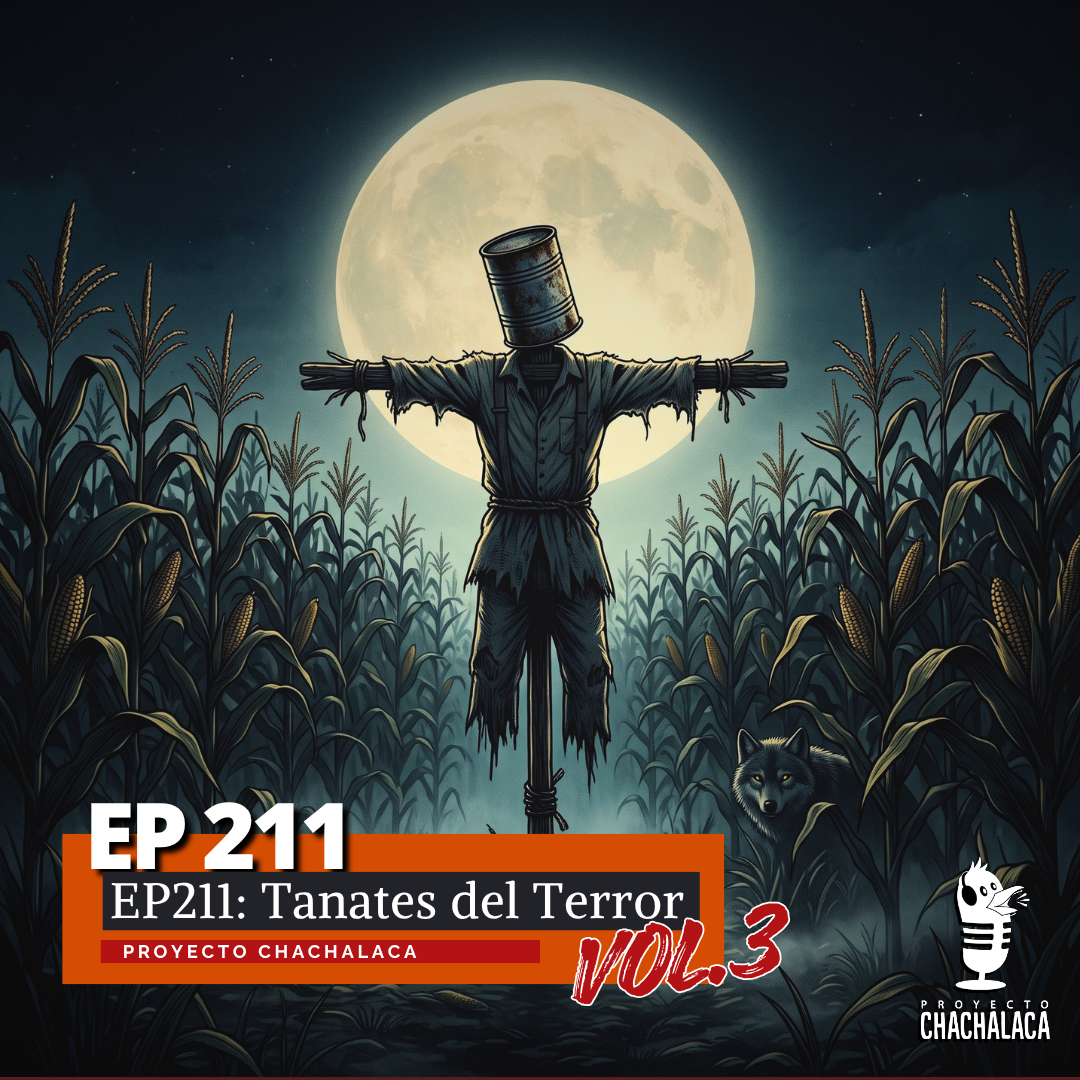
Tanates del Terror Vol. III: fear in Salvadoran literature
Episode 211October 8, 20261 h 06 minWith Carlos Paz Manzano, Bartolo Castellanos
English version of an episode recorded in Spanish. · Leer en español
Short link: proyectochachalaca.org/ep211
In a nutshell
In the third volume of Tanates del Terror (roughly, "a bundle of horror stories"), writer Carlos Paz Manzano and psychologist Bartolo Castellanos talk about why stories scare us and what they are for. From the Siguanaba and the Justo Juez de la Noche to Salarrué's "El espantajo" and Francisco Gavidia's "La loba," the episode explores fear as an emotion that paralyzes or saves, as a literary device and as a tool of social control, and ends on uncomfortable ground: the real terrors that fiction cannot fully tell.
Review
Review
Content note: the last part of the episode describes real femicide cases in detail. If this topic affects you, you can listen at your own pace or skip that section; it is also included in the transcript.
First scares
The episode opens the way good storytelling nights do: with scares. Bartolo Castellanos remembers that, when he was three or four, his brother peeked in wearing a mask of the Viejos de Agosto (a traditional August festival character) while he was in the outhouse in the backyard, and he still can’t describe that face. Carlos Paz Manzano tells how, as a teenager, he and his neighbors would hear horse hooves at night that faded away just as they reached them, in a neighborhood that used to be a farm. Neither of them has ever run into the Siguanaba, but both grew up with her, along with the Cadejo, the Carreta Chillona and the Justo Juez de la Noche, some of the best-known figures of Salvadoran folklore.
What makes horror different
For Carlos, what defines horror literature is its emotional charge and its atmosphere: an old house or the night stop being a setting and become characters. He recalls that literature was born with myths, going back to the Odyssey, and that when a legend moves from the grandparents’ voice to the page, the story survives but the craft changes: popular creation becomes an author’s work, with a style of its own. He also explains ellipsis, the art of not telling everything so readers complete the monster with their own fears, and Edgar Allan Poe’s idea of producing an “effect.”
A mirror that also watches
Bartolo looks at legends through social psychology. They are an emotional and historical mirror of a people, he says, but also a control mechanism: they were told so nobody would go out at night and nobody would step out of line. That leads Amaru to ask why El Salvador, with so many ghosts, has no great master of horror. Carlos answers that the supernatural has barely developed in Salvadoran literature; what abounds is political terror, the terror of persecution and violence.
“El espantajo” and “La loba”
Carlos reads two excerpts. The first is “El espantajo” (“The Scarecrow”), by Salarrué: in the context of 1932, Lalo hides from soldiers by posing as a scarecrow and silently endures a bayonet thrust. His family sees Calvary in the cross where he hung, and the story becomes an allegory of a crucified people. The second is “La loba” (“The She-Wolf”), by Francisco Gavidia, set in eastern El Salvador in pre-Columbian times: a grandmother who turns into a wolf cannot become human again because her granddaughter, unknowingly, burns her spirit. From there the conversation jumps to Lycaon, to the werewolves of Gothic literature and to Rubén Darío’s “Los motivos del lobo,” in which the wolf returns to the wild, disappointed in humans.
Freeze or flee
Between readings, Bartolo explains why fear sometimes paralyzes us and sometimes saves us, and why hearing a story told aloud is scarier than reading it alone. He distinguishes terror, which a whole people can live through and which passes, from anxiety, which he describes as an inner monster that only the person carrying it can see. Amaru mentions a lab in Denmark that studies recreational fear as a possible tool against anxiety, and Bartolo warns that scaring someone is no substitute for looking for the causes.
When reality is scarier
The final part is the hardest. Bartolo goes over real femicide cases that shocked the country and concludes that “these stories are scarier than the Siguanaba and the Cipitío.” Carlos says some readers can’t bear that violence even in fiction, and he knows it from his own novel. The conversation then returns to its opening idea, fear as a way of ordering a people’s life, and follows it through history: from the legends that kept young people at home to the curfews of the 1980s, and from there to the present, where each generation sees those who patrol the streets differently. Carlos closes with a concern about the space for artistic expression. For Bartolo, who admits he can’t watch horror movies, there is only one way out: facing our fears.
To go further
What research says about fear
- Freezing in the face of a threat, which Bartolo talks about, has a name: defensive immobility. It is one of the survival responses along with fight or flight, and neuroscience studies it as the body preparing to act, not as mere weakness (Roelofs, 2017).
- The lab Amaru mentions is the Recreational Fear Lab at Aarhus University, in Denmark. One of its studies found that horror fans showed more psychological resilience during the COVID-19 pandemic, as if the movies had served as rehearsal (Scrivner et al., 2021).
- Bartolo says that in El Salvador fright has been used with psychiatric patients to deter certain behaviors. It is worth clarifying that this is not among the treatments recommended by current evidence: psychosis is treated with medication and psychosocial support. What is well supported, and what Amaru’s question about “flooding” points to, is exposure therapy: gradually facing what one fears, with support, one of the best-evidenced treatments for anxiety disorders (Hofmann & Smits, 2008).
To read the stories
- “El espantajo” is part of Trasmallo (1954), by Salarrué, published more than two decades after 1932. For the context of that year’s uprising and repression, a good reference is Gould and Lauria-Santiago (2008). Feliciano Ama, the Indigenous leader Bartolo mentions, was captured and hanged in Izalco in January 1932.
- “La loba” appears in Cuentos y narraciones, by Francisco Gavidia.
- Rubén Darío’s “Los motivos del lobo” is a narrative poem from 1913, written in verse.
- On the ages mentioned in the episode: Poe died at 40, Maupassant at 42 and Lovecraft at 46.
Get involved
Ask an older relative what scary story they were told as a child to keep them from going out at night, and write it down before it is lost.
Further reading
- Scrivner, C., Johnson, J. A., Kjeldgaard-Christiansen, J., & Clasen, M. (2021). Pandemic practice: Horror fans and morbidly curious individuals are more psychologically resilient during the COVID-19 pandemic. Personality and Individual Differences, 168, 110397. View online
- Roelofs, K. (2017). Freeze for action: Neurobiological mechanisms in animal and human freezing. Philosophical Transactions of the Royal Society B, 372(1718), 20160206. View online
- Hofmann, S. G., & Smits, J. A. J. (2008). Cognitive-behavioral therapy for adult anxiety disorders: A meta-analysis of randomized placebo-controlled trials. Journal of Clinical Psychiatry, 69(4), 621–632. View online
- Clasen, M. (2017). Why horror seduces. Oxford University Press. View online
- Salarrué. (1954). El espantajo. En Trasmallo.
- Gavidia, F. La loba. En Cuentos y narraciones.
- Darío, R. (1913). Los motivos del lobo.
- Gould, J. L., & Lauria-Santiago, A. (2008). To rise in darkness: Revolution, repression, and memory in El Salvador, 1920–1932. Duke University Press. View online
You might also like
Transcript
Machine translation of the Spanish transcript (Gemini). Names, Salvadoran expressions and some details may be imprecise; the Spanish version is the reference.
Read the full transcript
[00:00] Amaru: Well, and that was episode 211. Dr. Carlos, what was it like being here?
[00:05] Carlos Paz Manzano: Well, I'm glad, because this is the second time I've taken part, and I like that we included a literary topic as well as social reality, so greetings to your audience and I hope that on another occasion I can join you.
[00:23] Amaru: Absolutely, of course. Dr. Bartolo.
[00:26] Bartolo Castellanos: It is a pleasure to share this dialogue to confront our fears, teaching ourselves from the field of psychology and accompanied by literature—well, what could be better, and even more so sharing a conversation with the Doctor.
[00:37] Amaru: The truth is that it has been an incredible episode. It touches on topics that—oof! Well, and I want to give a quick, how do you say, disclaimer for our listeners: there are parts of this episode where the description of certain events becomes a bit graphic, so for those who are sensitive, maybe keep that in mind because they are, let's say, rather difficult topics. But well, aside from that, I'd like to ask something we didn't ask during the episode, or that slipped our minds: have you guys ever been spooked? [laughter]
[01:05] Bartolo Castellanos: Yes.
[01:05] Amaru: And what happened to you, Bartolo?
[01:07] Bartolo Castellanos: Yes, yes, since I lived in the countryside, right? And in the countryside, bathrooms are outside the house, they're out in the yard, right? So we had a big yard, surrounded by trees and bushes and all that, and back then the bathroom—I remember I was maybe 3 or 4 years old—the bathroom at our house had an open gap between the roof and the wall, and my brother puts on one of those masks they bring out for the Viejos de Agosto, right? Just to give you an idea—but a mask, to this day I can't even describe how terrifying it was—and so there I was peeing, a 3- or 4-year-old kid peeing in the latrine, because that's what the bathroom was, right? An open pit latrine, and then my brother appears between the roof and the wall, just peeking his face out with that mask, and I remember running out peeing all over my feet and screaming, "Mom, Mom!" and when I got to my mom's arms, well, I arrived completely terrified, crying.
[01:58] Amaru: And you hadn't just peed yourself. [laughter]
[02:01] Bartolo Castellanos: And then they showed me the mask and I managed to see it, touch it, but that was stamped into my subconscious, right? And so I think those are part of those fears, and then these stories that we've narrated in the episode, which I think have also been feeding that fear that, in the end, one keeps as a survival tool and a stop tool to keep from doing...
[02:27] Amaru: Hey, hey, okay, okay. Well, Dr. Carlos, have you ever been spooked, either by a living person or maybe some kind of spooky ghost or something like that? [laughter]
[02:37] Carlos Paz Manzano: You know, on several occasions when I was a teenager, we used to hear horses at night—the neighbors, the neighborhood kids. At first we'd get scared, but then we got used to it, to the point that later on it was a novelty and we actually wanted to hear it. But that was happening in the neighborhood because the city was growing; we're talking about more than 40 years ago. And on one occasion, a night watchman told us, "This used to be an estate, and a lot of horsemen would ride through here." But since it was a supernatural phenomenon, right, you'd get scared because we couldn't explain it. And it turned out that as a group we'd hear that, to the point where we got used to it later, so to speak—we started facing our fears and began seeing it as normal. [laughter]
[03:25] Amaru: But you never saw anything, ever?
[03:26] Carlos Paz Manzano: No, we only heard the sound, and when the sound of the horses, of the hooves reached our level, beside us, it disappeared; when we looked over, it vanished.
[03:37] Amaru: You couldn't hear a thing anymore.
[03:38] Carlos Paz Manzano: Right, we couldn't hear anything anymore.
[03:39] Bartolo Castellanos: You guys took off running, Doctor. [laughter]
[03:41] Carlos Paz Manzano: Could be; one would vanish.
[03:43] Amaru: One would vanish.
[03:44] Carlos Paz Manzano: You say, "How could that happen?" Well, yes, it did happen, right? And that was something we experienced—the neighbors, friends.
[03:51] Amaru: Yeah, like trickster spirits. Well, and with that, we begin episode 211.
[04:00] Amaru: This is Proyecto Chachalaca, a space to talk about who we are as Central Americans, and it's the small actions that keep this project going. If you liked anything from this episode, share it with someone. Also follow us on our social media so you don't miss what's coming, and if you have a minute, leave us five stars wherever you're listening to us. Even if it might not seem like it, that helps us a ton to keep moving forward. And if you'd like to join in another way, collaborate with us, or suggest a guest, write to us; the door is always open. You can find us as chachalaca.pro, because remember that for a story to keep existing, it must keep being told. And now, let's begin.
[04:39] Amaru: Welcome to Proyecto Chachalaca. This is episode 211. This would be Tanates del Terror, Volume 3. Joining us this time are Dr. Carlos Paz Manzano and Dr. Bartolo Castellano. Here, among doctors, we are going to talk a bit about literature and the psychological effects that this element of literature has on people. But let's start here: how are you doing, Dr. Carlos? How are things?
[05:04] Carlos Paz Manzano: Doing very well, thank you for inviting me back on the show, and greetings to your audience.
[05:10] Amaru: Thank you very much. Dr. Bartolo, how's everything going?
[05:13] Bartolo Castellanos: Gladly supporting Chachalaca here so people across El Salvador and around the world can listen to us.
[05:20] Amaru: Excellent. Well, this is the customary question, right? To find out: have you ever been spooked? Have you ever suddenly run into, I don't know, the Siguanaba or the Carreta Chillona or something like that? What do you say, Dr. Carlos?
[05:33] Carlos Paz Manzano: Yes, we've been told stories, right? Personally, I haven't had that experience, right? But whenever we visited the town, they'd always talk about the Carreta Chillona and the Siguanaba, and that would make you nervous at night, right? But I have had, let's say, the experience of witnessing some supernatural effects, though not to that level of being terrified.
[05:59] Amaru: Okay. Bartolo?
[06:01] Bartolo Castellanos: Well, as a kid or teenager, one heard all these horror stories and legends in the country, right? That our parents, our siblings, adult friends, or neighbors liked to tell, right? And whether you like it or not, when you're a kid, talking about the Carreta Chillona, El Cadejo, El Justo Juez de la Noche, right, the Siguanaba, it scares you. So these stories—back then when there wasn't much television, there were no virtual social networks—those conversations sparked, alongside fear, right, the imagination and the morbid curiosity about how it would end.
[06:40] Amaru: And what happens. [laughter]
[06:41] Bartolo Castellanos: But in the end, you ended up scared. [laughter]
[06:45] Amaru: Terrible stuff, definitely. And well, maybe we'll start with a question more on the subject of literature: what sets this horror literature, the fantastic, apart from other branches of literature?
[06:58] Carlos Paz Manzano: What is very distinctive about horror literature is that it is highly emotive. These are atmospheric stories or novels where description as a technique is essential, because it has to reflect fear, dread. Generally, nighttime settings are what's being presented, and it requires mastery. Those who have ventured into horror literature, which is associated with the fantastic element, have been very experienced writers, like Edgar Allan Poe, for example.
[07:36] Amaru: H. P. Lovecraft, for instance.
[07:38] Carlos Paz Manzano: Bringing us to more recent times, right? So, that is key, because what sets it apart is the emotional charge, which is, let's say, the atmosphere, where it's not just the character, the person, right, expressing those emotions, but rather, say, an old house, a castle—by establishing that atmosphere, it comes alive; there are emotions, there is dread, and they become characters.
[08:10] Amaru: Even, I think something very characteristic of these horror narratives is the sensory details, talking about, for example, the textures of what might be in a room or something like that, right? Suddenly, they find a footprint and there's slime or something similar, and what happens then, right? Yes, but anyway, very, very interesting things. Now, speaking a bit about the horror narrative in El Salvador: here everyone has been told about the Siguanaba, for example. So, what from the narrative our grandparents and our ancestors had when telling these stories could be brought into the present day and that you'd find relevant in literature?
[08:44] Carlos Paz Manzano: Yes, that always remains relevant because we're talking about the cultural traditions of communities, and that is always picked up as an influential element in literature. It's always present; it doesn't mean that's the only theme that will be explored, but it is very influential, to the point that it influences magical realism, because it expresses people's culture, creativity, imagination, the theme of ghosts, mythological figures. And here we have to pay attention to a key historical detail: literature itself originates with the presence of myths. If we look, for example, at the origins of literature, which would be La Odisea [The Odyssey], with Homer, we're placing ourselves in the Archaic period, back in the 7th or 8th century BC, and what Homer does is draw on war stories and depict how mythology was structured in ancient Greece back then, and that's where we see the involvement of the gods, and the gods were violent, right? So, it's important because right from the origin of literature, we see the presence of myths.
[10:00] Amaru: How interesting. Did you see the movie, by the way, the latest one about...?
[10:03] Carlos Paz Manzano: No, no, I haven't seen it yet. [laughter]
[10:05] Amaru: Oh. Well, there's another question that strikes me as very interesting, because moving from an oral format where our grandparents told us stories and all that to writing it down, there's a sort of transformation in the narrative of the legend. My question would be: what happens when we go from a living narrative told by our grandparents to a written one? Does something change? What is lost? What is gained in that shift?
[10:30] Carlos Paz Manzano: Well, the story, the theme remains, but the change is fundamentally technical and literary. But that emotion transmitted orally is what's preserved, though then comes the writer's craft, right, who now has to use a specific code. So we go from what is known as oral literature or oral tradition to written literature: the written novel, the written short story. In other words, right, we move from the creative production of popular folklore legends to an authorial work, and that now carries their own style. That's what Salarrué did when he wrote, for instance, the short story La Siguanaba [The Siguanaba].
[11:10] Amaru: Okay. Look, and I'm thinking of something too, because when they told us these stories, sometimes they used references from right nearby, right? For example, down by the river on the other side of the hill, this happened there—so it feels more like your own when it's told like that, right? But in a book, it's locked down to a specific story, a specific river, a particular place, right?
[11:31] Carlos Paz Manzano: We're reinforcing the theme of identity, and that's important because it leads us to talk about history, right, and the lived experiences of our communities.
[11:40] Amaru: Interesting. Well, Bartolo, I'd like to ask you this as well: this thing where ever since we were kids we loved listening to stories about El Cadejo, the Siguanaba, but they told them to us so we wouldn't go out at night—and we'll talk a bit more about that soon, right? [laughter] But the way you see it, did that make us stronger or did it make us more anxious?
[11:57] Bartolo Castellanos: It will depend on individual differences, right? Horror stories, in how they are explained, whether narratively, experientially, or expressed orally, right, aim to frighten, but deep down they are a psychological, historical mirror, right, of our societies and our communities, in terms of expressing emotional aspects, as Dr. Paz Manzano said. But they are also mechanisms of control, right?
[12:30] Amaru: Mmh.
[12:30] Bartolo Castellanos: Of control, so that you don't go out at night, so that you have a certain morality and fear toward certain things, so that you don't stray from the prescribed rules,
[12:41] Amaru: To keep you right there.
[12:41] Bartolo Castellanos: Right? To keep you protected right there, as our grandparents would say, right? [laughter]
[12:45] Amaru: Okay. Well, Bartolo, let me ask you: were you told any stories as a kid?
[12:51] Bartolo Castellanos: Several stories. [laughter]
[12:52] Amaru: I imagine you were quite mischievous back then, right?
[12:54] Bartolo Castellanos: Several stories, right? So, stories like La Siguanaba, El Cadejo, El Cipitío, El Justo Juez de la Noche, La Carreta Chillona—one heard all these stories from those living towns, from our elders, our parents, or our older siblings. And yes, they were scary, but they also stirred up morbid curiosity: how does the story end? What did it turn into? Why did it turn into that? So that emotion of morbid fascination, but also fear, is what gives it its psychological essence, right? To see what's inside you—whether you have the courage to endure the story, right, or if it genuinely awakens fear and you go to bed [laughter] shaking with fright. [laughter]
[13:44] Amaru: Something that sparks my curiosity, for example, about the legends they told, is that there were people who transformed into animals, right?
[13:50] Bartolo Castellanos: Exactly.
[13:51] Amaru: For example, there was a legend: La Chancha. Have you heard of it?
[13:53] Bartolo Castellanos: Yes, yes.
[13:54] Amaru: I mean, if you ask me about a sow, the first thing I imagine is turning it into chicharrones and bacon. [laughter] But my question is, why transform into a sow and not something else? Wasn't there a spookier animal or something? But instead, people say, "She transformed into a sow and the whole town was terrified." It's curious, isn't it? But anyway, I'd also like to ask, Maestro Carlos: in our country, we have ghost stories of all kinds, right? From El Cipitío, La Siguanaba, El Duende, La Duendecita, El Justo Juez de la Noche...
[14:24] Bartolo Castellanos: Justo Juez de la Noche.
[14:25] Carlos Paz Manzano: Noche.
[14:25] Amaru: El Justo Juez de la Noche. We have stories in the east, in the west, even in Izalco there are stories connected to horror. But why don't we have a nationally recognized master of horror? What do you think is missing? Is there a lack of tradition in horror literature? A lack of a market? I don't know, or could it be that the everyday reality of ordinary Salvadorans is scarier than [laughter] anything anyone could write?
[14:47] Carlos Paz Manzano: Yes, look, this topic of horror from the perspective of the supernatural is what isn't well developed. That is, there is little tradition because the great masters, like Salarrué, did address this theme, but quite briefly; he leaned more toward realism and the fantastic. So there is no tradition; it's a weak area, and there are few studies as well. Traditions have been preserved, but it's not something very prominent. So what we tend to see is another kind of terror associated with politics or persecution,
[15:27] Amaru: With violence.
[15:28] Carlos Paz Manzano: With violence, which creates a sense of terror. Salarrué also has an important story dealing with terror, but from a political standpoint, which is El espantajo [The Scarecrow], right, in his book Trasmallo [Trammel Net], where he talks about the persecution of Indigenous people and soldiers hunting them down to wipe them out, right? And that creates terror. So that's what has been most prominent. For example, look: there's this book, El murmullo de la ceiba enana: cuentos de guerra [The Murmur of the Dwarf Ceiba: War Stories], by Edwin Ernesto Ayala, which denounces the repression, and even children die in it, right? Because it's an issue of repression, of persecution, but it generates terror. But from the perspective of the fantastic, that's where we see relatively little output. The fantastic has been explored, but not from the perspective of horror. For example, Claudia Hernández, an acclaimed, active writer who is now writing novels, deals with the fantastic in her short stories, but she approaches them with humor, with irony, where violence is normalized—as if society comes to absorb it as something ordinary, right? But she infuses it with humor; it isn't from the perspective of the horror story. So that's mostly how Salvadoran short-story writing has developed: the folkloric side, terror from a political standpoint, but from a supernatural angle paired with the fantastic, we have very little presence.
[17:09] Bartolo Castellanos: And from a psychological standpoint, Doctor, I think horror is also a form of denunciation, denouncing those wars. For example, El Salvador, having lived through a very fierce armed conflict, that's part of the terror people experience in the social collective, right? But horror also carries guilt on the part of the person writing or narrating it; there is also a certain guilt experienced by a town, a city, or an entire country, that collective guilt. But it also expresses fears, psychologically speaking, right? All these terms I'm using are based on social psychology, right, where fears also prevail in human beings to keep them from acting in a liberating, emancipatory way, right? And so we create these horror and scary stories, as I said at the beginning, as social control, right? To keep the populace subdued, right? And the story you mentioned from 1932, about soldiers chasing down Indigenous people, is part of that collective memory, right? If you recall, Feliciano Ama was murdered in a public square in front of everyone, right? The collective. So that generates fear, generates terror, and then people no longer seek emancipation, no longer seek liberation, but rather accept a political, military stance, right? Which ultimately breeds fear in the subconscious.
[18:36] Carlos Paz Manzano: And identity is destroyed.
[18:37] Bartolo Castellanos: And identity is destroyed, yes, exactly.
[18:39] Amaru: How heavy, and at the same time how interesting to consider, first of all, right? Because there are several elements to discuss here: how the writer must also, to some degree, be in the grip of those very same fears. Naturally, because to write horror, fear, or any of this, right, one has to feel it. One also has to be seized by that feeling of, "This scares me, which is why I can write about what scares me." But also discussing how the horror narrative itself is established through the media, right? Because so much of what you mention, for example in 1932, was a campaign of terror. What happened in 1932 was an effort to wipe out culture through fear, right? And what seems to me, or perhaps what I observe from my outsider's perspective—let's say, not having studied it professionally—is the fact that the terror we've experienced historically in El Salvador also limits the desire to seek out horror, to write horror as such. But well, we are prisoners of a different kind of terror. [laughter]
[19:40] Bartolo Castellanos: Yes, that's right.
[19:41] Amaru: Doctor, you have some stories here that you'll be sharing with us throughout this episode, or excerpts—would you like to start with the first one?
[19:49] Carlos Paz Manzano: Yes, look, the story I already mentioned is titled El espantajo, by Salarrué. Here we have a horror theme, but it's political terror because it's persecution, and it carries an allegory at the end. That final part where the allegory is found is what I want to read to you, right? What's it about? Well, we're talking about soldiers hunting down...
[20:15] Amaru: In the context of the 1930s.
[20:16] Carlos Paz Manzano: 1932, right after the massacre, and they are hunting them down. People tell Lalo, who is a teenager, that he has to flee, but supposedly nothing would happen to teenagers. But when the soldiers arrived...
[20:33] Bartolo Castellanos: They wiped out everything.
[20:34] Carlos Paz Manzano: Everything. Well, the point is that the soldiers passed through and the gunfire was heard, and people began asking, "Well, where is Lalo? What happened to Lalo?" He had hidden; he didn't run away, he hid. And once the soldiers left, they found him, and that's the part I'm going to read to you. In this case, he recounts what happened to him the moment the soldiers arrived. So a second narrative layer opens up, right, where he tells his story, and it goes like this: "The simpleton explained"—because Lalo, let's say...
[21:08] Bartolo Castellanos: Had a cognitive disability.
[21:09] Carlos Paz Manzano: Yes, he had a disability, yes, and he says: "When I saw 'em surroundin', I stuck the can over my head; I could see good through the holes; I climbed up on the stone, hung myself by my belt from the hook, and stuck my arms through the vines on the crossbar; I stayed right there, barely holdin' my breath. When they got there, oh!, they got spooked and fired a volley at me. The shots went through the can, but they grazed my head; one shot stuck me with a bayonet, sayin': 'Lousy cornfield scarecrow, you scared the hell outta me!' I took the thrust without flinchin' much or screamin', and from there they went off laughin'. Lalo was soaked in blood, but happy. Everyone, in a little huddle, got on their knees and thanked God. Where the tall grass had been, all that was left was the cross and some strips of twine. 'It's the very Cross of Calvary!' Goya said. 'Bless you, child! The Lord saved you on it; poor thing, they even pierced your side; it's a clear-as-day miracle!'" So there comes Salarrué's allegory: he's creating a representation of Jesus Christ's martyrdom on the cross, right? Showing how the soldier thrusts the blade, right?
[22:21] Amaru: Yes, the thrust, yes, exactly.
[22:23] Carlos Paz Manzano: To represent the figure of Christ. So the Indigenous people represent the suffering populace, the suffering that Jesus Christ endured, and there Salarrué makes a denunciation. This story was not published at the time; he published it much later, some time afterward.
[22:40] Amaru: Sometime afterward.
[22:41] Bartolo Castellanos: And because fear, Doctor, like Lalo's fear in that moment, right, serves two functions: it either petrifies you—
[22:48] Amaru: Which also happened.
[22:49] Bartolo Castellanos: Which can happen to you, right? Either the event overtakes you, or it makes you react, right? And that depends on how the human being responds behavioral-wise, right? And so, of course, faced with the certainty of death—they thrust the bayonet into my stomach—I bottle up the pain,
[23:08] Amaru: Bear it.
[23:09] Bartolo Castellanos: Bear it so they don't finish me off, right? So Lalo reacts, but that also happens with people in general, right? Faced with fear, some people freeze and just take the blow, the bullet, or whatever, while others flee and run, right?
[23:26] Amaru: For example, another very everyday thing related to what you're saying is a potential car crash, right? You're on the road and some people just blank out out of nowhere and freeze, right? While others seem to react immediately to survive the situation. Does that have a name in psychology?
[23:44] Bartolo Castellanos: Of course, because terror also leads to human survival. That is, terror...
[23:50] Amaru: Is a defense mechanism.
[23:51] Bartolo Castellanos: It's like a defense mechanism in the brain, like wondering how a horror movie will end, for instance, but riding that adrenaline of "and now what's gonna happen?" and the morbid curiosity of "if this happens, what if that happens?"—which is the same thing that happened to us as kids listening to all these legends, fantastic stories, right, from our living towns. You'd sit there listening to the story, but you also wanted to learn how to survive it if it ever happened to you, right? So it's mentally coding the brain to say: there is a way to survive, and to survive, fear and terror also exist—not just happiness, joy, and delight, right?
[24:32] Carlos Paz Manzano: Fear can save you too.
[24:34] Bartolo Castellanos: It can also save you, that's right.
[24:35] Amaru: But at the same time, that's my question, because fear can save us, like you're saying, by making us react head-on to a situation, right? But what determines whether fear petrifies us or makes us act?
[24:49] Bartolo Castellanos: Because there are individual differences among human beings, right? We aren't all the same biologically, psychologically, and socially. So individual differences will shape us so that some of us are stronger, braver, more like warriors, and others are more timid, quiet, and introverted, right? So these people who don't react might end up more traumatized; they are people who fall into states of anxiety, fall into states of depression, right? Because they couldn't endure going through a loss or experiencing terror, fear. So they bottled it all up, and in the end their body reacts with more anxiety or depression. But in other people, we'll find that it turns them into fighters, and so they enter the fray and fight, right? So those are the individual differences in us.
[25:39] Carlos Paz Manzano: And there you have to consider, when you mentioned the warrior, it's also because they have experience; a threatening situation arises, but since they already have emotional experience, they've rehearsed it, they control themselves—though that doesn't mean they aren't afraid.
[25:54] Bartolo Castellanos: No, of course, in the end they are afraid. [laughter] And out of fear, one fights and survives, right?
[25:59] Carlos Paz Manzano: Hence the importance of training.
[26:02] Bartolo Castellanos: Exactly. I think that when they told us these scary legends, deep down it was training us, preparing us for a critical situation, right? Deep down, something one might face in the future, and so on.
[26:15] Amaru: Yes, because look, speaking of how they prepare you when you're little: for example, I was prepared as a kid so that if I run into La Chancha, chicharrones—I mean, I learned from a young age to eat chicharrones. [laughter] But anyway, that reading is really interesting, because that allegory also speaks—and acts as a critique of—the very way they carried out the attack, right? What is it called?
[26:36] Bartolo Castellanos: Yes, in the side with the bayonet.
[26:37] Amaru: With the bayonet to Christ, they are also doing to the crucified people themselves here in...
[26:42] Bartolo Castellanos: Yes, through Lalo.
[26:44] Amaru: Exactly. Well, this serves as social critique as well, right? Now I'd like to ask: why does a story read out loud scare people differently than reading it alone in the privacy of your bedroom? What do you think?
[26:57] Carlos Paz Manzano: Well, that's a different specialty, right? Because we're talking about someone reading who has the ability to read while sustaining different emotions; the rhythm of the voice also varies—they raise it, lower their voice, right, and dramatically express what is being told, the story. So it's a matter of drama, of acting; it's another specialty, it requires experience.
[27:30] Amaru: Like a storyteller.
[27:31] Carlos Paz Manzano: Yes, like a storyteller, and that takes training; it's not a simple reading. So it's being lived, right, because the emotion is felt more intensely, and one isn't expending the effort of reading, right?
[27:45] Amaru: Okay. What do you think?
[27:46] Bartolo Castellanos: On the other hand, um, a text read by someone else, or seen, right? Or or or listening to the narrative, awakens fears, awakens, um, each person's fears unconsciously, right? That’s why when you watch movies about suffering, you connect with the one who suffers, because deep down, it’s your own unconscious suffering speaking about you, connected to the suffering of what you’re hearing or what you’re observing, seeing, right?
[28:14] Amaru: Empathy.
[28:15] Bartolo Castellanos: There’s an empathetic relationship, right? But also, since all of us in in in our life stories, um, have suffered, have lived through difficult things, whether in our family or personally, the brain registers all of that. So, of course, when you're listening to it, experiencing it, it’s a way of awakening and connecting those emotions of sadness, of of shock, of anger, of rage, of fear; but when you read it alone like that, in a whisper or to yourself, you’re sort of more sheltered, you’re sort of more grounded in in yourself, so it can only awaken you, let's say, emotionally, but not to a very high emotional degree compared to if you watch it, if you hear it, or if it's being dramatized for you. That awakens emotions much more intensely than reading it to yourself.
[29:09] Amaru: Well, Dr. Carlos, I'd also like to ask—because we've seen, right? Or we've read more than once that it's not so much how a monster is narrated, but rather what is left unnarrated, or when—when it's hidden, when it's in the shadows. How does this work in literature? What's scarier: narrating a monster, or narrating what it's doing and never actually encountering it? How does that work?
[29:31] Carlos Paz Manzano: Well, it's—it's that both things happen, because it is described, it is narrated, but not everything is told, so blank spaces are left, and that manages—keeps the tension. That technique is ellipsis, right? Not saying everything, and giving priority to actions, to the to the events. So the reader sees the character's actions or perceives the the emotion, but it doesn't always tell everything they do; rather, logic is also applied, let's say, right? Through through ellipsis. But since those voids remain, right?—what is left untold—and the reader has to make inferences, that makes room for developing the imagination, right? And following the sequence of actions, and suddenly something unexpected can happen and catch them off guard. So that's why those gaps are left, to surprise the reader.
[30:24] Amaru: And you know, something I find really, really interesting about what you're saying regarding ellipsis—that not everything is told—is that it also leaves room for you to put a face to it with the things that, as Dr. Dr. Bartolo could tell us, right? With the things you've lived through, the things that scare you the most. So it's like: fill in the monster's shape here with whatever you...
[30:43] Bartolo Castellanos: With your traumas, with your life stories, with your fears, with your, um, internal terrors, with your struggles, right?
[30:52] Amaru: With your imagination, yeah.
[30:53] Bartolo Castellanos: Um, and your imagination, because the writer is also going to foster imagination as a psychological process that all of us humans have: imagining, right? What this monster looks like. But that monster is accompanied and associated with my life stories, my fears, my terrors, my traumas, and so on, which are experienced in that way, but deep down it allows me to survive the pain.
[31:15] Carlos Paz Manzano: What Dr. Bartolo is saying is related to what Poe called producing an effect. That is, producing an effect means getting the the reader to identify with the character's emotion, because "I have lived it." So, if that's achieved, it's because, um, we've fulfilled the main objective of a short story or a novel, and since it establishes an emotional connection, it moves them, and that generates that tension, right? And the suspense to keep reading.
[31:45] Amaru: Interesting. Well, Dr. Bartolo, there's another thing that I find very interesting. As we already know, um, when we see a monster or whatever, the monster has a face, a shape, features, but in psychology, anxiety doesn't have a specific face. Could it be that monsters in these literary works, in these in these narratives, even in film, serve to put a face on the anxiety one carries inside?
[32:08] Bartolo Castellanos: You know, some authors in clinical psychology talk about how anxiety itself is a phantom, an internal monster that people constantly battle because only they perceive it, because only they have it, and that makes it different from fears and terrors—from terror—because terror can be experienced by an entire population, by a specific community, by an entire family, whereas anxiety is only experienced individually; only that person experiences it. And why does the person experience it? Because they're overwhelmed not just by terror, not just by fear, but by other traumatizing events, of course, right? Like rape, like sexual abuse they might have lived through, experienced, and that has turned inward, so they experience the pain and trauma through anxiety. And then the body, the the—the brain is telling the person: "Something is happening here, and as long as we don't address it, don't face it, you're going to live with this anxiety, with symptoms like I can't breathe, my heart is going to burst out of my chest, um, I think my life is going to end, that I'm going to pass out," um, and all those symptoms of generalized anxiety are evidence of a deeper internal problem that the person doesn't want to realize or doesn't want to face out of fear, right? But terror isn't like that; terror is momentary. That’s why when Dr. Paz Manzano talks about connecting with emotions, it's because emotions are transitory. So I might feel fear, terror at a specific moment while reading something or watching a movie, or or someone telling a story, and that emotion will last 10, 20—whatever the momentary experience lasts—but afterwards I might calm down, afterwards I might laugh, or right after the scare I'm laughing. Whereas anxiety remains deeply entrenched.
[34:05] Amaru: Well, let's move on to reading the next the next excerpt.
[34:09] Carlos Paz Manzano: Francisco Gavidia has a classic short story titled La loba [The She-Wolf], and it's set in pre-Columbian times and refers to to Indigenous culture, set in Cacaopera. And La loba tackles the theme of nahualismo. What we see is that the grandmother wants to marry off her granddaughter, right? To to an Indigenous chieftain,
[34:34] Amaru: A cacique.
[34:34] Carlos Paz Manzano: a cacique, right? To a cacique, but the cacique demands a bride price, and she can't she can't afford it. So, she transforms into a she-wolf to go around robbing, right? But during one of those times, when she turns into a she-wolf and goes out to hunt down her her little bit of money, to go around stealing, the daughter—who has a suitor, but the grandmother had rejected him—comes into the house and sees a little gourd bowl with something floating in it, and she thinks it's something something odd, something strange, so she burns it, and she's burning her mother's spirit. So the she-wolf, the grandmother, can no longer return to being human. Well, that's what this story about nahualismo is about. So, I'm going to read you a part, an excerpt that references that scene, and it goes like this: "Now, here is what happened one night: While Oxiltla slept deeply, Cola arose naked. The night cold is glacial, and the gloomy woman throws the thickest logs into the hearth, where enormous embers begin to glow. The witch then takes the pan of prayers, in which she used to present to her god the blood of hares sacrificed at the coming of the rainy season; she places this pan in the middle of the house; she leaps horribly in the glow of the bonfire; she makes sinister invocations to Ofo; and finally, she vomits into the clay pot a leaden vapor that remains there, resembling an opaline liquid: it is her spirit. At that moment the woman had transformed into a she-wolf: then she went off to steal." And it turns out that later the daughter doesn't know what's in there, right? So she gets frightened and burns it. And it ends like this: "At dawn, the she-wolf sniffs around the entire house; she paces, twists about, whimpers all around; she searches in vain for her spirit: day will soon break. Oxiltla stretches stretches, about to wake up with a graceful yawn; the she-wolf impatiently licks the spot where the sacred vessel had been; all is in vain: before her daughter wakes, she reaches the door and heads into the forest, which she deafens with her howls. Although she returned on subsequent nights to howl at the door of the house, that woman had remained a she-wolf forever." So she kept returning to the house, but because her daughter had burned the the spirit, she couldn't she didn't manage to become human again. So it deals with the theme of nahualismo, and aside from that, we're talking about a crucial theme, um, in horror literature, which is wolves, right? And that makes it interesting, right? Because we go back again to to ancient times, to to ancient Greece, and in mythology there's King Lycaon, right? And Lycaon, who was punished by by Zeus, right? And turned into a wolf, and that's where the term lycanthrope comes from, right?
[37:37] Amaru: Transforming into, yes, a wolf, a werewolf.
[37:39] Carlos Paz Manzano: Just imagine where, um, where that that lycanthrope story comes from, let's say. But, um, lycanthropy is already, say, a story framed at the end of the 18th century and the first half of the 19th century, which is when Gothic literature developed, associated with Romanticism, but with nocturnal settings, medieval settings, and always darkness, right? The gloomy is what predominates, the old, the ancient, and these stories develop in that atmosphere, and that's where the theme of vampires and wolves comes in,
[38:15] Amaru: Which are figures that come out to hunt at night.
[38:18] Carlos Paz Manzano: That come out to—exactly, that come out to hunt at night, and that helps develop horror literature along with other themes, like apparitions, ghosts appearing in in these stories. Well, then, um, the theme of the wolf was taken up by Rubén Darío from another perspective, but still within horror, right? Because toward his final phase, in his final years of literary production, he wrote Los motivos del lobo [The Reasons of the Wolf], which is a prose poem, but it's also a short story—it fulfills all the criteria: it has an introduction, a development, and an ending. And that's where what we were talking about earlier comes in: how legends and folklore influence literature, but once it's in the text, we're talking about an authored work, right? With all the literary techniques. And Rubén Darío wrote it in verse, and it's one of the masterpieces of the verse short story. So much so that for that verse story alone he is considered a master; he didn't he didn't need to write 100 poems like that—with just one, right? He becomes a classic in that style, not to mention that he was Rubén Darío, right?
[39:26] Amaru: He was Rubén Darío, of course.
[39:27] Carlos Paz Manzano: And he writes the whole story in alexandrines. So what we see there, according to the legend, right? Is that the wolf was terrorizing, hunting people—humans, right? Then Francis of Assisi comes and tells him, "No, calm down, let's make a deal. Come to the town, get civilized, we'll give you food and shelter there, you'll be fine." The wolf agrees, but once he's in in civilization, right? In the town, people start mistreating him, taking his food, beating him with sticks, and and the—and humans themselves were fighting each other and killing each other. So he gets disillusioned and returns to the wilderness, back to his misdeeds, hunting again. And Francis of Assisi returns, having been away, and comes back: "Well, what happened? Didn't we have a deal?" "Yes," and then the wolf delivers a monologue, which is another masterpiece of literary monologue, where he justifies why he returned to the wild. And there he explains, right? That humans, right? Are unjust, mistreat each other, kill each other, break their word, betray each other. And Rubén Darío offers a critique of humanity, right? The theme of war, the theme of historical injustice, right? And with that story he represents the historical nature of human beings, how some invade others.
[40:47] Bartolo Castellanos: Right, and that's why, you see, Doctor, there’s that saying, right? "We all have a bit of the poe—of the madman and the poet in us," right? But in the end, this literature, as you put it so well at the end of what you were explaining, is an explanation of human injustice, right? Of of sometimes also the traumas of people that these authors have experienced or or managed to see in someone, right? In how they were treated. So through a horror story, they are told to capture an audience's attention, right? And say what can happen if we are unjust, if we humiliate people, if I don't treat you like a human, right? And so in the end, it's about giving meaning to a narrative that expresses pain, right? That expresses psychosis or is an inexplicable tragedy, right? Because you say, "How is it that humans in a war kill each other over territory, when everyone could live in the same territory?" So one one can't explain that, but they construct a horror, a movie, or a legend, or or a horror story as a way of giving a literary explanation, right? To a collective terror or to an imaginary process of the suffering and pain that a certain group of people is going through or has gone through, right? And that's a way to to manifest it, to express it, to bring it to light, right? Psychologically speaking.
[42:11] Amaru: Okay. Well, speaking of psychology, there's a lab in Denmark that's already talking about horror as potential medicine, as as a psychological tool to treat the issue of of anxiety. What do you think about that? Does it does it give you anxiety? Does it excite you? Does it make you nervous? What do you think?
[42:30] Bartolo Castellanos: Doctors actually use that, you see, when there are patients with psychosis, right? Psychosis, which are troubled states for the individual. Doctors scare them and say, "We're going to operate on you from your belly button to your forehead," because they believe that with that fear, the guy will go back to being normal and will no longer show the psychosis he's exhibiting.
[42:50] Amaru: Like, "Oh, it's gone now, wait, that won't be necessary." [laughter]
[42:52] Bartolo Castellanos: Yeah, just like when you get the hiccups and someone scares you—oh, the hiccups will go away, right? [laughter] Well, similarly, doctors in the 20th century, in the 21st century, use it as a strategy. But it's also concerning, right? In the sense that we might fail to find the real causes of what drove this person to that psychosis, or what drove someone to a state of anxiety without knowing the causes of why they reached that anxiety, or why someone is in a depressive state—what the causes were that led them to that depressive state—or someone with suicidal ideation. So, um, that's why it's concerning, right? Because we might not treat them humanely, like we were discussing regarding the story of of La loba, right? Where she transforms because there is injustice, because there are humiliations, and so on and so forth. So in the end, it goes back to being that because when it tries to live among humans—no, it was the wolf, right?
[43:45] Carlos Paz Manzano: The wolf.
[43:46] Bartolo Castellanos: So, um, when he tries to compare himself to humans, he sees they haven't changed, that they're still stuck in the same, um, attitude,
[43:52] Carlos Paz Manzano: Dynamic.
[43:53] Bartolo Castellanos: um, relational dynamics, right? So that also tells us that an individual can have a spell of madness, psychosis, or anxiety, but if we don't find the causes, they can return to the original state of worry and tension that drives them back into that same state. That's why it's better to look for the causes of the problems: What causes us fear? And why are we afraid? What terrifies us, right? In our minds, um, and then look for a solution to that terrifying thing we uncover.
[44:20] Amaru: Okay, but then this could be, just as we've discussed in other episodes, like a process of of of flooding, what do they call it? Um, when you're overly exposed to something that can also cause a lot of terror or panic, it also allows you to habituate, right?
[44:34] Bartolo Castellanos: Sure, and remaining stuck in that same state, right? For example, doctors saying, "Well, someone with psychotic—we we we scare them into thinking we're going to operate on, um, their entire spine, for instance, when that's not true, when that's not possible, but that'll snap them out of it." But what if they stay in that psychotic state, right? Or in their psychosis itself, and the person never snaps out of it, right? Or like the daughter who dumped out the elixir of the mother from La loba, and then she couldn't turn back into a human. That's what—that's also what they're trying to tell us, Doctor: that sometimes if we don't if we don't change, we stay in the original state of tension and worry because we don't manage to do the the confrontations and actions to alter what made me—what turned me into that, right? Which could be what the author is trying to say in his narrative, right?
[45:17] Amaru: Okay. Well, um, Dr. Carlos, a question for you regarding the horror literature you've enjoyed: Is there a top three or something where you'd say, "These are my recommended horror works where I actually got scared, or maybe I didn't get scared, but they're really good"?
[45:31] Carlos Paz Manzano: As for scaring me, um, let's say not so much, but when this literature is adapted to film, since you're watching a spectacle, you do get startled a bit more. But in in my case, as far as being scared, not really, but I do love, let's say, the short stories of Edgar Allan Poe, who, um, um—he is the founder of the modern short story because he breaks with convention; he brings the the psychopath, he brings him into literature.
[46:00] Amaru: El corazón delator [The Tell-Tale Heart].
[46:01] Carlos Paz Manzano: El corazón delator, um, is excellent, and and there we see the emotions—a story of atmosphere and of and of emotions. So you're amazed, right? At at the man's obsession with an eye he didn't like belonging to the to the old man, and, um, and those obsessions, um, are crucial, important, because they generate emotion, and it's one of the of the readings that that I have I have enjoyed.
[46:27] Amaru: You've enjoyed. Any other any other writer that caught your attention?
[46:30] Carlos Paz Manzano: Well, you know, when we talk about Lovecraft—which, well, I pronounce in Spanish, Lovecraft—
[46:36] Amaru: Lovecraft, Lovecraft.
[46:37] Carlos Paz Manzano: he's another one who's, um, quite successful; that is, he's had a huge impact when we look at a more recent context.
[46:46] Amaru: The horror that they call—I mean, that he proposes is known as cosmic horror, I think, right?
[46:51] Carlos Paz Manzano: Yes, because he has certain stories, right? But, um, he has variety, though he is certainly recognized along along those lines, right? Cosmic horror. But there's also Maupassant, right? Who is a classic of literature. He has a whole variety, but he's one of the of the best, right? Who know how to handle the theme of of horror, and a classic, and it's surprising because they have a vast body of work and they're writers who died at age 42.
[47:20] Amaru: Quite young, let's say.
[47:21] Carlos Paz Manzano: Yes, imagine, from from 40 to 42 years old—I mean, how did they manage to write so much in in about 20 years, right? This author Lovecraft also died, I think he didn't even reach 50 when when he died, and there are several writers like that who die at an early age and produced a huge body of literature. I don't know what kind of social life they had, [laughter]
[47:44] Bartolo Castellanos: Right.
[47:44] Carlos Paz Manzano: but substantial.
[47:45] Bartolo Castellanos: No, but for example, when you mention, Doctor, um, Allan Poe bringing the psychopath into the narrative, right? Um, we have here—I'll share an experience, you can look it up—the case of a Salvadoran psychopath who, um, let's say was dating a psychology student at a private university, and, um, it turns out she leaves him. Um, he thinks she's leaving him for someone else, right? And he invites her to a last dinner, after the relationship was already over. This isn't a horror story, it's reality, but it's about a psychopath in a modern urban horror story, right? So he invites her to dinner; the young woman's mistake was attending the dinner. So of course, the guy was already prepared—he had cooked, had the table set, they ate dinner, but that was his moment to unleash his...
[48:40] Carlos Paz Manzano: His rage.
[48:41] Bartolo Castellanos: His rage, his anger, his fury, his his morbid jealousy, and he and he binds her, ties her up, and he had an angle grinder and cuts off her breasts, um, while she was still alive, cuts off her her buttocks with the angle grinder. An angle grinder is a metal disc that spins at an alarming speed. So, I don't know if you read the news—this was around 2018—where her head showed up in a bag in a park in the historic downtown of San Salvador. So the guy cut off her buttocks, cut off her breasts with the angle grinder, cut off her upper limbs, cut off her lower limbs with the the the with the angle grinder and the disc, and finally cut off her head out of jealousy, right? Because he was a psychopath. But this psychopath was copying another psychopath, a guy who murdered a journalist, right? Because psycho—these psychopathic personality disorders connect, and they sort of want to commit a perfect crime, but in criminological psychology, the perfect crime doesn't exist; our bodies always speak even in death, right? So, um, he was copying how the guy who killed the journalist posted on social media networks, "My wife didn't come home to sleep, does anyone know where she is?" But she actually had come home to sleep. He lets her go to bed, puts a bag
[49:05] Amaru: Over her head.
[49:06] Bartolo Castellanos: over her head so his fingerprints wouldn't be left on her neck, starts pressing her neck over the bag, and puts a pillow over her face with the bag, and suffocates her there. Then, once the journalist was dead—Carla Turcios is her name, was her name—he puts her in the car and dumps her out by the Longitudinal del Norte highway, and the next day he keeps looking for his wife. So both both psychopaths connected, right? Through the news, because the news was covered on on television and in print media.
[50:40] Amaru: I remember those were two cases that happened very close together.
[50:42] Bartolo Castellanos: Very close together, and they're associated with the main case, right? This—what's his name—this man who killed around more than 120 women in Chalchuapa, right? I think his name was Hugo Osorio, an expert psychopath. So, um, that year he was like the main one, and this this this Hugo Osorio had his his graves—what do you call them?—his
[51:05] Amaru: His, let's say his...
[51:06] Bartolo Castellanos: um, his private cemetery in his own home, and he had one under his bed and the other in his backyard, and he dumped all the victims he murdered right there. So, all these psychopaths were connected one after another through various disorders, and so you say: these are horror stories, right? But they are realities where a good writer takes those stories and gives them an explicit narrative, right? So that these women, victims of their own partners, are immortalized, and ultimately people know what happened, right?
[51:42] Amaru: Just like the case of Jack the Ripper in in England,
[51:45] Carlos Paz Manzano: England.
[51:46] Amaru: in England, exactly. But what can you say in this kind of situation, right? I mean, how bitter reality is sometimes compared to to this literature, right? Because, I mean, we saw it on the news, we heard about it, thousands of words were spoken about all this, but even then, you can't quite wrap your head...
[52:04] Bartolo Castellanos: And so these stories are scarier than La Siguanaba and El Cipitío. [laughter]
[52:08] Carlos Paz Manzano: And that case still isn't closed, right? It's still under investigation, as I understand.
[52:13] Bartolo Castellanos: Well, Hugo Osorio's—all three are in custody. They got over 50 years in in prison because they were charged with the crime of of violence against women, right? But it must be noted that the three—the last two were partners of the women they murdered. And to this is added the case of a man who also killed his his wife, a doctor, right? Under the same circumstances, right? With different evidence, because in this case he beats her on the on the cheekbones, right? And then drags her through the two-story house, drags her down the stairs, and the woman's occipital part of her brain—meaning the back of her head—keeps hitting the steps as he drags her down to the bottom step. When he gets to the bottom step, he suffocates her, starts beating her cheekbones, and slams her against the edge, her neck against the edge of the step, and leaves her there dying. When he sees she's dying, almost dead, he grabs her, puts her in the car, and takes her to the hospital in Santa Tecla, saying, "My wife fell from the second floor." So the doctor died at the hospital. When they do the autopsy, the body says: "I was suffocated and I was beaten, practically battered, right?" But the bruises were only on her face, and when you fall, you don't just hit one specific part of your body. So that's when they call the police. When the police arrive at the house, the guy is wiping away all the evidence and has shoved all the blankets into the washing machine to wash out the victim's blood, and that's where they arrest him. And that, too, was a story of a husband killing his doctor wife. So in the end, these true stories, let's say, that cause us fear, cause us terror because we don't know who we sleep with sometimes, um, or who we have right beside us, awaken a very real reality, right? Where those 1970s and 1980s tales of La Siguanaba fall short next to next to these Justos Jueces, right? Who belong to modern reality. So our audience can also understand that terror also exists inside people—I mean, we can execute it and put it into practice. In these psychopathic cases, it happens too.
[54:29] Amaru: What a... I'm just left... Yeah, look, it's just [laughter]
[54:31] Bartolo Castellanos: You're stunned. [laughter]
[54:32] Amaru: You have to you have to pull yourself together after after this, because it must be said—we re—we return to it, right? Fear has an origin, and narrative as such originates in fear, and so these are things that get constructed. We could even say that a lot of fear is socially constructed from the narratives on the news, for example; that's where you find many of the elements from which you piece together the psychological terror that stays with you your whole life.
[54:59] Carlos Paz Manzano: And there are readers who can't stand that kind of reading.
[55:02] Bartolo Castellanos: Of course.
[55:03] Carlos Paz Manzano: I mean, it carries too much violence. You know, I've I've had an experience with with my novel titled Caicaguín [Caicaguín], because a character dies in it—a woman, right? Because it's set in a wartime context. So she's captured, trapped in in an ambush and murdered, but they physically violate her, then dismember her and leave the scene there. And in in my experience, when I've gone around talking about the novel or at certain book presentations, people have actually confronted me [laughter] asking why why that happens to the character. And and sometimes people find it hard to accept,
[55:39] Bartolo Castellanos: To process.
[55:40] Carlos Paz Manzano: to process that, because it's a theme of of immense cruelty, even though it's handled in a way that's, let's say, somewhat discreet, but the scene is indeed depicted. Still, people have already told me that it's a it's too cruel a subject, and it's just a small scene. But narrating all those real-life cases that you've you've mentioned poses a risk for the for the reader, too, right?
[56:03] Bartolo Castellanos: For the audience, for the public, yes.
[56:04] Carlos Paz Manzano: For the audience, it's just too intense.
[56:07] Amaru: Because we have to look at how this news, or our understanding of reality and the world, has, let's say, shifted certain social dynamics. For example, my generation and, well, let's talk about the generations that followed, because we might say, "No, these kids aren't allowed to do anything anymore, these kids are the snowflake generation," but they grew up as the children of a generation that had to witness a lot during the war, right? That had to witness so many realities, so many terrible things that happened. It was no longer that era when you could go out at any hour of the night and walk around. For instance, my dad used to tell me, "No way, man, in Soyapango you could walk around at night"—all this before the war—"completely untroubled, and nothing would happen." But with these newer generations, we look at them, and after understanding everything we’ve come to understand about the world and reality, well, we don't want them out at night at certain hours. We don't want them to experience things we might have heard about or seen, or that even some of our listeners lived through. So, fear also starts taking hold, and here I’d like to ask—even though the answer is perhaps already taking shape, I’d like you to elaborate on it a bit more: is fear used to make people conservative, to set boundaries for them? How would you put it?
[57:15] Bartolo Castellanos: To exert control over them, over a people. For example, El Justo Juez de la Noche, as the story goes: El Justo Juez was a shadow that whipped anyone walking around late at night, while La Carreta Chillona, as they say, "would roll by announcing death with a terrifying racket to those walking at night." So, when you analyze all those descriptions, right? In generic terms, it's a manifestation, right, of guilt, but at the same time, it’s a fear of the night, and that's why many people fear the night, and that's why people say, "He's uglier than the night, this person is uglier than the night." In other words, you picture how ugly the night is, but the person next to you is even uglier than that night. Deep down, though, if you remember, during the war there was a curfew, right? And the curfew was a form of social control: after certain hours, no one could go out, and anyone who went out was arrested. What's it called today? The State of Exception, right? So, what changes throughout history, right, is the way people are controlled. Probably in the '70s, in the '60s, they controlled us through fear of this Justo Juez de la Noche, of La Carreta Chillona, La Siguanaba, El Cadejo, and it was a form of social control, but it was also like a family agreement, an agreement where—no, the kids won't go astray, man.
[58:32] Amaru: Yeah.
[58:33] Bartolo Castellanos: Yeah, then in the '80s and '90s, it was through the armed conflict.
[58:37] Amaru: Bartolo, look at it this way too: for example, there's a well-known period in U.S. history, the anti-communist era in the United States, where the goal was to push terror of communism so that people wouldn't stray from the fold they had set up in the U.S., right? So they wouldn't organize or anything like that. So now I'm starting to understand that these narratives, woven not just into stories but into the daily news, expose the public to a terror, a fear that serves to channel public opinion, and that way also ensure, let's say, the continuity of a political agenda, so to speak, right? Shifting a bit more into politics now.
[59:14] Bartolo Castellanos: Or social control—social control, meaning keeping people from stepping out of an established regime, right? In this case, well, in the '80s it was the curfew, and if you were outside after 6:00 p.m., something bad was going to happen to you: either death, or they'd haul you off to jail, which was the least severe outcome. But in the modern age, youth today need to understand that the State of Exception is also a form of control, so that neither you, nor the three of us talking here, nor anyone listening to us has any rights—so you can't voice an opinion, you can't rebel, you can't disagree, but rather just comply peacefully with what you're living through, however you want to see it, obediently and without complaining, right? Because if you complain, a beating awaits you, or any of those prisons they have...
[60:04] Amaru: And how this is also tied to a social dimension, so to speak, because for instance, seeing a police officer today isn't the same as seeing one a few years ago when this regime wasn't in place. That is, some people might feel more fear now if they happen to be dressed in work clothes, say, doing welding or some kind of manual labor—fearing they might get searched just because they aren't dressed so well.
[60:28] Bartolo Castellanos: No, if you look at news reports from the '80s—and the doctor won't let me lie—you were terrified of the soldiers because they had no respect for human dignity. If you didn't obey, they'd hit you with rifle butts, throw you to the ground, strip you naked, and strip away your dignity. Nowadays, soldiers are back on the streets.
[60:48] Carlos Paz Manzano: That's what Salarrué denounces in El espantajo [The Scarecrow], what was happening in the 1930s, and we come back to the subject of state terrorism, right? Which has a long history in our country.
[60:58] Bartolo Castellanos: And so terror is also a tool of pressure, let's say, of control, right, over a given country or town or city. Salarrué depicted it in '32 with the Indigenous people of Izalco, right? But today we see that this very same thing—how long has the State of Exception been going on, four years?—is applied to the whole country. So maybe young people today say, "I see a soldier and I feel safer," but if we ask the grandparents, the parents of these young people, seeing soldiers in the '80s terrified them, right? Because they didn't respect human dignity and there were no boundaries. Now, there are probably rules of conduct, but the narrative is different—that is, I see it in concepts, in illusions of safety, but at the end of the day, it's about control, not safety, which is the exact same thing that happened in the '80s during the armed conflict: it was also control disguised as safety.
[61:53] Amaru: Okay. It’s so interesting how all of this ties together, right? Around terror. Because I've always said: El Salvador has a universal history; El Salvador is like a book with blood-soaked pages all through it: 1833, 1885, with Indigenous uprisings in between; 1932, which we all know what that meant; and we had the armed war in El Salvador, which was a social upheaval that was... but behind all of this, if violence is something tangible, so to speak, the spirit of that violence is fear. It's this narrative of terror that has followed it throughout all these years, right?
[62:34] Bartolo Castellanos: Sure, absolutely, because after the postwar period, fear was no longer generated by security institutions; it was generated by gang organizations. So it was the gangs—
[62:42] Amaru: Organized crime, right?
[62:44] Bartolo Castellanos: Organized crime. It was the gangs that had control over the people, over the communities, the neighborhoods, the barrios, and so on. So we just switched models, right? We swapped out the terror, or the fear, whatever you want to call it, and now we've locked up the gangs, the gang members, but the fear is generated by institutions, and among them, the Armed Forces.
[63:04] Carlos Paz Manzano: And that's why people don't want to talk much.
[63:07] Bartolo Castellanos: No, not at all, right? Not at all, because there is widespread fear, right?
[63:10] Carlos Paz Manzano: Yeah.
[63:11] Amaru: Okay. And really, when it comes to terror, there's always a thread to pull, somewhere to find it. Maybe we think or say that horror only exists in movies, in literature, but terror is everywhere. Terror and fear exist even when crossing the street, right? But there's also that terror or fear exerted directly on a person, right, by an institution, for example. But anyway, as we wrap up this episode, I'd like to ask a couple of things: in a country like ours, what fascinates you the most, and what makes you the most uncomfortable about the subject of fear, whether in literature or in psychology?
[63:53] Carlos Paz Manzano: What fascinates me most about our country is the culture, the corn. I love pupusas, [laughs] atol de elote, [laughs] and what I don't like is that there is very little room for ideological freedom—I mean, that's being lost, and that means the space for artistic and literary expression will keep shrinking. That's the kind of situation we're in right now.
[64:19] Bartolo Castellanos: In psychology, they say that fears are only overcome by confronting them; there's no other way. So people need to understand that one way to confront what we're living through is, let's say, casting off our fears and bringing about what Paulo Freire talked about: emancipating people. That is, people finding their strength and fighting for their rights, enjoying life as it comes, and therefore, we have to confront our fears. And confronting fears means those fears include the internal fears we carry—call them trauma, call them anxiety, depression, whatever name you want to give them—in the end, they are internal fears and traumas, pain, suffering that life itself has caused us, which ultimately manifest as terror, as fear. If you ask me, "Doesn't Bartolo Castellano watch horror movies?" No. Why? Because I had terrifying experiences in my childhood that make it impossible for me today to watch scary things. I couldn't read authors of...
[65:19] Amaru: Like H. P. Lovecraft or Edgar Allan Poe.
[65:20] Bartolo Castellanos: Or horror writers, no, I couldn't read them because they're intense, and they go against—let's say—the fears they awaken inside me. Even though I've already faced them, I've overcome them, the fear is still there with less emotional impact on my life, but I can't wake up a sleeping monster. [laughs] So, that's the point: people have to face their fears, there is no other way to overcome them.
[65:45] Amaru: Okay. And with that, we conclude episode 211 of Proyecto Chachalaca, Tanates del Terror [Bundles of Terror], Volume 3: Fear.
Topics: horror literature, Salvadoran legends, Salarrué, Francisco Gavidia, psychology of fear, 1932, memory, social control