
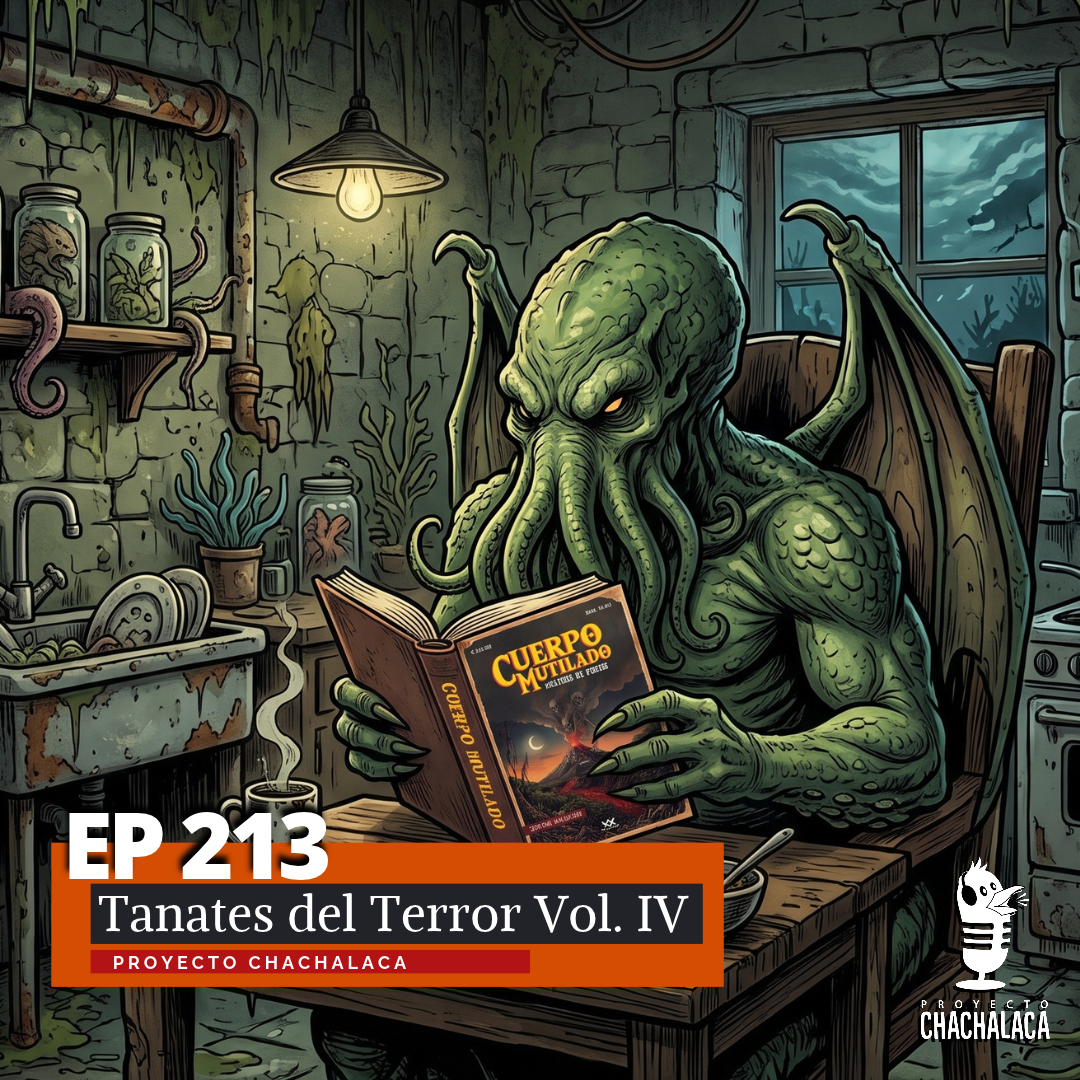
Tanates del Terror Vol. IV: The Cuerpo mutilado (Mutilated Body) Pact
Episode 213October 22, 20261 h 11 minWith Felipe Alfonso García, Ricardo Hernández Pereira
English version of an episode recorded in Spanish. · Leer en español
Short link: proyectochachalaca.org/ep213
In a nutshell
Two years ago, right here at this microphone, Felipe Alfonso García and Ricardo Hernández Pereira promised to put together an anthology of Salvadoran horror. They delivered: it’s called *Cuerpo mutilado* (*Mutilated Body*), bringing together seventeen writers and published by Pantógrafo Editores. In this fourth edition of Tanate del Terror, we talk about what it takes to curate an anthology, the many faces of fear, the Siguanaba (a shape-shifting spirit of folklore) as a *nahual* woman (a being with the spiritual power to transform into an animal), why this country's history is more terrifying than any ghost, and what place remains for artificial intelligence in creative writing.
Review
Content warning: This episode includes a reading of a short story with scenes of violence set during the 1975 student massacre, as well as mentions of extreme violence in other stories.
Review
A promise kept
Two years ago on EP108, Felipe and Ricardo said on air that someone needed to put together a Salvadoran horror anthology. This time, they’re back with the book in hand: Cuerpo mutilado. Antología de terror (Mutilated Body: A Horror Anthology), gathering seventeen Salvadoran voices published by Pantógrafo Editores and backed by the magazine Café Irlandés. They share how the idea hung in the air until Ricardo insisted on making it happen, and how, starting in January, they met every Tuesday to read and edit.
How a story gets chosen
Rather than putting out an open call, they reached out to authors whose work they already knew, ensuring a consistent quality and a wide range of styles. Ricardo draws a line between a compilation—which simply gathers pieces around a shared theme—and an anthology, which carries a deliberate editorial vision. Along the way, they talk about how hard it is to sustain independent cultural projects in El Salvador, and Felipe leaves a message for anyone asking for unpaid work: art is real work, too.
A street to get lost in
Felipe reads his story, «Una calle donde perderse» (“A Street to Get Lost In”), about a driver stranded at night on 25 Avenida Norte in San Salvador, where echoes of violence still linger. The story was born out of the July 30, 1975 student massacre. For Felipe, people often associate horror with ghosts, but war is just as terrifying—if not more—than a spirit whose very existence is in question. Ricardo takes it further: the book’s title speaks to a country scarred by impunity and terror, and the anthology serves as an X-ray of that shared history.
The faces of fear
Ricardo reads an excerpt from «El experimento Kravetz» (“The Kravetz Experiment”), a body horror tale about a corpse that begins losing fingernails and teeth after having been dead for only a few minutes. From there, our guests survey the subgenres living side by side in the book: body horror, folk horror in close-knit communities, Lovecraftian cosmic dread, the paranormal, and psychological horror complete with psychopaths, exorcisms, and altered states of consciousness.
The Siguanaba is a nahual, too
Local legends aren’t left behind. They discuss stories that reimagine the Siguanaba (a legendary shape-shifting figure from Central American folklore) as a woman nahual (a Mesoamerican spirit guardian or shape-shifter), exploring how the arrival of Catholicism reframed figures that once held profound spiritual roles into devils or moral punishments. They also bring back Francisco Gavidia’s «La loba» (“The She-Wolf”), which had previously appeared in EP211.
Who is truly terrifying
A common thread runs through stories written by authors who don’t even know each other: terror often stems from the very people supposed to keep us safe. An authority figure, a uniform, a priest’s cassock. The guests trace this back to Central America’s long history of violence, the disappeared under Latin American dictatorships, and the lingering reality of living where things happen every day that would be deemed unacceptable elsewhere.
Writing in the age of algorithms
The conversation closes around the craft itself. Ricardo welcomes artificial intelligence as a research aid, but never to write in someone else’s voice; Felipe stresses that an algorithm has neither lived experiences nor an inner need to express anything—and writing is, fundamentally, having something to say. Ricardo adds a warning about our fading attention spans, noting how hard it has become to stay immersed in a page for more than twenty minutes. Before saying goodbye, they give a shout-out to each of the book’s seventeen authors.
To go further
A little extra context from us to enrich the conversation.
The July 30, 1975 massacre
Felipe’s story draws on historical fact: on July 30, 1975, a peaceful student march departing from the Universidad de El Salvador was brutally attacked along 25 Avenida Norte in San Salvador. To this day, the true number of victims remains unconfirmed. A 2023 study, grounded in a survivor’s testimony, traces how that date has moved from enforced silence into the active memory of new university generations.
The nahual, beyond the scare
In Mesoamerican tradition, a nahual is far more than a witch who takes animal form. Anthropological studies describe the nahualli as a figure carrying vital community—and often protective—roles, whose meaning was rewritten by Spanish colonization. Reading the Siguanaba as a woman nahual restores that deeper, older indigenous layer to the legend.
Folk horror in insular communities
What Felipe calls folkloric terror is widely known in English as folk horror: tales of secluded rural communities, rituals, and insular traditions that curdled into active threats. Critic Adam Scovell mapped out the subgenre through foundational cinema like The Wicker Man. Just a quick note: Midsommar, mentioned in passing, came out in 2019.
Postwar dread
The idea that Central American horror springs straight out of its history has solid critical grounding. Literary scholar Beatriz Cortez famously characterized the region’s postwar writing as an “aesthetics of cynicism,” deeply shaped by disillusionment, trauma, and routine violence.
Get involved
Come celebrate the first public presentation of Cuerpo mutilado: Saturday, October 31 at 3:00 p.m. at the CRAI de la UCA, as part of the «Lee bajo tu propio riesgo» (“Read at Your Own Risk”) series. The guests also announced upcoming dates this November at Café Luz Negra and Centro Cultural Leyla.
Further reading
- Cortez, B. (2010). Estética del cinismo: pasión y desencanto en la literatura centroamericana de posguerra. F&G Editores.
- Davisson, B. (2025). El mito y la posición del héroe en los cuentos tempranos de Salarrué. Káñina, Revista de Artes y Letras, 49(1), 1–18. View online
- Gómez-Agudelo, J. W. (2023). Masacre estudiantil de 1975 en El Salvador: memorias, silencios y activaciones políticas. Revista Latinoamericana de Ciencias Sociales, Niñez y Juventud, 21(1), 1–27. View online
- Lovecraft, H. P. (1927). Supernatural horror in literature. The Recluse.
- Martínez González, R. (2006). Sobre la función social del buen nahualli. Revista Española de Antropología Americana, 36(2), 39–63. View online
- Scovell, A. (2017). Folk horror: Hours dreadful and things strange. Auteur Publishing.
You might also like
Transcript
Automatic transcript (Gemini), translated from Spanish and partially reviewed: names and unclear words may contain errors. The episode opens with a chat recorded at the end of the conversation; the formal introduction starts at 3:31. The read-aloud texts are the guests' own work, read by them.
Read the full transcript
[00:00] Amaru: That was episode 213 of Proyecto Chachalaca. Once again, we find ourselves here with Ricardo and Felipe, Los tanates del terror, volume...
[00:09] Ricardo Hernández Pereira: Four.
[00:09] Amaru: ...four. Already? Yeah, unbelievable. Time has flown by. But anyway, let's see, something I didn't ask you during the episode, but we're doing it because it's October: have you ever been spooked?
[00:19] Ricardo Hernández Pereira: Yeah, a couple of times.
[00:20] Amaru: What happened to you, Ricardo?
[00:21] Ricardo Hernández Pereira: Uh, I felt someone sit down on on on my bed.
[00:25] Amaru: Uh-huh.
[00:25] Ricardo Hernández Pereira: Right, I mean, I was Well, I wasn't in my bed, I was somewhere else, uh and I really felt like someone sat at the foot of my bed. And the next day when I asked, "Hey, what happened?", "No, no one came in here." Seriously, no one had entered. It was completely inexplicable to me.
[00:41] Amaru: Okay.
[00:41] Felipe Alfonso García: No, and this is going to sound really silly, but I feel excluded by the by the other world. They They don't want to spook me, they don't do anything to me. What did I do to them for them to not want to scare me?
[00:50] Amaru: Maybe when you want it too much, you scare them away. It's like a ghost repellent, something like that.
[00:54] Felipe Alfonso García: Yeah, how outrageous.
[00:56] Ricardo Hernández Pereira: No, but you're going to scare them with your work.
[00:57] Amaru: What?
[00:58] Ricardo Hernández Pereira: You're going to scare them with your work.
[00:59] Amaru: Ah, well, well.
[00:59] Felipe Alfonso García: Ah, well. Now that you say that, uh, some Some movies have horrified me, but because they're bad; some some books have also horrified me because they're bad, but just that.
[01:10] Amaru: Not Not the effect you'd want it to give you.
[01:12] Felipe Alfonso García: Not the effect I wanted, yeah. Nothing more.
[01:13] Amaru: Leaves you with no desire to keep reading. And well, taking advantage of the moment, let's make the announcement: on October 31st...
[01:19] Ricardo Hernández Pereira: That's right.
[01:20] Amaru: ...there will be the presentation of a...
[01:23] Felipe Alfonso García: The presentation of a horror short story anthology, an idea that came up in this project, in this In this podcast, and that managed to come to fruition, and today we're presenting it here.
[01:33] Amaru: Excellent. And what's the anthology called, Ricardo?
[01:35] Ricardo Hernández Pereira: Uh, it's it's titled Cuerpo mutilado. Antología de terror [Mutilated Body: Horror Anthology]. It features 17 voices of Salvadoran female and male authors whom, well, uh To whom I'm thankful for their trust, uh, and and for giving us the opportunity to create this anthology. It's a very good anthology that I highly recommend. Going back to it: October 31st at the UCA's CRAI at 3:00 in the afternoon, as part of the Lee bajo tu propio riesgo [Read at Your Own Risk] event series. We're going to be doing the first of three presentations, and well, what better way to celebrate Halloween than reading horror stories, right?
[02:10] Amaru: That's right. So well, you're also going to have other presentations, uh, at...?
[02:14] Ricardo Hernández Pereira: We're going to have a presentation on November 7th at Café Luz Negra, and on November 14th at the Centro Cultural Leyla we'll be presenting this material, uh, which is really high-quality material. I recommend it a lot.
[02:27] Amaru: Excellent. Well, next week, also opening a quick parenthesis, a short publication regarding this episode will be available on the Chachalaca website, proyectochachalaca.org, so you can read it, uh, and the references to the books we're talking about here will also be there so you can check them out, along with more Salvadoran authors. So, well, shall we start this episode?
[02:49] Ricardo Hernández Pereira: Let's do it.
[02:51] Locutor: This is Proyecto Chachalaca, a space to talk about who we are as Central Americans, and it's the small actions that keep this project standing. If you liked anything from this episode, share it with someone. Follow us on our social media too so you don't miss what's coming, and if you have a minute, leave us five stars wherever you're listening to us. That, even if it doesn't seem like it, helps us a ton to keep moving forward. And if you want to join in another way, collaborate with us, or suggest a guest, write to us. The door is always open. You'll find us as chachalaca.pro, because remember that for a story to keep existing, it must keep being told. And now, let's begin.
[03:31] Amaru: And this is Proyecto Chachalaca, Tanates del terror number four. This is episode 213, coincidentally. Well, and that's right, as you can imagine, this is Tanates del terror 4; the week before last was Tanates del terror number three, this is flying by. How's it going, Felipe? How are you? Two years without having you here on the project.
[03:51] Felipe Alfonso García: Yeah, two years already. And And last time I had also gone two years without coming, meaning that every every two years I return here to the to the To the podcast, yeah, during horror season, yeah.
[03:57] Amaru: Yeah, look, and during horror season.
[04:00] Felipe Alfonso García: Uh, like Like you told me: "You're like Pennywise, you return every so often."
[04:03] Amaru: Exactly, yeah. And Ricardo, who also got washed in by the tide? How's it going, Ricardo? How are you?
[04:07] Ricardo Hernández Pereira: Really happy to be here, man. Thanks.
[04:09] Amaru: Very good. Well, something we hardly ever do here, but I have a short bio of the guests. Here we have Ricardo Hernández Pereira, born in 1985, educator, director of Pantógrafo Editores, and creator of the podcast Bibliófilos El Salvador, author of Los lugares que abandonamos [The Places We Abandon] and...
[04:25] Ricardo Hernández Pereira: La ciudad en los ríos [The City in the Rivers].
[04:26] Amaru: Ah, excellent. And on the other side we have Felipe A. García, born in San Salvador, 1991, novelist, stand-up comedian, and head of the magazine Café Irlandés. Now, author of El infierno heredado [The Inherited Hell], a very good book, by the way.
[04:42] Felipe Alfonso García: Thanks.
[04:42] Amaru: And I think you had another book, another publication?
[04:44] Felipe Alfonso García: Yeah, there's the novel Hard Rock and Diario mortuorio [Mortuary Diary].
[04:48] Amaru: Okay. In this episode, and as is tradition, we're going to tackle the topic of horror narrative, and well, there's a a special thing, something that unites us today, and that is that on Saturday, on Halloween, you're going to do a book launch at the UCA, right? But I'd like to ask, what is it about October that puts all of us in the mood to get spooked? And also, at the book launch, are you going to go in costume, or are you going as normal?
[05:12] Ricardo Hernández Pereira: You say that October uncovers everything, right? The October winds uncover everything. No, I don't know if we're going We're not going, uh, in costume, but...
[05:19] Amaru: Hey, a chance to...
[05:20] Ricardo Hernández Pereira: Well, or whoever wants to show up, can show up in costume. I'm going to show up disguised as a professor. Uh...
[05:24] Amaru: You're going disguised as Ricardo.
[05:26] Ricardo Hernández Pereira: And look, happy because on Halloween we're going to be presenting at the CRAI, as part of Lee bajo tu propio riesgo, the anthology... I understand it's the first horror anthology published in El Salvador featuring multiple voices. We're going to be presenting it on on the 31st at 3:00 in the afternoon as part of this Lee bajo tu propio riesgo event, and well, thrilled, right? In what other What better way uh to think about Halloween if not by telling horror stories?
[05:53] Amaru: Okay.
[05:54] Felipe Alfonso García: And yeah, if October has something uh that makes it a season for scaring, it's a a phenomenon somewhere between meteorological, between Well, even climatic, and that is that at this time of year, the planet's northern hemisphere, which affects our country, is already at a point where it receives less sun, so the afternoons uh are much uh shorter, there's less sun, there's more darkness, cooler weather starts rolling in, and all of this is like a great stage to tell a a horror story.
[06:23] Amaru: Cooler.
[06:29] Ricardo Hernández Pereira: Of transformation.
[06:30] Amaru: Of Definitely, look, because I mean, during this season, what what I feel like doing is being all bun bundled up when it's cold, or when it used to be cold...
[06:38] Felipe Alfonso García: Yeah, it's it's not that cold anymore, but but still, I mean...
[06:40] Amaru: Now the cold only remains in literature, right?
[06:42] Felipe Alfonso García: We're kind of gloomy right now. We have somewhat gloomy weather right now that can also uh lend itself to a horror story.
[06:48] Amaru: Okay, very good. Well, 2 years ago on this very, let's say, podcast, you guys committed to to developing an anthology. Was it hard? How does one make an anthology of this kind? And well, what's the anthology called, by the way?
[07:01] Felipe Alfonso García: The anthology is called Cuerpo mutilado. Antología de cuentos de terror [Mutilated Body: Horror Short Story Anthology], and yeah, in in fact, 2 years ago when we were talking about horror stories, when we were specifically talking about horror stories from El Salvador, uh the idea came up that, well, it would be interesting to make an anthology of of of stories by Salvadoran authors, and I must say it was thanks to uh Ricardo, who was the one who uh didn't let it just stay as an idea, but almost, I don't remember if it was the next day or or...
[07:29] Ricardo Hernández Pereira: About a week later.
[07:30] Felipe Alfonso García: ...or a week later, yeah. But he wrote to me and said: "Hey, I'm down, I I do want to do the anthology. Uh, you up for it? Let's do it." And then he started proposing the the the first stories. Uh, I think you proposed more stories than I did; I mean, I I had a a few in mind, nothing more, and then came the whole process of reading of of the of those stories to select them.
[07:49] Ricardo Hernández Pereira: It was a pact, right?, that was fulfilled in the end. And it happened right here where we're sitting recording this podcast, and well, these things come about just playing around, right? I think that that's the fun part of the process. I really had a blast because it took us over a year. I think we finally got organized, like, seriously around the middle of last year; that is, we finally went like: "Okay, look, let's pick this back up."
[08:12] Amaru: Uh-huh.
[08:13] Ricardo Hernández Pereira: Uh: "Let's meet up." And well, since I think since January we've been meeting every Tuesday—correct me if I'm wrong, Felipe—since January uh we did it through a timeline, a schedule of meetings, and starting in January, um, we set to work with the selected texts, uh working on each one, reading it and editing it.
[08:32] Amaru: Look, how how interesting this is, and congratulations, because it must be said that what is often promised on a podcast is like what's promised during a drunken brawl: it doesn't...
[08:40] Felipe Alfonso García: [Laughter]
[08:40] Ricardo Hernández Pereira: Hell yeah, that's true.
[08:41] Amaru: ...it usually doesn't happen. But, uh, I find it really interesting, but how does this work? Is it like running a sort of two-person book club to reach a final product? Or how how would you describe it? I mean, you met on Tuesdays, you said.
[08:52] Ricardo Hernández Pereira: Look, uh uh the credit goes to the authors, right? The credit goes to the authors who gave us their trust and believed in the project, letting us read their materials, letting us uh review them, edit them in cases where they warranted some kind of editing. I think it's always great to have an extra pair of eyes to review each other's work, and well, like that, right?, with dedication, with dedication and with patience, like everything that's done in art.
[09:19] Felipe Alfonso García: I think there are two ways to make an anthology—not that I have a ton of experience in the matter, but I've I've I've seen it: one is with an open call, when an open call is launched, but there uh you run the risk of receiving all kinds of material, some of higher quality than others, and that, well, makes the selection a bit harder, it takes longer because while you're waiting for, like, the perfect amount of stories for for the anthology, we don't know how long it could it could take, right? I mean, no matter how much you set a deadline, we don't know if we're going to reach that number. But here we had the advantage that we already had, like, the track record of these stories; we had already read them before, uh some had already been published, and it was just a matter of: "Hey, do you remember that story by by by that author?", "Yeah, I think that one has this characteristic, it's this and this, and and it fits into the horror category," "Ah, perfect. Look, what about this other story?" So then it was a matter of discussion in in which we started to review all that material we had already read and see which ones met the the criteria to make it into the into the anthology.
[10:19] Amaru: Okay. Well, let's put that on pause for a moment because there are some questions here that we need to ask so that the the people listening to us can get to know you a bit more, but we'll soon continue with how this anthology thing is put together. And well, I'd like to start here. Ricardo, in these 2 years, Daños colaterales [Collateral Damage] and now this anthology arrives, who is Ricardo nowadays compared to the last time you were here?
[10:43] Ricardo Hernández Pereira: I'd like to think someone who listens more, who reads more, and who speaks more through his work. Uh, in fact, I even quit one of my jobs to have time in the afternoons to read more, uh write more, and dedicate myself, well, to a couple of projects coming up at Pantógrafo for this next year, so I'm happy, happy to have created those conditions and, well, to enjoy the process, because in the end that's what you enjoy, right?, the process.
[11:08] Amaru: Okay, very good. And on the other side, Felipe, you who return here like Pennywise every 2 years, uh, Café Irlandés was on hiatus and this year it came back. Who are you this year, and why is Café Irlandés returning now?
[11:12] Felipe Alfonso García: Every time, yeah.
[11:21] Felipe Alfonso García: Well, I don't I don't remember what my answer was 2 years ago, honestly, but I don't think there's much change; I mean, I think I've stayed uh true in the sense of of being a reader, of, uh, being a person who likes telling stories, who likes listening to stories too, uh so I think I stay true to that. Regarding Café Irlandés, well, same thing: it's a personal project, it's a project that obviously doesn't generate income or anything like that for me, and so there are moments when one has to look out more for uh surviving, right?, for looking for other types of activities that do yield some remuneration, and therefore those uh personal projects get neglected; I mean, uh I don't With all due apologies to people who sometimes uh ask me for some work and tell me: "Do it for the love of art," well, no, I can't uh do things for the love of art either because art is also work, so I can't just give away uh certain uh certain activities that easily either. It's like, I say in Remember that I also do stand-up comedy, I say in in in in some bits, I mean, it's like me telling my my barber: "Look, cut my hair for the love of hair," right? I mean, no, don't...
[12:30] Amaru: [Laughter]
[12:30] Felipe Alfonso García: ...I'm belittling his work, I'm belittling his work, and it shouldn't be that way either.
[12:34] Amaru: [Laughter] I can't imagine that.
[12:36] Felipe Alfonso García: So... Yeah, yeah, so uh...
[12:39] Amaru: I'm going to pay you in hair, Mr. Barber.
[12:41] Felipe Alfonso García: [Laughter] Right, of course. So when when the project was on hiatus, it's because I didn't have, let's say, the time to sit down to to to read all the stories I was receiving—not that there were that many, but for the very reason we mentioned regarding the anthology, right? I mean, you receive stuff, and stories don't always have, like, the same quality, so uh there were moments when I couldn't find material to publish. Now I think I have a little I mean, it's not that I have the time, but I think I can reach out uh to certain people who can help me and can uh lend me material so the magazine can keep being fed.
[13:12] Amaru: Okay.
[13:13] Felipe Alfonso García: Maybe not at the same pace as before, but it's always going to be active.
[13:15] Amaru: It's always going to be active. And it's always an option for people to contact you and send you...
[13:17] Felipe Alfonso García: Yeah.
[13:19] Felipe Alfonso García: Always, it's always an option.
[13:21] Amaru: Okay. Well, let's continue with the anthology topic. You were already mentioning that this was like a It wasn't an open call, but rather like a selection project from what you had already read, right? So, to start, I'd like us to define what an anthology is, because for this, let's say for those of us on the ground here when it comes to literature, how is an anthology different from, say, a compilation book or a collection of stories by a single author?
[13:48] Felipe Alfonso García: Well, uh if you want...
[13:50] Ricardo Hernández Pereira: Well, my understanding is that a compilation is a collection of materials based on a theme, a genre, um, or a movement that you want to bring together—you simply gather them and publish them. In the case of an anthology, there’s an underlying criterion, there’s an intent, um, in how you choose the materials, um, even how you order them, how you arrange them. There’s an intent and an editorial criterion behind it, um, and that’s what we’ve tried to do. In this case, an—an—an anthology of different authors, um, though authors can also put together or create an anthology themselves with an intent or under their own specific theme, but I understand that would be like the—the—the most basic distinction, right, Felipe?
[14:33] Felipe Alfonso García: Yes, it has a lot to do with the—the plurality of—of—of styles that can be found, of themes that can be found, and I'm not just talking about a plurality of—of—of authors, right? That goes without saying, that there will be multiple authors, but the same theme, um, can be approached in different ways depending on each author's interests. That is, every author, in the end, when they're writing, is pursuing some interest, whether it's, um, because of their references, what they've read, or the topics they're interested in addressing. So ultimately, um, to be more specific with the question you were asking me, um, a collection by a single author, um, of an author's texts, a—a—a single body of work—I mean, there, for instance, we’re going to see a series of short stories that might be very different from one another, but they pursue an interest on the author’s part, a specific theme; there’s an objective there, a—a communicative objective, if we want to get a little more, um...
[15:27] Amaru: More dry or technical, let's say.
[15:28] Felipe Alfonso García: ...yes, more technical. There's a communicative objective behind them. On the other hand, in an anthology featuring multiple authors, well, we're going to see that—that variety of—of—of—of styles, of themes, of goals that each one has. Always brought together under an editor's concept, so—so to speak...
[15:43] Ricardo Hernández Pereira: And—and in the case of Cuerpo mutilado [Mutilated Body], it's an anthology where we tried to ensure the quality, um, didn't drop below a certain standard, um, and above all, that it draws on different elements of horror, right? From—from body horror, cosmic horror, supernatural horror, folk horror, um, through a plurality of voices and approaches, we've tried to organize the authors' materials into an anthology that offers a reading experience to that audience, especially young readers too, right? Which is also a way into literature, into the world of reading, of course, and, well, um, we've tried to make it very well put together.
[16:27] Amaru: Right. Now, here's the thing. I'm trying to, like, translate this, right? So let's say this is like—you guys are like the head coach of a soccer team, right? Let's imagine it's La Selecta, so what you do is make a selection, but there have to be criteria. Just like, for example, La Selecta has a habit of getting people's hopes up and then playing terribly, so I imagine what you guys are trying to do is select short stories or tales that meet a certain standard. So, I'd like to know what criteria you used to make this selection of narratives.
[16:54] Felipe Alfonso García: I think that before anything else, we are readers too, and for that very reason, um, it was a selection of stories that we would have liked to read, that we would like to find in—in—in—in a book. Um, there were several stories that were left out of—of—of the anthology, um, some—I don't want to say because they were of lesser quality or anything, but maybe they just weren't what we were looking for as readers at that moment; others, um, veered off into other themes, and they were great stories, but at the end of the day, um, they got away from us due to length or things like that, right? But I think the main requirement was a story that we would enjoy reading as readers. Then after that, um, we start adding other kinds of criteria, such as: "Okay, we need, um, a story that..." Well, if we're going to talk about horror, something very important is for the characters to be in a situation where they truly, you know, feel threatened, where they genuinely convey to the reader that anguish they're experiencing because of what's happening within the narrative, right? Those are more technical matters that one goes about selecting, and then you also add styles into the mix, right? The ones Ricardo mentioned to you: folk horror, which is a type of horror that takes place, say, in a town bound by a tradition...
[18:09] Amaru: Like, folklore-based, like folk horror, like the revenge of the Torito Pinto, something like that.
[18:15] Ricardo Hernández Pereira: [Laughter]
[18:16] Felipe Alfonso García: Um... Well, that could be a setting, that could be a setting, yes, but well, for example, um, if we translate it, say, to a movie to make the—the—the—the example broader, um, I think Midsommar, a movie from 2009, I think it is...
[18:34] Ricardo Hernández Pereira: Or El hombre de mimbre, The Wicker Man.
[18:36] Felipe Alfonso García: The Man—right. But they're—these are characters who leave the city, go to a village where they have a different kind of—of—of—of traditions, a different kind of rituals that have nothing to do with what one is used to, so when they see—when they encounter those traditions, they feel threatened by them. There comes a moment when they even feel in danger because of these—these, um, traditions. I think the most emblematic story of—of—of this, of folk horror, is Shirley Jackson's, the one with, um, La lotería [The Lottery]...
[19:03] Ricardo Hernández Pereira: La lotería.
[19:04] Felipe Alfonso García: ...where in the end, it's seemingly an ordinary lottery game in an utterly ordinary town. Eventually, someone turns out to be the winner of the drawing, and this person who won starts worrying and says, "No, I—I didn't want to win. I mean, not my family, no, no." So, you find yourself asking in the text, "Why doesn't she want to win the lottery?" And in the end—sorry for the spoiler here—in the end the prize is more of a punishment than a prize, but it's the tradition of this town, foreign to our own traditions, right? That's, for instance, an—an—an example of folk horror.
[19:20] Amaru: Why doesn't she want to win?
[19:35] Amaru: Right, right, I'm getting the idea now.
[19:37] Ricardo Hernández Pereira: There are quite a few stories in the anthology—I think Jorge Mercado's...
[19:40] Felipe Alfonso García: Jorge's, yes.
[19:41] Ricardo Hernández Pereira: ...Julio, um, Orellana's too, is—is along those lines...
[19:46] Felipe Alfonso García: Héctor González's.
[19:48] Ricardo Hernández Pereira: Héctor González Guerrero's, exactly. There are quite a few stories set in urban settings and rural settings, in houses, in enclosed spaces, in parks, um, and it's really nice to find familiar places in a way, and—and—and—and here I'll take the opportunity to answer the question as well, right? Which stems precisely from that imaginative impulse, right? If a horror anthology were to exist in this country, what would I want that anthology to look like? How would I like to read it? And based on that idea, we started selecting the materials...
[20:18] Amaru: Right, the criteria. Uh-huh.
[20:20] Ricardo Hernández Pereira: ...and, um, you know that, like any editorial—look, an editor is someone who recommends something to you, and I think that's where that genuine urge comes from: "Look, you have to read this," right? Like, "This material is so good, I like it so much that I want you to read it." And that's also how many publications come to be, and—and that's how an editor builds their catalog. You say, "This material is so good that I don't want to just read it myself, I want someone else to enjoy it."
[20:41] Amaru: And let everyone else suffer. If I suffered through this, everyone else is going to suffer through it too.
[20:43] Ricardo Hernández Pereira: Or—or relish it at the same time.
[20:45] Amaru: Or relish it, yeah. That's fine, I find that very interesting. And well, Ricardo, since we're on the subject, you had put together some anthologies previously, right? You already had two previous anthologies, I believe. Um, what difference do you find in this anthology and the way you put it together compared to the earlier ones?
[20:59] Ricardo Hernández Pereira: Look, I think all projects are important. The—the Cuentos indispensables [Essential Stories] project came about because I wanted to bring together the voices of teachers, of educators. Look, we live in a country where reading, um—well, the thing is, we see it in test scores and we see it in the classroom, and I'm telling you this as a teacher myself. Um, of course, I think there's a lot of reading in this country, but what kind of reading are we doing? Um, how many students are capable of losing themselves for twenty—twenty minutes, half an hour, deep in a text, um, and—and forgetting the outside world and focusing on a reading? Um, Cuentos indispensables arose from the desire to seek out those teachers who loved reading, who taught people how to read, and who also, um, wrote. That's how Cuentos indispensables came about, spanning three volumes, um, where the requirement was that the authors had to be educators. And it was also a learning experience, you know? I think there's no school for this sort of thing here in the country, and sometimes you just learn as you go. And—and then with Daños colaterales [Collateral Damage], well, it was a fairly similar situation, only these are texts, they're—they're narratives, they're works of fiction addressing the state of exception in El Salvador from different angles. So, um, what came about with—with Felipe here, and—and it was part of the pact we fulfilled and why we're here talking about it now, is that Café Irlandés is a platform, um, a very important magazine that began building a catalog of—of narratives, um, and I always really enjoyed the Halloween specials that Felipe put together. In fact, um, Sos machi [You're Machi] was published there in one of those open calls, if I'm not mistaken, back in 2020, and—and I think those spaces, now that there are no magazines, um, or at least no state-run magazines, but rather magazines, um, or independent publishing initiatives like El Escarabajo, for example, like Revista 3000, the 3000 cultural supplement, um, like Café Irlandés is—well, we said, "Alright, let's do it, man. Let's do it, since we have this material, let's create something." And we started meeting and—and—and shaping the material and bringing together all these wonderful stories that we hope people enjoy.
[21:12] Amaru: It's becoming scarce.
[23:08] Amaru: Also, as part of this episode and a tradition we have on Tanates del terror [Bags of Horror], we're going to read a few horror stories, so let's start with the first one.
[23:17] Felipe Alfonso García: Well, um, I selected this story—plain and simple—because of a rights issue. While it's true that the authors granted us the rights to the stories, that was for publication; reproducing them, that is, reading their stories on other audiovisual media, that requires a different kind of permission that we'd have to clear with them first.
[23:35] Amaru: Which we don't have at the moment.
[23:36] Felipe Alfonso García: Which we don't have at the moment, so since I'm right here, it's better if I read one of my own stories—not out of ego, but so—so we don't run into any kind of trouble.
[23:44] Amaru: Yes, of course.
[23:46] Felipe Alfonso García: The story is in fact in the anthology; it's called Una calle donde perderse [A Street to Get Lost In].
[23:51] Felipe Alfonso García: 25 Avenida Norte is a street where it's easy to get lost. I don't say that because it's full of twists and turns, because it isn't. It's a straight, two-way street where you don't even need an intersection to leave it. The problem is that anyone trying to walk it at night is exposed to the energy inhabiting it, clouding and disorienting their path until they can no longer find a way out. During the day there's nothing frightening; it's one of the busiest thoroughfares in the capital. The only danger is getting mugged; the chances of being killed in broad daylight are very slim—at least nowadays. But during the war, there was no schedule and no justification needed to blow someone's brains out. At night, the atmosphere is different. Once the eight o'clock rush hour ends, the street is left deserted; you feel the emptiness and the silence. Except for a gas station at the intersection with Bulevar Tutunichapa, there's no nightlife or open businesses around. It's an area with hospitals and clinical labs, so quiet is essential for patients to recover. The National University is also there, but at that hour of the night it's closed. It wasn't a street I drove down often—in fact, I still don't—but that night I had to drive through there because I was giving a classmate a ride home. After dropping her off, I set the GPS to find the best route back home. As soon as I turned onto the avenue, I saw the lights of the gas station. I didn't pay it much mind because I didn't need it, but four or five blocks later, my car broke down. I was stranded on that avenue. I looked up my insurance company's number on my phone, but for some reason, I lost cell service. The only thing I could think of was to head back to the gas station to ask for help. I locked the doors and windows tight, and made sure I hadn't left anything valuable inside. I was terrified that when I got back, I'd find the car stripped, with smashed windows and no tires. I walked with my phone in hand, checking it every few steps, hoping the signal would come back at any second. It wasn't until I saw the first person that I realized how risky it was to walk around holding something so valuable. My first thought was that the guy approaching was a junkie. It was the only explanation that made sense seeing him walk down the middle of the street, with no fear of getting run over by cars. He was stumbling along, his clothes dirty and torn. I tried to avoid eye contact as much as possible, afraid that if he noticed me, he'd try to come over, but the man walked right past me. It was surreal how deserted the avenue felt. I might have seen one or two cars pass by at most since I'd started walking. One of those cars flew by so fast that I worried about the supposed junkie wandering in the middle of the road. If that reckless driver crossed his path, there was no way he'd be able to swerve in time at that speed. I took my phone out again to check for reception, but there was still no service. Just as I slipped it back into my pocket, the second man appeared. He was walking on the same sidewalk, heading toward me. He had a cap on, and half of his face was covered by a red bandana. It was hard to tell if he was looking at me; he was walking faster than the first guy. He had a rock in his right hand. The closer he got, the more I realized he was staring right through me, as if I were a ghost. Just a few steps away from me, the guy raised his hand with the rock and threw it at me. My immediate reaction was to cover my head with my hands. I heard the rock hit the pavement in the distance. I opened my eyes and looked around for him. The man was already gone. I knew I wasn't far from the gas station, which urged me to pick up the pace. I felt a few drops fall on my head; I didn't think much of it, assuming it was just water. When I looked down at the pavement I was walking on, I slowed down again. Under the glow of the streetlights, I saw drops darkening the sidewalk. It wasn't water; it was a thicker substance. I stared at the asphalt avenue and noticed it was getting splattered with that thick, dark substance. I looked up, but there were no clouds, no stars—just a black mantle enclosing everything around me, cutting me off from all sound. Before that sonic torture erupted, silence reigned. I tried to ignore my surroundings and kept walking, but the drops kept marking my path. Then the third person appeared. The man was hunched over, limping, clutching his right side with both hands. When he stumbled into me, he collapsed beside me. I didn't know how to help him; I had no first-aid training. The only thing that occurred to me was to apply pressure to the wound to keep him from bleeding out. "Do you want me to call someone?" I asked frantically, even though I knew I didn't have cell service. The man didn't answer; the moment his eyes met mine, he lost consciousness. What came next is something I still can't explain. I felt the road begin to vibrate beneath my feet, but it wasn't an earthquake; the vibration was like the ground shaking when a heavy freight truck rumbles by. Then came a barrage of detonations, explosions that seemed to echo across the sky. I crouched beside the fallen man and covered my head with my hands. I had no idea whether someone was setting off powerful fireworks a few streets ahead or if I was in the middle of a battlefield. The air turned noxious. I pulled my shirt over my nose to avoid breathing in whatever was hanging in the air. My eyes stung fiercely and began to tear up. I felt an urge to splash water on my face to soothe that burning that scorched my skin and kept me from opening my eyes. I could barely part my eyelids, and with all the tears pooling in them, everything was a blur. I can't say for sure how many people appeared on the road—I don't even know if I imagined them—I just had the feeling I was about to be trampled by a crowd fleeing from something. Mingled with the blasts in the sky were screams, heavy breathing, and fearful sobs. I even heard shouts of hatred that were just as thunderous as the explosions. Silhouettes were sprinting past all around me. "What's happening? What is going on?" I started yelling, holding out my arms, but no one answered. I tried to stand up, but my legs were tingling with pins and needles, and whenever I tried to get up, I collapsed to my knees. I rubbed my eyes trying to clear them, but the scene remained blurry through the film of thick tears. That was when I felt hands on my shoulder. "Friend, are you okay? Do you need help?" a man shouted in my ear. "What's happening?" I yelled back as he helped me to my feet. "Come on, let's get help," he said, ignoring my question. He seemed well-intentioned, but my suspicious nature got the better of me. I shook the man's hands off and asked myself again what was going on, but I didn't feel his presence anymore. The man had vanished.
[29:55] Amaru: Okay. That's really interesting because, well, the 25th has plenty of stories, right? And what I get from this narrative is how everything that happens—everything that has happened there, like the 1975 massacre, the constant traffic of buses or heavy freight in the area, its history with Tutunichapa, the violent acts that have taken place there—it's like it all converges in the mind of someone walking across it?
[30:18] Felipe Alfonso García: Yes, the story actually stems from the student massacre. We have to remember that history—the history we have in our country, which is a very violent one—is also part of the terror we've lived through. I mean, when people talk about the horror genre, they usually associate it with the paranormal, with ghosts, but let's be realistic: a war is just as terrifying, or even more terrifying, than a ghost that we don't even know truly exists or not. So the story blends the paranormal a bit with the country's history.
[30:50] Amaru: You know, that's really interesting too, because you could say we often watch war movies more from a heroic angle rather than as acts of terror or something like that, but that's precisely because we're watching it on a screen or reading it in a book that talks about heroism as such. That's what people have gotten used to, let's say. But nevertheless, if you look at it from the perspective of someone actually living through it, it's something nobody wants to experience...
[31:13] Felipe Alfonso García: Of course.
[31:14] Amaru: ...living in constant terror. And well, regarding the title, I also find it very interesting: it's called Cuerpo mutilado [Mutilated Body], right? What connection do you see between the title and the stories inside?
[31:25] Ricardo Hernández Pereira: Well, we live in a country where we've had so many wars—just imagine. A country plagued by impunity and horror. In a way, I think this is an X-ray of the national psyche and history. How could we not talk about terror and impunity in a country defined by that very thing? And I think Central America as a whole, right? It feels a bit like The Twilight Zone. Here in Central America, all sorts of things happen that wouldn't be tolerated in other parts of the world, and here it's completely normal, right?
[31:47] Amaru: Clearly.
[31:54] Amaru: You know what? I'd add Central America and Argentina—two places where things happen...
[31:56] Ricardo Hernández Pereira: Ah, right.
[31:59] Amaru: ...that have no explanation.
[31:59] Ricardo Hernández Pereira: Latin America, exactly. So it kind of comes from that direction, right? There's a poem I really like by José María Cuéllar titled Guerras en mi país [Wars in My Country], and I think that, in a way, El Salvador is a mutilated body, isn't it?
[32:12] Amaru: Okay. Well, also, when I think of a mutilated body, I just think of Frankenstein, because it's a mutilated body stitched together from different corpses, right?
[32:21] Felipe Alfonso García: Sure, and it's really interesting you bring that up because, well, Frankenstein, as we know, is—what do you call it?—a compilation of body parts, right? But if we analyze the history a bit, of how and when Frankenstein was written, we see that the fears back then were different. But I want to tie it to this: there's a book called Frankenstein en Bagdad [Frankenstein in Baghdad], if I'm not mistaken...
[32:30] Amaru: Of parts.
[32:45] Felipe Alfonso García: ...by an author whose name I can't pronounce because it's, um...
[32:51] Amaru: Let's blame copyright, right.
[32:52] Felipe Alfonso García: No, no, no, [laughs] seriously. It's unpronounceable, it's—what's his name, uh...
[32:53] Ricardo Hernández Pereira: No, they want to.
[32:57] Amaru: Let's play the copyright card because we can't afford to pay.
[33:00] Felipe Alfonso García: Right, let's play that card. But it's about a compilation of body parts gathered from a war—the Iraq War—and how they're assembling it. So it's like an Iraqi version of Frankenstein, right? But it's because of the war, because of the fear they live with there, which is the war they experience.
[33:17] Amaru: Okay. And yeah, look, I think for our generations—I mean, I was born pretty much right around wartime, I was born in '91, and I think you were too.
[33:25] Felipe Alfonso García: Yeah.
[33:25] Amaru: So we didn't really see the war firsthand; whatever happened, we don't remember it. The Peace Accords were even signed in '92. But for those who lived through the war, for many of them, when it comes up, it's something they never want to experience again. Especially if you were like the vast majority of Salvadorans—poor or middle class, right?—so it's not something you'd ever want to relive. These are terrors that keep circulating in our narratives. But anyway, I'd like to move on to the next reading. You'll do this one, Ricardo.
[33:56] Ricardo Hernández Pereira: Yes, it's an excerpt from the piece titled El experimento Kravetz [The Kravetz Experiment].
[34:01] Ricardo Hernández Pereira: "My father says I was dead for a couple of minutes. They tried to revive me with electric shocks. It was Ana Lucía who recognized me in the crowd; she carried me in her arms and brought me straight to the hospital. 'You're dying,' my father tells me as he holds a mirror in front of my eyes. My cheekbones are hollow, my lips are cracked all over, and I have barely any hair left on my head. My old man points to some flowers resting on the bedside table, next to the IV pole holding my drip bag. 'She left her number,' he says, handing me a small brown envelope. On the ride home, looking through the car windows, I watch the city's appearance change the farther we get from downtown. The streets grow narrower, dimly lit, and lonelier than ever. A strange sense of unease washes over me. My toes feel numb; when I look at them, I realize my toenails are missing. They sting, they ache. I feel terror. I need to call Dr. Kravetz as soon as possible."
[34:56] Amaru: Okay. Let's talk about this story. I believe it was also in your previous book, right? What would you say inspired you to write this experiment?
[35:05] Ricardo Hernández Pereira: Well, look, I can't really say, because it's only once I finish writing that I go, "Well, what's going on here? What did I just do?" But it's a story that touches on the alter ego, right? The other self, a transformation. Some friends at the book launch told me, "Hey, look, it reminded me of a movie—I think it's called The Substance." I told them, "Well, look, this was published before that."
[35:23] Amaru: Ah. Like a sort of shapeshift—a metamorphic thing.
[35:25] Ricardo Hernández Pereira: It was published a couple of years earlier, so [laughs] no, it has nothing to do with it, but in a way it does, because it deals precisely with transformation, with processes, with the algorithm, with a personal desire, and with the other people who can inhabit you, right?
[35:41] Amaru: Okay. Well, Felipe, what do you think? This time you were on listening duty.
[35:45] Felipe Alfonso García: It's quite a disturbing story because we've all felt pain at some point, and the story as a whole evokes physical pain so strongly. It touches on something we can all relate to, like feeling your teeth fall out at one point in the story, feeling brittle bones, feeling—what do you call it?
[36:10] Ricardo Hernández Pereira: The nails.
[36:11] Amaru: Nails, teeth, right?
[36:12] Felipe Alfonso García: Nails, yeah, teeth. Right, I mean, we've all experienced that, so when we read the story, we can feel it to a certain extent, and that's what makes reading it so uncomfortable and therefore pretty terrifying, too. Because let's face it: beyond any ghost or whatever, we're all afraid of getting sick, we're afraid of death, we're afraid of pain. I mean, some people aren't afraid of death itself, but they're afraid of pain...
[36:37] Amaru: Of the sensation.
[36:38] Felipe Alfonso García: ...of the sensation of pain. So I think that story—which, again, if we're talking about subgenres, could be labeled as body horror—handles that very well.
[36:50] Amaru: Okay. It also reminds me of a movie called Martyrs, which itself is—I guess that would be body horror, something like that, right?
[36:57] Ricardo Hernández Pereira: The Fly as well, Cronenberg.
[36:58] Amaru: Ah, The Fly, yeah, yeah, exactly. How—when his skin is peeling off and the whole deal, which is something that just...
[37:02] Ricardo Hernández Pereira: In fact, that was one of Cronenberg's intentions, wasn't it? Having the character go through a decline, just like any terminally ill person goes through a progressive deterioration.
[37:14] Amaru: Yeah, in fact, these Cronenberg monsters have become famous again today thanks to Rick and Morty, because they show up regularly there, right? All the time, a whole universe of Cronenberg monsters.
[37:25] Felipe Alfonso García: Just allow me to add a quick note there—the book I mentioned is called Frankenstein en Bagdad, the author is Ahmed Saadawi. Yeah, that's why I couldn't pronounce it, but now you have the info.
[37:34] Amaru: Ahmed Saadawi.
[37:40] Amaru: Okay, perfect. Well, let's also talk about these different types of—you already mentioned cosmic horror, which is essentially H.P. Lovecraft's foundation, right? Where he tries to evoke horror or these terrifying entities that come from beyond the planet. But could you tell us a bit about the terrors we can find, the types of horror in literature?
[37:59] Felipe Alfonso García: Look, in the end, these are all labels used mostly for categorization. They all belong to the same genre, which is...
[38:08] Amaru: Horror.
[38:09] Felipe Alfonso García: Okay, there's a slight distinction here that that that we really need to make. That is, we're used to talking about genres, and sometimes people talk about subgenres, but in reality there is no subgenre; the genre would be narrative fiction. We're talking about narrative fiction, then there's the poetry genre, the essay genre, non-fiction, et cetera, et cetera—though non-fiction, well, it's also narrative of... Theater, that was the one I was missing. The rest are styles, narrative styles. In the case of horror, horror is a narrative style, but what happens? As work has continued on it, each author starts wanting to develop their own narrative style within horror, so they pick up new characteristics, and when they start picking up more characteristics, that's when they start getting labeled so they can be organized. A professor told us in our master's program that in the end this is more of a convenience, something given to booksellers to make it easier when shelving books, but in reality we're talking about identifying certain characteristics and saying, "Okay, these follow the same line, so we can categorize them this way." That being said, the genre, I repeat, is horror—sorry, the style is horror, but from that stem other types of horror, like body horror, which is what we were mentioning where...
[38:30] Amaru: Theater, right.
[39:23] Amaru: It evokes the sensation, so to speak, it aims to produce sensations related to physical pain.
[39:26] Felipe Alfonso García: Yes, exactly, precisely around physical pain. That's where, let's say, its main agent of fear is centered. There's also, as we were telling you, folk horror, which has to do with leaving the city we're in or the place we're in and going to remote towns with other traditions that clash with ours. At the end of the day, we could define horror as two worlds colliding that shouldn't be together. So, we're here with our own traditions, and suddenly we go to a town with a different tradition, where we even end up thinking: "Why are they doing that? That's barbaric, you'd get locked up for that in..."
[40:06] Amaru: Say, for instance, we could make up a simple story here called Los verdaderos juegos de las bolas de fuego de Nejapa [The True Fireball Games of Nejapa], right? Where what people actually do is douse themselves in gasoline, and what they're playing at is practically killing each other.
[40:14] Felipe Alfonso García: Exactly, exactly.
[40:19] Ricardo Hernández Pereira: Trying to burn each other.
[40:20] Felipe Alfonso García: Exactly. So, to other people it might be something completely foreign, and we say, "Hey, what they're doing is dangerous," but it comes from a tradition, you know, that they have.
[40:31] Amaru: Right, right, I'm starting to get it.
[40:32] Felipe Alfonso García: What else could we mention? Well, the paranormal, which is the most common one, the one everyone associates with horror—we're talking ghosts, demons, right. Yeah...
[40:39] Amaru: Ghosts that don't find peace in this...
[40:42] Ricardo Hernández Pereira: Psychological horror as well, right?
[40:43] Felipe Alfonso García: Psychological horror...
[40:44] Ricardo Hernández Pereira: Laura Vadillo's short story is also psychological horror.
[40:46] Felipe Alfonso García: It has psychological horror, correct, which is basically the psychosis a character experiences, the paranoia they can go through when they don't even know if something is actually happening. What's also known as an altered state, right? They're in an altered state where they don't know if what they're experiencing is actually the result of something paranormal or if it's all in their head. We're all afraid of losing our minds at some point, afraid of madness. Another characteristic of horror is change, metamorphosis, and madness is something that represents a change for a person. Going from being a sane person to reaching, say, a certain age and starting to lose your—what do you call it?—your memory or something, is something we all fear. So the psychological aspect also taps into that feeling of not knowing what's happening, whether I'm really going crazy or if something is truly harming me. What else could we mention?
[41:38] Ricardo Hernández Pereira: Look, Luis Contreras's story goes along those lines too, doesn't it?
[41:41] Felipe Alfonso García: That one too. Just to give a brief mention, it's about a person who is kidnapped, and the whole—I mean, most of the story takes place in a room.
[41:47] Amaru: Is that the one by Luis Flores?
[41:48] Ricardo Hernández Pereira: That's the one by Luis Flores.
[41:49] Felipe Alfonso García: Oh, you told me Luis Contreras, right, yeah.
[41:50] Ricardo Hernández Pereira: The one titled Buenas personas [Good People].
[41:51] Felipe Alfonso García: Buenas personas, yeah. Although in Buenas personas we also see a kind of horror that stems more from a psychopath's perspective; he's a character who is more of a—I don't know if he's a psychopath or a sociopath, but you can tell he's someone who isn't entirely right in the head, because it begins—it's a story that starts out quite playful, very childish, narrated in his childhood watching Woody Woodpecker, but...
[42:17] Ricardo Hernández Pereira: But there comes a point where the story offends you, doesn't it?
[42:19] Felipe Alfonso García: Right, there's a moment where you think, "What is up with this guy?"
[42:22] Amaru: What happened?
[42:23] Ricardo Hernández Pereira: Yeah, yeah. Look, the thing is, all the stories are really good. I mean, this story by Luis—by Luis Contreras, Buenas personas—reminded me a lot of Psycho, right? Of Psycho. And well, all the stories, right? There are a couple of stories about exorcisms, like Jorge Mercado's, for instance, Willy Palomo's; there's folk horror in Héctor González Guerrero's El monte de las piedras [The Mountain of Stones]; I think El círculo del castigo [The Circle of Punishment] also has a bit of psychological horror and, above all, paranormal elements too. Felipe García's—Felipe's story we also already mentioned, it plays with a historical element, with a terrible event from the war, the events of July, July 30th, and takes inspiration from that. Benjamín Silva's story is very beautiful, Viaje astral [Astral Projection], which tells you about what can happen when you don't have a good astral projection, right? In those experiences of leaving your body and being able to travel; it's a truly beautiful story. Muñecas [Dolls], which deals with a situation involving a guy who's digging up little girls from a cemetery. And well, Pedro's as well, Blackout, is another story about a character who gets lost in the sewers of Mejicanos and is never the same again. Andreas Portillo's El abismo en todas las cosas [The Abyss in All Things] is another great story that tells us about...
[42:23] Felipe Alfonso García: Right.
[42:52] Felipe Alfonso García: Paranormal too.
[43:44] Amaru: What a great title that is, El abismo en todas las cosas.
[43:45] Ricardo Hernández Pereira: ...yes, it tells us about the "General Brujo" [Sorcerer General], right? And it's set at the beginning of the 20th century, where some guys want to clear a railway line after the earthquake, the landslide, and the volcanic eruption, and it has a lot of cosmic horror elements as well.
[44:02] Felipe Alfonso García: Yes, fantastic. It blends, I think, folk horror and cosmic horror too. Honestly, you're going to find a catalog, a variety of styles across each story that you're really going to enjoy. [Laughter]
[44:14] Amaru: Okay, that sounds really interesting, truly. But well, among the things I'd like to ask is—okay, let's see, let's go back to the past for a moment, right? In many towns, people swore from personal experience or something that happened to an uncle that the Siguanaba was real because she appeared to him, or grandparents would tell stories like, "Back when I was a kid, I went toe-to-toe with the devil up on the hill." But these are kind of mythological legends, kind of—well, we couldn't really call them urban legends because they're not urban, but my question is: is there anything like an urban legend in El Salvador today that you've identified or managed to document in this literature you've compiled? Something where you'd say, "Well, it looks like there really is a recurring element, an element we could point to and say this could be an urban legend in El Salvador nowadays"?
[45:09] Ricardo Hernández Pereira: Jorge Mercado's story...
[45:10] Felipe Alfonso García: Jorge's, yeah.
[45:11] Ricardo Hernández Pereira: ...yeah. What's it called?
[45:13] Felipe Alfonso García: Las transformaciones de la bruja [The Transformations of the Witch].
[45:14] Ricardo Hernández Pereira: Las transformaciones de la bruja reminded us a lot of the Siguanaba figure.
[45:17] Felipe Alfonso García: Yeah, because, look, legends are raw material for horror, absolutely. Now, in general there are quite a few stories—I think it's most noticeable in the folk ones—where there are traces of our country's legends, right. Not necessarily the most canonical legends, as I was saying before we started recording, which are the ones we all know, right? Like the Siguanaba, the Carreta Chillona, the cadejos, et cetera, et cetera. But take Izalco, for example—when someone talks about Izalco, what comes to mind? Automatically people mention sorcerers, witchcraft, exactly...
[45:36] Amaru: From the past, right.
[45:55] Ricardo Hernández Pereira: Naguales.
[45:56] Felipe Alfonso García: ...naguales. So that's part of it, yes, that's part of a legend that has grown over time. But here's the interesting part: regarding Jorge's story, just to give a brief summary, it's the story of a woman in a town—they never say which town—who is in love with a man, but she discovers that this man practices bestiality.
[46:21] Amaru: Damn.
[46:22] Felipe Alfonso García: So, yeah, he practices bestiality, and that...
[46:23] Amaru: Wait, bestiality, or did he have a therian girlfriend?
[46:26] Felipe Alfonso García: No, no, no, [laughter] bestiality, plain and simple bestiality.
[46:29] Ricardo Hernández Pereira: Bestiality, yeah, yeah.
[46:30] Amaru: Just wanted to be clear, lest there be any...
[46:31] Felipe Alfonso García: [Laughter] So she loses her mind after that revelation and starts wanting to learn how to transform into an animal. We know there's this belief in certain towns that sorcerers—exactly, nahualism—turn into animals. There's even a part in the story where it says that once she manages to master the technique, people come looking for her to hire her to turn into a monkey and scare people. That's part of a belief we share. And here's the curious thing, which is why Ricardo and I were saying it has that connection...
[46:44] Amaru: Nahualism.
[47:04] Ricardo Hernández Pereira: Cecilia Morales's story also deals with a transformation.
[47:06] Felipe Alfonso García: It also deals with a transformation, correct. But what Ricardo was saying, the connection we see a bit with the Siguanaba in that story is that, well, the version we know of the Siguanaba—of this woman who appears to men, turns into a creature like a mare, her breasts sag and all that—that's the version that has already been altered by Catholicism.
[47:30] Amaru: We could call it the post-Catholic version, because we know the Siguanaba as such, as a narrative, already existed, so it's post-Catholic.
[47:33] Felipe Alfonso García: Exactly.
[47:35] Felipe Alfonso García: Exactly, she already existed. That's where the Catholic point of view comes in, seeing her as something evil, as a sort of monster. But what does Siguanaba mean? Sihua means woman and nahua is nahual; she's a nahual woman. So nahualism—these aren't my words, Benjamín Palomo says it in his book Hablan los nahuales [The Nahuales Speak]—nahualism is like a religion, and part of that transformation happens when they manage to separate the soul from the body, and it's like a form of reincarnation where they can transform into an animal or even a plant to keep watching over their people. And it also mentions—I might not be entirely precise with the details here, but it talks about having a second half, a masculine part and a feminine part. So the masculine part searches for the feminine, and vice versa. So the Siguanaba is ultimately a being searching for her masculine counterpart, and when she can't find it, she transforms into that creature, which ends up being terrifying, to drive him away. And if you think about the scenario: a character like the one in Jorge's story who turns into an animal to attract her beloved, but in the end this beloved isn't the person she expected, it has a lot to do with our legends.
[48:47] Amaru: What bad luck.
[48:48] Amaru: It reminded me a lot of the story we read a couple of episodes ago, Francisco Gavidia's La loba [The She-Wolf].
[48:53] Felipe Alfonso García: La loba, yeah, yeah.
[48:54] Ricardo Hernández Pereira: La loba.
[48:54] Amaru: Exactly.
[48:55] Felipe Alfonso García: Correct.
[48:56] Ricardo Hernández Pereira: In fact, other legends stem from that, right? Like the female coyote with a woman's face. I read about that, I remember that—look, we're part of a very specific generation, because I remember the first horror show I ever watched was Primer Impacto, and that's how it happened, when they were talking about the chupacabra, right? Al Rojo Vivo—I mean, you'd see a whole series of horror stories there, about nahualism, the chupacabra, bizarre occurrences...
[49:10] Felipe Alfonso García: Ah, yeah, yeah.
[49:17] Amaru: And they reported it so seriously that you...
[49:19] Ricardo Hernández Pereira: ...and across all of Latin America, right? And you'd think, "The chupacabra is heading this way through Mexico, it's coming through Guatemala, it's..."
[49:23] Amaru: "It's getting close."
[49:26] Amaru: That's true. You were terrified.
[49:27] Ricardo Hernández Pereira: And that's what I'm telling you. We truly have a history that feeds on all those elements, as Felipe mentioned, from urban legends to state terror, wars, massacres. Imagine how many wars we've had since the founding of the country...
[49:44] Amaru: Countless.
[49:46] Ricardo Hernández Pereira: ...and above all, impunity. And that's another characteristic we found in the anthology: that the source of horror is very often an authority figure—be it a police officer, a soldier, a priest. And that's another striking thing: people who don't know each other, writing about very similar things or from very similar premises, trace the figure or the source of terror back to an authority figure.
[50:11] Amaru: Of course, because well, it has to be said. Look, in the previous episode where we were discussing psychoanalysis, we expanded a bit on the concept of reality and how meanings are constructed within a social context, and how we inherit this from generation to generation, right? So one thing we can see in the history of El Salvador is that it's written, let's say, in red ink—yes, in pure blood. Because if you look at it from the formation of El Salvador as a province, its more formal founding as a republic, then Salvadoran national identity and all that, throughout all those stages, the violence of one social group over another has always been present, right? So suddenly, rather than feeling reassured, you feel afraid of a law enforcement figure.
[50:55] Felipe Alfonso García: Yeah.
[50:56] Amaru: It happened during the war, before the war too; a lot of people feared them, and historically that's how it's been, right? I mean, practically even the way we relate to one another—for instance, there are people who, as children, felt fear rather than affection toward their father because of the way punishment and violence were used, which is something that has been handed down from generation to generation.
[51:16] Felipe Alfonso García: And that's being explored a lot in horror right now. For example, what you just mentioned about fearing a father—we can see that in María Fernanda Ampuero's short stories, where the domestic sphere ultimately becomes something terrifying. The figure of the soldier—I don't recall the title of the story, but Rubén Darío has a story where the figure of the American soldier invading the country becomes—I mean, he describes him straight up as a demon. So it's also a way of showing how these figures ultimately become agents of terror for cultures, for people, for an entire era.
[51:51] Ricardo Hernández Pereira: Mariana Enríquez also has a couple of short stories that talk specifically about social horror, right? There's a story called El agua negra [The Black Water], uh, which is set on a river where historically bodies have been dumped to disappear, and something emerges from that river, right? Something contaminated, but also demonic, and and it and it—exactly, and it hides like behind a... There’s a cult around it.
[52:16] Amaru: It reminds me of Solomon Grundy, who is born like that, from from an enchanted swamp; they threw a mobster's corpse in there and...
[52:22] Ricardo Hernández Pereira: Well, well, it's a way of drawing on historical elements, events, disappearances under military regimes and dictatorships—how from that point you can also frame the err- the horror through an authority figure as well, right?, and from your own history.
[52:38] Amaru: Right. Look, the thing is there are horror stories, even, and you'd have to say there are horror stories and there is reality that outdoes horror stories. Well, for example, things that terrify me just thinking about them, for instance, the death flights, known in in Argentina and which were practiced in parts of Central America, but anyway, look, these are things that that really are there, that serve as raw material for writing new new works. And well, I'd also like to as- ask something about this other thing that is also scary: what is it like to publish without any cash? [Laughter] Because how are you financing this publication, and also how does book financing work here in El Salvador, for a publication?
[53:17] Ricardo Hernández Pereira: With our own funds, man. [Laughter] It's a matter of risking your your Christmas bonus now that they paid it early, [laughter] so we hope the book sells. Look, I have high hopes for this Pantógrafo publication, uh, that it can reach a wide audience, especially young people, who can also get closer to the world of reading, and uh, and well, right now when there's no support, let's say, from the state, there are many independent publishers that have been promoting narrative lately, and that makes me really happy, uh, and especially digital spaces as well that serve to exchange uh texts, to promote dialogue, and it's been really, really, really interesting to be able to create uh an anthology that can come and speak to us about the present and the past as well.
[53:23] Amaru: That's exactly it.
[54:05] Felipe Alfonso García: No, same here. I mean, in in the end, uh, these are projects that, uh, when, since they come from within, that's where we really do them for the love of art, but because we want to, right? I mean, uh, if it were someone else's request, then yeah, we get into what we were talking about earlier, but here it really is something we do, and, uh, the sacrifice is being made, uh, because we believe in the project; I mean, there's trust in the project.
[54:14] Amaru: Of course.
[54:28] Amaru: Okay. Well, another topic I'd like to discuss with you is, well, the use of artificial intelligence today in narrative writing. What do you guys think? Are you for it, against it? When should artificial intelligence be used, and when shouldn't it?
[54:40] Ricardo Hernández Pereira: I think artificial intelligence is valuable when it's used as a tool, right? I mean, you can look something up, you can research, you can, uh, search for some information, as long as you do it in a responsible and ethical way. I think there is an ethical dimension. Uh, you can't blame AI for writing something if you're the one giving those prompts, those guidelines; as long as you use it to build your work, to support your research, to, uh, rephrase an issue, an idea, and to shed some light on things, then to me it seems valid. The the mistake is trying to just come in, copy, paste, and and ride on that and say it's—and say: "I did it." I mean, I think that's where there really is an ethical issue behind it.
[55:20] Amaru: And say that you...
[55:24] Felipe Alfonso García: Yes, mainly that that word, ethics, is what's very—the most important thing, because, let's see, uh, we've always had that ethics problem sinc- since before artificial intelligence. I mean, uh, Ricardo won't let me lie when it comes to student assignments, for example, which used to be Wikipedia, now it's...
[55:39] Amaru: El Rincón del Vago [The Slacker's Corner].
[55:40] Felipe Alfonso García: ...or El Rincón del Vago, n- now it's, what do you call it, artificial intelligence. People look it up, but another thing also happens: I don't believe in, uh, that artificial intelligence, or at least not yet, because so many things are being said, but that it's going to replace the work of of an author, an author's reasoning, the the the, let's say, human part of of of the text, right? Uh, look, just really quick—it doesn't have much to do with, well, it doesn't have to do with literature, but, uh, as you know, I also do stand-up comedy, and recently, last year, we had a workshop where they gave us an, uh, artificial intelligence app that could help us to to to write jokes, and we honestly were like: "Okay, let's try it." Uh, and once you try it, you realize it follows certain patterns, it follows certain rules of comedy, but in reality it's not a tota- totally thinking being; it's an—it's an automaton, so to speak. It doesn't have that feeling, and therefore it doesn't guarantee that the the joke actually works. So the same thing happens with writing: you can tell an artificial intelligence, maybe: "Write me a story," or something like that, and there are going to be people who won't be very ethical who will copy and paste. I mean, there's already a case of of of a literary prize that was won with a story written with artificial intelligence. There, I feel it comes down to the writer's ethics—who, rather than a writer, seems to me like someone who wants to be famous, because part of of writing isn't, uh, wanting the book to be published and signing books and all that. No, no, no, that's—if you want to be famous, go be an influencer, do anything else, right? The writing process is a process of having something to say. You have, uh, you have rationalized a subject or you've experienced a subject and you want to share that that information; it's having something to say. Uh, yeah.
[56:01] Amaru: Of the text, right?
[56:47] Amaru: Of course.
[57:21] Ricardo Hernández Pereira: And it also requires, uh, a lot of honesty and a lot of patience, above all, right? I think that in the end, someone goes and seeks out an author because what they're writing is like their fingerprint: you go and you want to know the experience of this writer immersed in a specific time and space, and above all, what they have to say, and whether what they're saying is being said with honesty and, above all, with patience and rigor and respect for the word. How you use the word, too, right? How there are even authors who break the word and seek to create a new register, like Faulkner did. Well, here in El Salvador we have Alfonso Quijada Urías, an outstanding poet—how, uh, he has used the word in a unique way, and I think it also goes along those lines, besides what Felipe says.
[58:07] Amaru: Okay. Yeah, look, in the end, well, we already know artificial intelligence arrived around late 2022 roughly, 2021, and it's here to stay as a tool, uh, that's just never going back into the box now, so I think it's like learning to live alongside the use of these tools as long as maybe widespread regulation hasn't arrived, but, but yeah, look, I think deep down the issue of ethics is always going to be there. Now, you do have to say that a lot of times, uh, a lot is asked when it comes to ethics, but it also happens that big businesses, corporations, or or, well, the ones who control, let's say, the narrative, overuse artificial intelligence. We can see the case of of the PlayStation 5 right now with with... Well, let's get back on track. Now, if there's one thing that keeps being repeated about reading: people aren't reading. What—you guys have been at book fairs? Well, Ricardo, you've been at fairs, you've been talking with different people in the reading world, but what what do you think about that? Are people reading less? Why are people reading less? What's going on?
[59:03] Ricardo Hernández Pereira: Look, maybe from my experience as a teacher, I think students are always reading. Now, what kind of reading are we talking about? I think that, well, you can read a WhatsApp message, you can read the ads that pop up on your phone, you walk down the street, you read something, but having the ability to zone out for 20 minutes, for half an hour, an hour, and lose yourself, uh, forget your surroundings and and empathize with a story or concentrate on a story—that, I do think, is being lost, and I tell you that from from my experience as a teacher. Uh, I know these are processes, I know it's a way in which your brain is reading other things and reading differently, and there's nothing wrong with that; there's nothing wrong with being able to reach—to get your message across to your audience through a video, right?, through a reel that pops up, uh, through a podcast like what we're doing right now, I think that's wonderful, but also, uh, you can't put aside the experience that reading gives you, of being able to, uh, immerse yourself through a world of words and be able to empathize and manage to reach a reality, or understand a reality, or feel it, or be moved by it in the case of fiction.
[59:48] Amaru: Uh-huh.
[60:10] Amaru: Okay.
[60:11] Felipe Alfonso García: I'm not sure, or I don't I don't know if I can claim that people are reading more or reading less. I mean, I think that at the end of the day reading always has a lot to do with who the people are that guided you to to to to read—I mean, who those mediators are that one has with with reading itself. Uh, it catches my attention that often people who don't read suddenly do pick up a book because they have other kinds of mediation. Well, for example, just now, I mean this year, La odisea [The Odyssey] came out, the the movie, uh, by by Nolan...
[60:44] Amaru: Oppenheimer.
[60:45] Felipe Alfonso García: ...and it caught my attention how suddenly on on Instagram, on TikTok, on, uh, YouTube, young people appeared saying: "Oh, the uh the movie is based on this book." And it's like: "Wow!" I mean, to you it's like, you didn't know that that that it was a book? Incredible! Even, uh, it caught my attention—it went a bit viral, uh, this, uh, BookTuber, I think they call them...
[61:09] Ricardo Hernández Pereira: Yeah, yeah, yeah.
[61:10] Felipe Alfonso García: ...who said: "Oh, look, uh, La odisea is a book!" And it was like: "Wow!" I mean, [laughter] that person who theoretically promotes reading on the internet didn't didn't didn't know this fact, right? But in the end, when there's the the the, what's it called?
[61:14] Amaru: Uh-huh.
[61:25] Ricardo Hernández Pereira: The proper mediation.
[61:26] Felipe Alfonso García: The prop- proper mediation, uh, one manages to get into reading. Uh, sometimes it might be like a movie—uh, suddenly how many people, I don't know, because they watched a movie, later say: "Hey, there's a—there's a book, maybe I'll read it." Or sometimes it can be a a person who simply says: "Hey, I recommend this book because look, this..." I mean, it all depends on what the the, what do you call it—uh, "mediators" isn't, uh, the word I'm looking for, it slipped my mind right now, but...
[61:56] Amaru: The medium, maybe, the format.
[61:57] Felipe Alfonso García: The stimuli, the stimuli. Uh, it all depends on the stimulus you get to approach a text, too.
[62:03] Amaru: Okay, sure.
[62:04] Ricardo Hernández Pereira: And and above all, the experience reading gives you—I mean, it's an experience of approaching, uh, different worlds, different realities, different truths, and being able to discuss them; but having that reading experience is what, uh, benefits you, right?, uh, not just cerebrally, mentally, neuronally, but really being able to enjoy and savor that unique experience and question the world, because every book is a dialogue, right? Every book is meant, uh, to contribute to the conversation about what's being discussed, about the theme or the genre you're writing in: what new thing are you contributing to that dialogue, or how can we enter into a discussion based on what you're writing? It's also a dialogue and a way of communicating.
[62:47] Amaru: Okay. Well, we're going to start wrapping up this episode. I have a few questions I'd like to ask. Maybe we'll start with the writers. I was told there were 17 writers, right? Uh, could you mention who they are?
[62:59] Ricardo Hernández Pereira: Hey, look, I think so.
[63:01] Amaru: Well, we have Ricardo Hernández Pereira and we have Felipe Alfonso García among the writers.
[63:04] Felipe Alfonso García: There's Andreas Portillo, who opens the the anthology; there's also...
[63:10] Ricardo Hernández Pereira: Pedro Romero Irula.
[63:11] Felipe Alfonso García: ...Pedro Romero Irula, uh, Georgina Vanegas...
[63:13] Ricardo Hernández Pereira: Georgina Vanegas.
[63:15] Felipe Alfonso García: ...there's Laura Vadillo, Benjamín Silva...
[63:16] Ricardo Hernández Pereira: Laura Vadillo.
[63:19] Ricardo Hernández Pereira: Derlin De León.
[63:20] Felipe Alfonso García: ...Derlin De León...
[63:21] Ricardo Hernández Pereira: Felipe García.
[63:22] Felipe Alfonso García: You have the list right there.
[63:23] Ricardo Hernández Pereira: [Laughter] Jorge Mercado, Cecilia Morales, Ricardo Hernández Pereira, Julio Orellana, Alumora, Héctor González Guerrero, Luis Flores, Óscar Arnulfo González, Willy Palomo, and Luis Contreras.
[63:36] Amaru: The 17 selected for this...
[63:38] Ricardo Hernández Pereira: For this for this publication, that's right. Uh, and a shout-out and thanks to the authors who also trusted this project and whom we can showcase, uh, in this very order, which also offers an interesting reading experience. I mean, look—you're going to open the anthology and you can read whatever story whatever story comes up, right?, uh, or in whatever order you want, but within that order there's also a rationale, uh, and it's nice—it's super nice to find different texts that dialogue with horror or that speak to you from horror, but from different voices, from different perspectives, different criteria, uh, and aesthetic standpoints, right? Uh, and there it is, there it is.
[64:18] Felipe Alfonso García: It's like an album, right? It's like a music album. Well, now they pretty much only release singles, but before, when you bought an album, well, it had an opening track that could be very, very upbeat to catch your attention, then a ballad would come in, then another more cheerful one, but they hardly kept the the same genre or the same style so the album wouldn't wouldn't sound boring, right?—instead it has that variety of rhythms. So it's the same with this anthology.
[64:43] Amaru: Yeah. Well, opening a quick parenthesis, a bit of history: recently I was looking through records we had here at the house, and I was seeing that back in the day Disco Almacenes and all those places sold or gave away, I think, certain records that had like a music mix, and it was precisely that—suddenly it started with a Rolling Stones song, but on the record there was one by, for example, Ricky Martin, there were some by Shakira; I mean, it was a mix that had like the music of the season.
[65:07] Felipe Alfonso García: Yeah, to have like all all the moods on on the same record, because how boring is an album that sounds all the same. Coldplay, uh, how boring that would be, [laughter] I mean, right? A Coldplay song every now and then is fine, sorry, but then the whole album sounding the same, no.
[65:21] Amaru: Okay.
[65:22] Ricardo Hernández Pereira: It shifts, right? I mean, different tones, there's a differen—there are different styles, and and I think that's also the job of any editor, and that's why I'm telling you, this material genuinely came about because we said: "We'd like to read a horror anthology written by Salvadoran authors." This material has come to life, this pact was finally fulfilled, and well, now we have the book. We hope to present it, uh, on October 31st at the UCA's CRAI at 3:00 in the afternoon as part of Lee bajo tu propio riesgo [Read at Your Own Risk], and well, we hope that that that this book also, uh, engages in dialogue and stirs the waters, and if other books come along, not just from Pantógrafo Editores, from any other publishing project, well, all the better; what we're looking for are good reads.
[66:06] Amaru: Okay.
[66:06] Felipe Alfonso García: Yeah, what Ricardo is saying is very important. I mean, short story anthologies in this country—yes, they're around, they already exist, but I'm going to say that there are very few, if not none, uh, anthologies dedicated to a single style, a single—uh, we we already clarified genre, but as we're used to saying, a single literary genre, right? So it would be wonderful if someone buys the the anthology and says: "Oh, such-and-such authors were missing," instead of criticism, it's like: "I'm going to make my own horror anthology," or...
[66:39] Amaru: Like, put it out there already, then.
[66:40] Felipe Alfonso García: Yeah, like to offer a counterproposal, or even—not just horror—like: "Hey, an anthology of detective fiction in El Salvador would be interesting, a science fiction anthology in El Salvador."
[66:51] Amaru: Which is also horror, detective fiction in El Salvador, if we're being honest. [Laughter]
[66:53] Felipe Alfonso García: That too, it is, exactly.
[66:55] Amaru: But look, I find it really interesting, and I think we should make something clear here, right? It's not like just because you're putting together an anthology today, no other anthology should ever be made again, that it stops here. Rather, this is, like we say, right?, a teaser of emerging writers who are developing, who want to start publishing right now, and I think this is a great opportunity for us to get to know them, fall in love with reading again, and start building this new generation of readers that we're lacking here in El Salvador. I have a question I’d like to ask you. Look, for example, we have the whole Stranger Things thing, right? In that series, for instance, what they did was kind of take these '80s fears, all these terrors that existed, and turned them into a series; they transmuted these terrors. What do you think would be the transmuted terror here in El Salvador?
[67:04] Felipe Alfonso García: Quite the opposite.
[67:41] Ricardo Hernández Pereira: I think we’ve been discussing that throughout the whole podcast, haven't we? Uh, a— There are many elements that stem from oral tradition, that come from ancestral legends, that also pass through personal, individual experiences, that come from historical and social terror, uh, and well, from the author's own exercise of imagination based on their reading. Uh, we were talking about it too: the source of terror can often be an authority figure. And well, if people want to know more, go buy the book, come to the presentation, the first book launch. I repeat: it's on October 31st.
[68:13] Amaru: That's right.
[68:14] Ricardo Hernández Pereira: There are going to be other presentations: on November 7th as well, we hope to hold one at Café Luz Negra; we're in talks about that. The book will be available at Café Luz Negra and at the UCA bookstore, and we also hope to do another presentation, uh, later on at the Centro Cultural Leyla.
[68:30] Amaru: And what do you say, Felipe, regarding what this Salvadoran terror would be like? How—this figure or this entity, how would you put it?
[68:37] Felipe Alfonso García: Yeah, I think I agree with Ricardo in the sense that the authority figure is a recurring figure in most of the stories, like—it could be a soldier, uh, for those who worked more with historical horror; uh, for those who worked with social horror, it can also be figures like a gang member, which has also been an agent of terror; and even within religion itself, that is, within the—the paranormal itself, a lot of times it comes from that imposition of Catholicism onto our traditions and how it was—how they changed, and how what before could be, as we said at the beginning, a nahual woman, later became a monster. Religion itself turned it into a monster when it wasn't one; it was simply a character that is, let's say, practicing a philosophy, a religion, so to speak, but since it isn't the one that was imposed, it gets turned into a monster. And we can see that, for example, in Héctor's story, the one we mentioned is folk horror, where there is a ritual, a tradition where a deformed god is being praised, a deformed crucified God, but in the end they themselves say: "It was because Catholicism was imposed, but in reality it wasn't a god, at no point was that figure being praised in the story a god."
[70:03] Amaru: Okay.
[70:03] Ricardo Hernández Pereira: Or look, uh, the back cover of the book says: "These stories are the cartography of our own terrors and fractures. Violence, social trauma, psychological, cosmic, or body horror are not only reflections of our collective psyche, but recurring elements in a territory whose history has been a permanent echo of impunity and horror. Through a plurality of voices, styles, and approaches, this anthology showcases its ability to question our Central American identity beyond worn-out formulas and proposes, just as Poe and Lovecraft once did, a journey through madness and the presence of the abyssal in everyday life."
[70:38] Amaru: Okay. Well, and with that, we conclude episode 212 of Proyecto Chachalaca [The Chachalaca Project]. I hope you enjoyed it. This was a conversation that I found fantastic—it’s like seeing an idea that was conceived right here come to fruition, and I think it’s very important because I think this also speaks to the opportunities that exist in Salvadoran literature. Talk to you soon.
Topics: horror, Salvadoran literature, anthology, Cuerpo mutilado, Pantógrafo Editores, Café Irlandés, nahualism, memory