
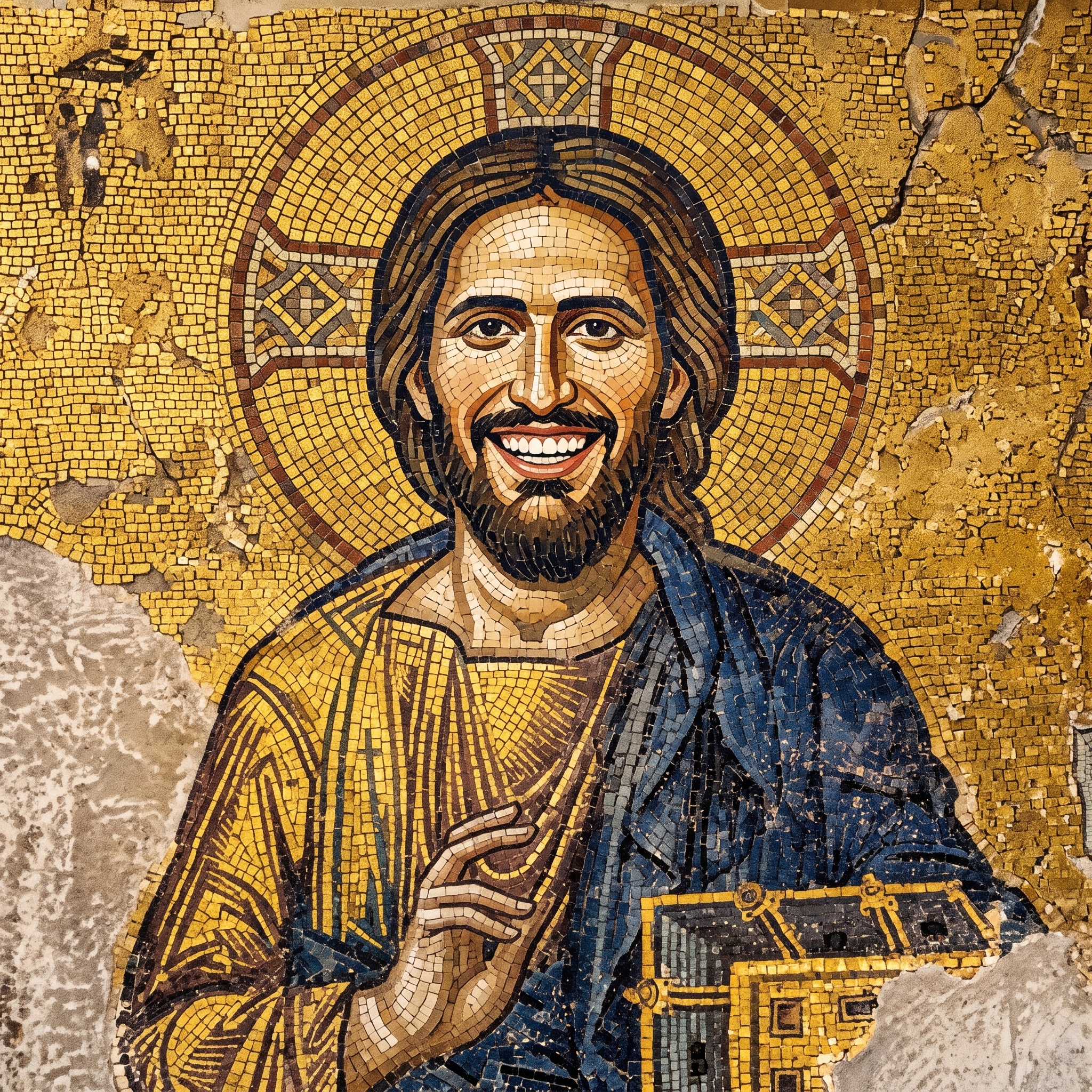
Interview with the Smiling Man Who Claims to Be Jesus: Making Movies in El Salvador Without Making a Living from Cinema
Episode 215November 5, 20261 h 16 minWith Ángel Ricardo Rysh, Melvin Nerio, Maité Portillo
English version of an episode recorded in Spanish. · Leer en español
Short link: proyectochachalaca.org/ep215
In a nutshell
What would happen if Jesus returned and chose El Salvador? We spoke with the crew of *«Entrevista con el risueño que dice ser Jesús»* (Interview with the Smiling Man Who Claims to Be Jesus), an independent Salvadoran feature film in post-production: its director, Ángel Ricardo Rysh; Melvin Nerio, who plays Jesus; and Maité Portillo, a real-life journalist who plays reporter Raquel Vera on screen. They share how an idea that shook Rysh's faith at age 14 evolved from a web series into a movie, how it was filmed with zero budget between downtown San Salvador and Lake Ilopango, and why someone described it as “too heretical for a Christian, but too Christian for a heretic.” An episode about faith, identity, and the stubborn passion for making films in a country where you still can’t make a living from them.
Review
Review
Rysh’s Return, Now with a Movie
Ángel Ricardo Rysh had already visited Chachalaca in episodes 21 and 23, when we discussed whether filmmaking was worth it in El Salvador. He returns with a completed film, Entrevista con el risueño que dice ser Jesús, and alongside two of its leads: Melvin Nerio, who plays Jesus, and Maité Portillo, a journalist in real life and on screen, where she portrays Raquel Vera, the reporter tracking him down for an interview. The premise fits in a single line: in a turbulent El Salvador, news spreads of the second coming of Jesus. Is he the Son of God or a con artist?
From Age 14 to a Web Series Turned Feature Film
The idea first shook Rysh’s faith when he was 14 years old. A Catholic—“not a very good Catholic,” by his own admission—he began writing the feature in 2019; the pandemic halted it, and a screenwriting workshop in Cuba pushed him to finish an initial treatment. The project started out as a seven-episode web series and was shot that way, episode by episode. It was in the editing room, for narrative reasons, that it became a movie. Rysh describes it as a trick he played on himself: had he told himself “I’m going to make my first movie,” he’d still be terrified of writing it.
A Jesus Found in Suchitoto
He crossed paths with Melvin on another production in Suchitoto, between dinner and the nocturnal hustle and bustle. He asked him out of nowhere: “Would you like to play Jesus?” Melvin, who had kept his hair long since finishing bachillerato (high school), was tired of university theater constantly casting him in that role, so he gave an evasive answer. He was won over by the script for the first episode and something he had observed in Rysh over the years: he always finished and screened his projects. Maité first received a mood board featuring photos of journalists, including pictures of her out reporting. During production, she ended up handling casting, wardrobe, and acting all at once, setting out to ensure that on screen it wouldn’t be Maité, but Raquel.
Why Would a Non-Believer Watch It?
It’s the uncomfortable question of the episode, and the answers point toward identity rather than faith. For Melvin, El Salvador possesses a deeply Christian culture even if you aren’t religious: the first communions, the everyday idioms, saying “primero Dios” (God willing). To rethink Jesus is to rethink something that belongs to us. And he adds an insight that rings true for all national cinema: it isn’t the audience that needs to strain to appreciate art; it’s the storytellers who must give them reasons to show up. Maité turns the question around: why not? What she hopes is that anyone watching the film discovers a Salvadoran identity that feels completely unforced.
A Jesus Without Magic Tricks
Melvin’s challenge was portraying a human Jesus, a “teacher without acting like a teacher,” who could seem divine or seem like someone who “le faltan tres coras pal dólar” (is a few cents short of a dollar; a bit crazy / ‘coras’ being quarters). During a preparatory visit to El Calvario church in downtown San Salvador, it occurred to him that this Jesus wouldn’t feel at home surrounded by images depicting his own torture and death. Comparing it to Mel Gibson’s The Passion of the Christ, he says their film moves in the opposite direction: there, there is no doubt he is God; here, whether he is or isn’t doesn’t matter as much. Rysh sums it up: people usually need to see to believe, but this Jesus asks you to believe to see. Nor do they want a caricature or a Jesus who takes himself too seriously.
A Downtown That Is No Longer the Same
Several scenes were filmed in downtown San Salvador, and Rysh later realized that some of the locations no longer exist or have drastically changed: a bar that shut down, streets where the man with the carretón de zapotes (wooden pushcart selling mamey sapote fruits) used to pass by, the street noise, the honking horns. A year and a half passed between filming the first episode in 2024 and shooting the rest of the film in late 2025, and many of those settings could no longer be filmed the same way. Without meaning to, he says, his productions end up serving as a tribute to spaces that vanish.
“Too Heretical for a Christian, but Too Christian for a Heretic”
The movie is currently at 75%, undergoing color grading and sound mixing, and Rysh hopes to wrap it up in 2027. It has already been screened for the crew and for Catholic groups, including a committee of Latin American romeristas (devotees of Saint Romero of El Salvador): someone suggested using it for youth catechism in Colombia, while another thought about distributing it in Chile. Someone described it with the very phrase that titles this section. The movie poster’s tagline came from Maité: whoever wants to believe, let them believe.
Making Cinema Without Making a Living from Cinema
It was shot over roughly 15 days, self-funded, with a crew that volunteered their time, dawn call-times to reach cantón San Agustín (a rural village) on the shores of Lake Ilopango, and off-grid locations without electricity to plug in gear. Rysh spent every night editing what he shot during the day. Can films be made in El Salvador? His answer today sounds like a sequel to Making or Not Making Cinema, Part Two: yes, you can make cinema, but you still can’t make a living from it. For distribution, he is looking at festivals and planning an independent circuit through schools, universities, and community groups, because commercial theaters are scarce and concentrated, and because the film invites conversation once the credits roll.
To go further
Our own background context, expanding on the conversation.
A Catholic Country That Is No Longer Just Catholic
Melvin talks about an El Salvador that is “more Catholic than anything else.” Surveys show a more nuanced landscape: in the 2014 Pew Research Center regional study, roughly half of the Salvadoran population identified as Catholic, while more than a third identified as Protestant or Evangelical. While culture remains steeped in Catholic tradition, as Melvin notes, the country’s religious life is far more diverse today.
Jesus Returns, and Isn’t Always Welcomed
The question of what would happen if Jesus returned carries a long tradition. In “The Grand Inquisitor,” the parable Dostoevsky included in The Brothers Karamazov (1880), Christ returns to Seville, only for the head of the Inquisition to have him locked away. And cinema about Jesus has continually swayed between the divine and the human Christ: scholars like Adele Reinhartz have shown how every era projects its own questions onto these films. The portrayal offered by this creative team aligns much more closely with the human Jesus of Scorsese’s The Last Temptation of Christ (1988) than with Gibson’s.
Cinema with Whatever Is at Hand
The notion of making movies with no budget and whatever tools are at hand has a historic name in Latin America. In 1969, Cuban filmmaker Julio García Espinosa penned “For an Imperfect Cinema,” a manifesto advocating for a cinema produced outside the traditional industry, made with minimal resources and in direct dialogue with its audience. And the history of Central American cinema, which María Lourdes Cortés mapped out in La pantalla rota (The Broken Screen), is largely the story of such productions: intermittent efforts fueled by the stubborn sheer will of their creators.
A Correction
When asking about Mel Gibson’s film, Amaru refers to it as The Passion of Jesus. The correct title is The Passion of the Christ (2004).
Other sources consulted: Pew Research Center (2014), Religion in Latin America: Widespread Change in a Historically Catholic Region.
Get involved
Would you like Entrevista con el risueño que dice ser Jesús to screen at your university, school, or community group? Send us an email at pro.chachalaca@gmail.com and we’ll put you in touch with the film’s crew.
Further reading
- Cortés, M. L. (2005). La pantalla rota: cien años de cine en Centroamérica. Taurus.
- Dostoievski, F. (1880). Los hermanos Karamázov [El Gran Inquisidor, libro V, cap. 5]. Obra original en ruso; varias traducciones al español.
- García Espinosa, J. (1969). Por un cine imperfecto [Manifiesto]. La Habana.
- Reinhartz, A. (2007). Jesus of Hollywood. Oxford University Press.
- Tatum, W. B. (2013). Jesus at the movies: A guide to the first hundred years and beyond (3.ª ed.). Polebridge Press.
You might also like
Transcript
Automatic transcript (Gemini), translated from Spanish and partially reviewed: there may be errors in names and unclear words. The episode opens with the chat recorded at the end of the conversation and the podcast intro; the formal presentation begins at minute 4:53.
Read the full transcript
[00:00] Amaru: And that was episode 215 of Proyecto Chachalaca. Maité, Rysh, and Melvin, how was it being here?
[00:07] Maité Portillo: It was very, very lively, truly joyful to share a little bit of our vision for this great project. Thank you for having us, and definitely delightful.
[00:17] Ricardo Rysh: Delightful. Delightful.
[00:19] Melvin Nerio: Delightful.
[00:20] Ricardo Rysh: I thought you were going to say amen.
[00:22] Maité Portillo: Amen, not anymore.
[00:23] Ricardo Rysh: No, really happy that this interview is happening with the crew of Entrevista con el risueño que dice ser Jesús (Interview with the Cheerful Man Who Claims to Be Jesus). It's—it's chivo (cool) to be able to start this process of outreach, of distribution, let's say, talking about the film and having it start building a presence so that those who hear about this film are in the loop right from the start about what it's about, what it is we're doing.
[00:44] Melvin Nerio: I think it was—it is very comforting, it's very nice to kind of remember, uh, remind ourselves why we said yes to this project, why we are also, well, here, so today is—is—has been about that, about talking about the film, our experience on—on the set, and just, well, very happy because it's the first one, it's the first of this promotion for the film, so soon enough, in 2027, it'll be time for Entrevista con el risueño que dice ser Jesús to, well, see the light of day.
[01:17] Amaru: Okay. Look, we're going to do a little dynamic here to introduce this movie. Imagine we're in 1998 and we walk into a Blockbuster Video. So, you see a movie there and it catches your eye, you pick it up, and on the back is the synopsis. Maité, you say the—the first paragraph of what that synopsis would say, Rysh the second, and Melvin the third. And how does the synopsis of this movie begin?
[01:41] Maité Portillo: Why am I always first? Um, let me see. How would it start? In—in a turbulent El Salvador of 2024...
[01:52] Amaru: Uh-huh, because it's futuristic, that's true. Uh-huh, uh-huh, uh-huh.
[01:54] Ricardo Rysh: Oh, no, wait, keep going.
[01:56] Maité Portillo: No, that's the beginning: in a turbulent El Salvador of 2024...
[02:01] Ricardo Rysh: Word spreads of the Second Coming of Jesus to Earth.
[02:05] Melvin Nerio: Could this be the Son of God, or is he a con man walking the Earth? Find out in this engaging film, winner—I hope—of some award.
[02:17] Ricardo Rysh: Uh-huh, with the—the laurel down there.
[02:19] Amaru: And a laurel, of course, yes. Action, intrigue.
[02:23] Maité Portillo: Children's.
[02:26] Amaru: Well, and the truth is that this film has been very interesting. Well, rather, the interview, the interview about this film, because I think it leaves behind something very intriguing, this reflection that is the entire film, right? I think it's realizing that—that beyond reading what the Bible or a—or a historical account of—of the life of Jesus might be, it's understanding that he was also a human being. And what would happen if that person came back today? I think that will resonate in more than one person's mind for the better, it'll strike them as odd, or it might even end up, you know, upsetting them. But I think that's what a film is about; I don't know if it was you who told me, that a film sometimes has to make people a bit uncomfortable.
[03:05] Ricardo Rysh: And this one, I think it's going to achieve that. I mean, involuntarily or not, I think my beliefs are definitely captured in—in—in the themes and the visions of the film, so I think it's going to cause—it's going to stir things up, this movie. Uh, we hope that it always leads to—I mean, the goal is for there to be conversation, for there to be discussion about the topics, for there to be debate as well, which I think is important. And right now, with those we've been able to share the film with, I think the sweetest part of watching it is the conversation afterward, because we spend hours talking about whether this topic, whether that, whether it's true, whether it's not true, whether Jesus did this, whether Mary, whether etcetera, etcetera, vea (right).
[03:47] Amaru: Okay, well, and let's get started.
[03:51] Announcer: This is Proyecto Chachalaca, a space to talk about who we are as Central Americans, and it's the small actions that keep this project standing. If you liked anything about this episode, share it with someone. Follow us on our social media too so you don't miss what's coming next, and if you have a minute, leave us five stars wherever you're listening to us. That, even if it doesn't seem like it, helps us a ton to keep moving forward. And if you want to get involved in another way, collaborate with us, or suggest a guest, write to us, the door is always open. You can search for us as Proyecto Chachalaca or on our website proyectochachalaca.org, where you can also find extra material for each episode, as well as ways to contact us and support the project. Because remember: for a story to keep existing, it has to keep being told. And now, let's begin.
[04:39] Melvin Nerio: I'm going to make up Bible verses throughout this whole podcast, yes.
[04:43] Amaru: Any new commandments?
[04:44] Ricardo Rysh: No, man, the ones you said.
[04:45] Melvin Nerio: Which ones?
[04:46] Ricardo Rysh: The—how does it go?
[04:48] Melvin Nerio: I don't know, I don't know.
[04:48] Ricardo Rysh: About the things of the Lord, the ways...
[04:50] Melvin Nerio: Oh, yeah, mysterious are the ways of the Lord.
[04:53] Amaru: And with that, we begin episode 215 of Proyecto Chachalaca. This is Interview with the interview of the Cheerful Man Who Claims to Be Jesus. Joining us this time are Ángel Ricardo Rysh, the director; Melvin Nerio, Jesus; and Maité Portillo, Raquel Vera. What's up? How are you all doing?
[05:09] Ricardo Rysh: Good, good, pretty happy to be here once again with the crew of Entrevista con el risueño que dice ser Jesús.
[05:17] Melvin Nerio: Pretty good, pretty happy, I think, well, let's see, first time for me in—in this, well, in this format, on this show, and, well, let's see what we talk about too.
[05:27] Amaru: Had they interviewed you before, Jesus, or only in the movie?
[05:30] Melvin Nerio: Yes, I had been interviewed before on a couple of occasions, uh, so let's say we're already a little bit used to it, so let's see how it goes this time.
[05:41] Maité Portillo: Maybe I'd like to mention that the previous interviews were very high quality, they were tough, they were complicated, but—but we pulled it off.
[05:49] Amaru: We pulled it off, we pulled it off.
[05:50] Ricardo Rysh: We pulled it off.
[05:50] Amaru: Such humility on this panel.
[05:52] Maité Portillo: No, and right now I'm holding back. Thank you so very much for having us.
[05:56] Amaru: Well, Rysh, how's it going? How long has it been since we've seen you around here?
[06:00] Ricardo Rysh: I think it was like two—no, man, three years maybe. Uh, as I recall, it was episode 23, the last one, the one we shared with Cuzcacharlas.
[06:09] Amaru: Cuzcacharlas, that's true.
[06:11] Ricardo Rysh: And before that, like two shows before, we had talked about whether or not to make cinema in El Salvador.
[06:17] Amaru: Exactly, back then those—those two coincided, episode 23 of Cuzcacharlas and episode 23 of Proyecto Chachalaca.
[06:24] Ricardo Rysh: Cabal (spot on), exactly.
[06:25] Amaru: Very cool. And we also have Maité. Maité, what's up? How are you?
[06:28] Maité Portillo: Thank you so much for the invitation. Uh, maybe a little nervous, uh, well, they're always new experiences, so I am kind of eager to see what you're going to ask us, but also excited to be able to talk about this project, and—and, well, hopefully people can connect.
[06:45] Amaru: Okay. Maité, who is also Raquel Vera in the movie, a journalist in real life and in—in cinema.
[06:51] Maité Portillo: Yes, yes, in fact, maybe as a fun fact, you know, that's really interesting because even though I'm a journalist in real life, I think Raquel Vera in the movie is different from how I practice. So, yes, uh, I think that similarity is there, but I'd like to make the distinction between the character and—and myself.
[07:12] Amaru: Okay. Well, look, on this podcast we have a question that helps us get to know our guests, and it's expressing who Jesus is. In this case, it would be Melvin Nerio. Who is Melvin Nerio?
[07:24] Melvin Nerio: Ah, well then. Uh, different ways to answer that, maybe. I'm going to say this time that Melvin Nerio, well, in this context, is someone who's very lucky, uh, who I also think is very grateful for life's coincidences that have led to—that one way or another have put him, well, on this project, uh, which ended up—by coincidence I ran into Rysh, by coincidence I think he thought it was—it was good or that it was, uh, really good for me to fit the character, and I think from there, well, the rest is history, right, here we are. So I think that's it, Melvin Nerio is someone who's very lucky, uh, very happy with—with the things that have happened to him so far, and excited about life too, just like that.
[08:14] Amaru: Excellent.
[08:14] Melvin Nerio: That's what I'd say.
[08:15] Amaru: What an—what an interesting way to—to size yourself up. I like it, I like it. Well, in the other corner, Maité Portillo, who is Maité Portillo?
[08:22] Maité Portillo: Maybe, I'm a journalist, I'm a person who likes to, uh, work in different fields. Even though I do journalism professionally, I've also dipped my toes into acting, I've dipped my toes into modeling, I've dipped my toes into other areas. Nevertheless, I've been given this opportunity that I think is—is very important, that has been very eye-opening for me, uh, because I've truly gotten to know this profession of acting a bit more in depth. But on a personal level, I think I'm a very creative person, I think I'm a very curious person, and—and that's it.
[09:00] Amaru: Okay. Cool, cool. Welcome. Ricardo el Rysh, you were on episode 21 and 23, but there was a question at the end of that episode where I asked you what you would say to a young Ricardo before starting this—this journey. You told me back then that it all started because you found a book in a library, something like that, if I remember correctly, and that was what sparked everything. Back then you told me you'd tell him no, that he should study to make music instead or something along those lines. But now with a movie, uh, running, so to speak, what's changed?
[09:35] Ricardo Rysh: Well, what's changed is that my answer would be the same.
[09:38] Amaru: It would be the same?
[09:39] Ricardo Rysh: Yes, what happens is that I think sometimes, uh, within these—these kinds of answers that can sound kind of pessimistic or, or I don't know, discouraging, or yeah, that—that aren't encouraging at all, to say: no, keep pushing and make movies. I think I stand by it, and based on experience, it's—it's a matter for the brave, maybe, or the ignorant, either of the two, because I think what has enabled us—I think me, the crew—to make this movie is maybe not sticking to the—what?—the established processes for making films. So we're doing it from the "ignorance," in quotes, of, well, if we don't have this, we don't know that we're missing this piece of equipment or that budget to do something.
[10:26] Amaru: Ah, of course.
[10:27] Ricardo Rysh: So we just do it, we pull it off. Obviously there's a lot of sacrifice behind this. Uh, well, maybe here they—they—I don't know if they're going to mention it at some point, but we had Maité taking on way more roles than acting. She was coordinating the actors, she was doing wardrobe, she was doing, uh, also a bunch of shopping runs with—with me for—for props.
[10:40] Amaru: Wardrobe too. And—and from what I heard, Jesus was also turning water into wine and multiplying the food over there.
[10:52] Ricardo Rysh: And—and—and even—Melvin also, uh, helped out on extra production days running sound, so he'd set up the sound, position the mic, and then run off to act. So, uh, I think it's not encouraging at all in the sense of: alright, let's make movies and how lovely everything is going to turn out, but I think the experience of—of having done several productions, having already made several mistakes, it kind of doesn't teach you how you're going to do it, but it lets you know that the mistakes you already made, you might make them again, but with the peace of mind of: ah, well, we'll sort it out or we'll find a way to do it. And—and just like that, we already have a film shot, it's still in post-production. I hope that by early 2027 we can have it finished. That's another long process, which has more to do with—with the support they're giving me on the post-production side, which obviously, since there's no budget to pay people so they can turn the work around in the timeframe it needs to be done, uh, we've been kind of more flexible with—with the time of the people who are collaborating, and—and I'll just say it: thank God, things are falling into place.
[11:58] Amaru: Okay. But well, Ricardo, look, you've made the effort, I mean, you've managed to make a movie, as you say, out of the ignorance of not knowing how much a lot of things cost, or knowing, but, uh, taking it on or solving it, let's say, however possible. And that's a massive effort. What do you feel needs to change in the way we consume cinema in El Salvador so that this effort would truly be valued, or truly be, let's say on your end, um, justified, perhaps?
[12:24] Ricardo Rysh: Well, that's where I'm going to start sounding pessimistic again, because I don't know, I think first and foremost, we made the film out of the conviction that we love the story; maybe, uh, the main one who loves the movie has been me from the beginning, and that conviction of me liking the project has allowed me to convince other people to chip in, to be in the movie, to feel like part of the movie, and from there, well, I think the film—the one it's going to give the satisfaction of being finished to is us, the crew. Then, uh, we also know that—and—and I think, well, I say it, I love the movie, I think people can also—they might like it because of the themes it tackles, because of the—the angles or directions it explores, but I also don't think people have an obligation to want to see it just because it's a Salvadoran film. I imagine a lot of people, because of the subject matter, right, which is a bit—it touches on certain sensitivities regarding the country's religious tradition, I think a lot of people might—might feel offended, I'll just say it like that, but I think a lot of people, especially the youth or young people, uh, I think they might find something that brings them closer to—to God. In a way this reflection sounds very Christian, but I think, yeah, that—that could happen too.
[13:46] Amaru: Look—look at that, how interesting. And you know what? I think just like we might suddenly come across people who say, "Today I'm going to binge a Czechoslovak post-Soviet film cycle," they'll say more or less, "Well, I'm going to binge a—a cycle of 1920s Salvadoran films," maybe. But as a disruptive question, I'd like to ask the three of you, taking what you just said as a reference, right? Why should a non-believer go see this movie?
[14:09] Melvin Nerio: Ah, good question.
[14:11] Ricardo Rysh: Um, Melvin, go ahead, go ahead, go ahead.
[14:12] Melvin Nerio: Yeah, yeah, yeah, I—I—I like—I like the question. Uh, yeah, I'll—I'll answer it, and then I want to make a comment about the last question that—that—that Rysh answered. Uh, I think a non-believer should go see the movie, mmm, yeah, yeah because we're—yeah because we're Salvadorans, we're Latinos, and we also have this identity, and I think that goes, uh, hand in hand with the reason why I was, well, pretty interested in the script when I read it for the first time, and it's that, uh, we can't separate the fact that, uh, as Salvadorans, we are a very, very Christian culture, I mean, I think that's something that is ingrained in—in us. I'm not talking about faith, I'm talking about—about the cultural aspect, I mean, we've all grown up around the whole thing of, uh, first communions, uh, weddings, the way people talk, the sayings, the manner, I mean, it's something that's—
[15:08] Amaru: Dios guarde (God forbid).
[15:09] Melvin Nerio: Uh-huh, primero Dios (God willing), Dios mediante (God permitting). Suddenly you always find yourself—or—or our—our life is shaped according to, well, our—our—
[15:18] Amaru: This Catholic dogma that, let's say, is embedded there in our culture, uh-huh.
[15:19] Melvin Nerio: Catholic dogma, uh-huh. Yeah, we could, to generalize, rather than Catholic I'll say Christian, nowadays because of the fact that, uh, there are more denominations, but the truth is that it's more Catholic than anything else because it's also a matter of—of—of tradition, I mean, otherwise we wouldn't set up, uh, our celebrations the way they're set up. So, uh, Christianity, the figure of—of Jesus is so immersed in our culture that suddenly visualizing a new take, uh, a new—a new tale, a new story of the myth, suddenly is—is interesting because it's part of—of what's ours, maybe—
[15:58] Amaru: Kind of like bringing a fresh breeze to this whole thing of—of—of Salvadoran Christianity, right?
[16:01] Melvin Nerio: Maybe, I don't know whether to call it a a or something fresh, but maybe it's about asking ourselves things that we're sometimes afraid to ask, or that we just don't dare to. So I think that's an interesting exercise because, and maybe I'll just say it like this, the plot of the movie is, uh, as far as the premise goes, maybe I'll use the word, it's ridiculous in the sense that it's the Second Coming and Jesus is on Earth, and he's in El Salvador. I mean, what the heck is he supposed to be doing in El Salvador? That's the first question anyone would ask. But the same thing happens with gringo (American) movies—why does the end of the world always start in New York or Los Angeles? Suddenly—
[16:35] Amaru: And why are the bad guys always Russian or Chinese?
[16:37] Melvin Nerio: Exactly, yeah. So those kinds of things are part of that cosmology we have about watching and consuming cinema. And I think this movie does a great job, and here I'll wrap up the thought because I also wanted to touch a bit on what you asked Rysh, how wonderful that we can have cinema whose presence, whose world-building actually takes place in El Salvador and not somewhere else. So, I don't think the audience needs to do anything specific to appreciate it or anything like that. I think it's up to us, the storytellers, to give Salvadorans reasons to go watch it. And this is a story that unfolds in El Salvador, stars Salvadorans, and I dare say it gives you time for reflection, time to laugh. If you're not a believer, surely—
[17:29] Amaru: You're going to have a good time.
[17:29] Melvin Nerio: you'll go watch it for the irony, and if you are a believer, maybe you'll go watch it to find something new. Who knows? You have to go with an open mind, and I say we have to go watch Salvadoran cinema.
[17:40] Maité Portillo: My turn?
[17:41] Melvin Nerio: Yes, sorry, I went on for too long.
[17:43] Maité Portillo: Well, uh, I think I'd turn the question around, and rather than asking why a non-believer should go see the movie, my question would be: why not? We really Well, at least on my part, uh, I don't think I did the work, and I don't think I joined the project with the goal of changing minds or even—
[18:07] Amaru: We are going to change lives today.
[18:08] Maité Portillo: neither changing lives, nor changing minds, nor changing stances.
[18:12] Amaru: Okay.
[18:12] Maité Portillo: However, I do strongly pick up on something Melvin mentioned, which is precisely the theme of identity. So it's a very Salvadoran proposal, and that also connects with Rysh's answer that we often consume a lot of foreign media and we always make, or usually make, the mistake of saying: "Well, but here in El Salvador there aren't many bold bets," or suddenly the bets that are out there, we don't like them, I don't know. I do think every person, every Salvadoran, and every film buff has their own measure of how and what they consume. However, I think that for a non-believer, or even for anyone intrigued by the movie, it's simply about seeing a fresh take, and it's Personally, I think they will notice many cultural identity elements that weren't forced, because even that plays a very interesting role in the film. I feel it's really important for us to see that—not a forced identity, but an authentic identity that, once people watch the film and draw their conclusions, you really manage to perceive. I think that truly was a goal.
[19:18] Amaru: Okay, that's interesting. Well, let's see, on this other side. Rysh, what was that moment like when you said: "¡Agüey! (Holy crap!), we've got a movie here"? When was that?
[19:28] Ricardo Rysh: Um, look, it was a rather long process of discovery, perhaps, because, uh, this whole thing about the Second Coming of Jesus on Earth, speaking about contemporary issues, let's say, I think I started reflecting on it, reading about it when I was around 14, and that was a huge shake-up to my faith. I'm Catholic, uh, maybe not a very good Catholic, but since then, since I was 14, it was like I started being more flexible regarding faith, dogmas, and all the tradition as such. Obviously always very respectful; I never went around defacing things, or Bibles, or anything like that. I've been very respectful, and I still am, in fact. Uh, but in 2019 I started writing the feature film. I started cranking out 20 pages, and I said: "2020 is the year I'm going to make it." I had already made a couple of short films, but, uh, the pandemic, vea (you know). So—
[20:29] Amaru: Of course, the pandemic.
[20:31] Ricardo Rysh: And and and it was interesting because I think that always—and I don't know if I mentioned this the time we chatted before—I can't write something if I don't have the characters in my mind, the actors who are going to play the parts. Back then, uh, I had two people in mind and the story was going in a different direction, heavily based perhaps on the personalities of those first, uh—
[20:53] Amaru: Characters you had spun together in your head.
[20:54] Ricardo Rysh: Cabal (Exactly), of those first Raquels and Jesuses, with other faces or other actors, whom I never got around to rehearsing with, or talking to, or telling them anything. It was simply like: "Oh, he could be this one," like an exercise in "I'm going to write a feature film and I'm going to do it writing straight from my imagination without knowing if it's possible or not," giving free rein to the imagination. However, after I took a film workshop at the Cuba Film School, which obviously since I was paying for it, the idea was to write a script by the end of the workshop, and it was like: "Well, I'm paying, I have to do the homework."
[21:26] Amaru: "I'm going to make something."
[21:27] Ricardo Rysh: So I forced myself from that point on to write a first treatment, and over the years, uh... Well, that was 2022. In 2023 the project was still in that state of "yes, I'm going to do it, I'm going to do it," but no... I think with Maité, on that first mood board I made of "this is going to be Raquel, this is going to be Jesus," uh, I had already mentioned it to Maité, but we didn't have such a close line of communication, so it was like: "Hey, look, I want to do this, could you?" And Maité: "Oh, yeah." But it wasn't like anything set: "okay, we're doing this on such-and-such date." It was like... And I think you might have even answered me like: "Alright, whenever you actually do it, vea (you know)."
[22:02] Maité Portillo: No.
[22:04] Amaru: Because that totally That tends to happen, look. People People just come out of nowhere and tell you: "Viejo (Man), I've got this in mind," or or: "Look, we're going to do this at some point."
[22:11] Ricardo Rysh: Yeah, there are tons of people with lots of projects that start as initiatives, but they don't get developed, though if they get made, there's no problem doing it, vea (right). But actually executing them might take time. The thing is, at the end of 2024—2023, let me see, 2—yeah, '23, uh, I bumped into Melvin on a production and it was like... Well, the look and everything, the hair and all.
[22:30] Amaru: You saw him and went: "Ah!"
[22:32] Ricardo Rysh: Yes, yes, yes, definitely, I think his personality was what made it click for me to say: "Hey," besides the look, right, the long hair, the beard and everything, and it was—
[22:40] Amaru: And the good vibes, I mean.
[22:42] Ricardo Rysh: Yeah, and we were eating and he told me: "Hey, Rysh, ¿qué ondas? (what's up?) How are your projects going?" And—
[22:45] Amaru: He said: "Want to see this trick?" And my brother doubled the tortilla (flatbread).
[22:49] Ricardo Rysh: And I just stood there looking, like: "Hey," and I told him, I think the first thing I told him was that: "Ah, I want to do a story about the Second Coming of Jesus." And Melvin was probably like: "Ah, alright, another project that if it happens, great, and if not, that's fine too, vea (you know)." But eventually, once I had both of them in mind and started talking to each of them separately, that's when I said: "No, come on, let's sit down, let's write the script for the first episode," because at first it was a seven-episode web series, uh, and: "I wrote episode one, démosle (let's do this)," vea. And we re- we started meeting up, and from there we became little buddies, and from there, uh, I think that friendship, that friendship we've built, was what gave me the green light to say: "Come on, man, yeah, we've we've we've got to keep going." And and there's a great dynamic; if we already did the first—the first 15 minutes of episode one, why not do the other episodes? And eventually, uh, it turned into a movie, and and I think that was the most chivo (cool) thing about making the first movie, because it was made without knowing it was going to be a movie. I think if I had said: "I'm going to make my first feature film," I'd still be sitting there scared to write it.
[23:52] Amaru: Okay. And at that moment when you decided to go from a web series to making a movie, did you say: "Well, the Lord will provide"? How did those funds come together?
[24:02] Ricardo Rysh: Uh, no, actually, uh, well, the movie is self-financed slash a collaboration and contribution from everyone.
[24:08] Amaru: All together, okay.
[24:09] Ricardo Rysh: So, uh, between one gig and another, savings, uh, I pulled together a little fund and said: "Well, we're going to..." The the the guy who supported me as a producer, Daniel Marroquín, Buba, I told him: "Alright, look, this is what we have." And he, also already knowing the dynamic, with his experience as well... Uh, well, he was the one who produced Los torpes with Armando.
[24:28] Amaru: Ah, of course, of course.
[24:29] Ricardo Rysh: So, uh, they were fresh off doing that, and I told him: "Look, uh, I want to do this. How do we budget it?" And he gave me the plan: "Alright, we're going to allocate this much per day and that'll get us through, the rest we'll source and manage," vea. So from there, that was the push, and and it worked out. The the shooting wrapped up; it stretched on longer than we imagined, but but it got done. And I think that's the most valuable thing, that it got done.
[24:50] Amaru: Okay. Excellent. Well, let's go to the other side of the story. Maité, what was that moment like, that instant, I don't know, what were you doing all of a sudden when Rysh showed up and said: "Here's the initiative, the movie"?
[25:05] Maité Portillo: You know, well, maybe the first thing is that I have a terrible memory. So, if I try to recall dates and and very exact things, I'm really, really bad at it.
[25:17] Ricardo Rysh: I'll I'll jump in with the time stamps, vea. February 2024.
[25:21] Amaru: Incredible.
[25:21] Maité Portillo: February 2024 was when you sent me... No.
[25:24] Ricardo Rysh: Yeah, when we met up to read the script.
[25:26] Maité Portillo: No, but first you sent me the the image with the references. That's the that's the first—
[25:29] Ricardo Rysh: Oh, no, that was before.
[25:31] Maité Portillo: Yeah. The first time was a message with a—
[25:35] Ricardo Rysh: A mood board of—
[25:36] Maité Portillo: Yeah, where there were photos, where he told me: "This is the journalist character." I don't know if the character had a name back then.
[25:44] Ricardo Rysh: Yes, it was Raquel, Raquel.
[25:46] Maité Portillo: Okay. But not Vera. But not Vera, yeah. It just had the name, and there were a bunch of photos of journalists, there were also some photos of me from when I was reporting, and he told me: "This is more or less the profile I want." And it caught my attention, uh, I told him: "Yeah, yeah, I'm interested." Then later in 2024, the date?
[26:04] Ricardo Rysh: Cabal (Exactly), February 2024.
[26:05] Maité Portillo: February 2024 he told me: "Yeah, uh, we're already working on this." I don't recall... Back then you did mention to me, Rysh, that it was a series.
[26:14] Ricardo Rysh: Yeah, it's just that it only recently turned into a movie, in October—a year ago now, in October of last year, yeah.
[26:20] Maité Portillo: So, in fact, the shift, uh, series to movie happened between 2024 up to early 2026.
[26:26] Ricardo Rysh: Yes.
[26:26] Maité Portillo: Meaning at the start, yeah, only—
[26:28] Ricardo Rysh: It's just that from the start it was a series. The the movie was also shot episodically. In my head it was: alright, we're shooting episode six, now episode seven. But in the edit and for narrative reasons, the decision was made to turn it into a movie.
[26:42] Amaru: A movie.
[26:43] Maité Portillo: And in this case, since it was just one episode, it was actually just the demo, so I said: "Well, I mean, it's just one episode." I didn't... If I have to be honest, I wasn't expecting the movie, but rather I thought: "Maybe it's just going to be the demo. Later on, I don't even know if I'll be the one continuing with the character, or if it's just for the demo right now." And it caught my eye, the profile caught my eye, the story caught my eye, and that's when I said: "Well, let's give it a shot." We shot the first episode, and later on it was like: "Look, it's not going to be a series anymore, it's going to be a movie."
[27:15] Amaru: Surprise!
[27:16] Maité Portillo: That's right.
[27:17] Amaru: Okay. And on the other side, how did Rysh approach you and say: "Hey, guess what..."?
[27:23] Melvin Nerio: I think it's, uh, well, it's it's an interesting courtship story because, uh—
[27:28] Amaru: Quite the charmer, Rysh, when it comes to getting—
[27:29] Melvin Nerio: It really is a courtship joke, yeah.
[27:30] Amaru: Tell him, he's a real charmer when it comes to landing his actors.
[27:33] Melvin Nerio: I'm going to call it a seduction strategy, because, uh, we met... I I was doing, uh, sound assisting for a short film where Rysh sur- I didn't know he was part of the of the crew, so we ran into each other. I already knew of him from way back, va (right), from projects; he's always kind of been around in in in the scene, popping up, Rysh hosting events and all that. Well, Rysh was always a character who was right there, yeah, at that time. And well, he showed up, I think we were having dinner, uh, before the shoot or or in between, I don't I don't remember the exact moment very well.
[28:07] Amaru: So far it sounds romantic, just like... Yeah, you know it. There you were eating chicharrones (pork cracklings), drinking beer, background chatter.
[28:09] Melvin Nerio: Yeah, yeah, it sounds very romantic, at a pupusódromo (food court specialized in pupusas).
[28:11] Ricardo Rysh: There were a lot of people too, lots of people.
[28:15] Melvin Nerio: Background chatter, yeah, a a a very warm town like Suchitoto is, the evening—
[28:19] Amaru: A slow merengue was playing in the background.
[28:22] Melvin Nerio: the illuminated church, a fountain in the town square. No, look, all the conditions were set—
[28:27] Amaru: Incredible.
[28:28] Melvin Nerio: when out of nowhere, he drops the the the bombshell, right?
[28:31] Amaru: "Wait up, look, I want to ask you something," just like that.
[28:33] Melvin Nerio: That's right, yeah. And he says to me—
[28:35] Amaru: "What time are you free?", that's what he told me once.
[28:37] Melvin Nerio: And he says to me: "Would you like, uh, to be Jesus?" Yeah. Of course, the moment I heard that, I I thought: "Well—
[28:44] Ricardo Rysh: "Alright."
[28:45] Amaru: But wait, did he say it to you just like that, without giving any context? Wait, he said it to you without giving context about some movie?
[28:50] Melvin Nerio: Yeah, no, he said it to me with no context.
[28:51] Ricardo Rysh: Yeah, no. "Would you like to be Jesus?"
[28:52] Melvin Nerio: Would I like... Yeah, he told me without context. Usually, and well, clarifying a bit here, uh, and and talking a little about that, I've had long hair since 2009, I think, or 2008. Well, not anymore, not anymore.
[29:03] Amaru: Because of the play?
[29:04] Melvin Nerio: It's part of the of the movie, I don't know?
[29:07] Ricardo Rysh: It's part of letting go.
[29:08] Melvin Nerio: It's part of letting go of the movie this time, yeah. But I had—I've had long hair since around that time, it was more a matter of finishing high school where all the time it was like: short hair, short hair. I went to institutions that insisted on short hair.
[29:11] Amaru: Ah, okay.
[29:20] Amaru: Ah, of course, yeah, yeah, yeah. I went through that too, yeah.
[29:23] Melvin Nerio: And once I got out, I let my hair grow out, and it just kept getting longer, right?
[29:28] Amaru: Okay.
[29:29] Melvin Nerio: So, uh, I did theater in in college, uh, and also after college for a bit, so it was funny because being Jesus was already like a constant question. It was always like: "Look, we know you, would you like to play Jesus?" Sometimes I'd say yes, sometimes I'd say no. So it was already something I was tired of, let's say. It was already something where you'd say: "Well." So—
[29:46] Amaru: Ah, you were already tired of it. "I'm tired of being Jesus."
[29:53] Melvin Nerio: Rysh tells me that, and I thought: "Ah, another thing where they want me as Jesus. Well—
[29:57] Amaru: Another cofradía (religious brotherhood).
[29:59] Melvin Nerio: another thing." So it was just another thing. Well, the shoot went on. "Yeah, well, we'll see." I mean, I remember answering yes, but evasively.
[30:08] Amaru: But but but did you already know it was for a movie?
[30:09] Melvin Nerio: No, no, I didn't know, I mean, he didn't tell me more. He mentioned something, but but honestly there's like a filter.
[30:11] Amaru: In other words, Rysh told you...
[30:15] Amaru: You didn't connect right there, yeah.
[30:15] Melvin Nerio: No, I didn't connect at all. I mean, there's a filter that that that, let's say, kicks in: someone tells you something and you know you're not connecting, so everything that comes after that, you just tune out. So everything that had to do with that—
[30:26] Amaru: It's like some crazy guy just asked me something, and—
[30:29] Melvin Nerio: Yeah, I—I wasn't paying attention. Sure, throughout everything else I was, it was—it was very I mean, it was an enjoyable production because of the camaraderie, even though it was exhausting,
[30:36] Ricardo Rysh: Yes, it was—
[30:37] Melvin Nerio: it was very, very exhausting. It's worth mentioning that I might not remember a lot of things simply because of the exhaustion. But anyway, it happened. I think that was in October or August, I don't remember well.
[30:46] Ricardo Rysh: October, November 2023, Suchitoto.
[30:48] Melvin Nerio: He—he remembers the date really well.
[30:49] Amaru: Incredible.
[30:50] Melvin Nerio: Yes, yes, he Sure, because it was a romantic moment. So—
[30:54] Ricardo Rysh: And I can't really contradict him here, just listening to the story, vea (right)?
[30:57] Amaru: Yeah. Well, silence gives consent, but—
[30:59] Melvin Nerio: But let's continue with the story.
[31:01] Amaru: Those nervous laughs he's letting out, I'm just saying.
[31:03] Melvin Nerio: Yeah, yeah, yeah, but it worked for him, it worked for him, that's why we're here. He kept writing to me, meaning we kept talking a bit about the project. I really wasn't very convinced, but anyway, one day—and I think here comes an important detail—even though I knew of Rysh, meaning we had met each other over time and all that, I also knew him because he was always doing his projects. He was always presenting things, making things, and I think that's something really important and something key to getting this project made: that consistency, the fact that he was always going to present something. Because around here it happens a lot that suddenly they call you for a project, you're working, you shoot it, you put all your effort into it, and you never find out what happened to it, right?
[31:47] Amaru: Mhm.
[31:47] Melvin Nerio: But in Rysh's case, he always followed through, he always finished his projects, he always screened them. So that was like a nagging thought that had stuck with me. Then he sends me the script for episode one, and when I read the script, when I read what it was about, it was like: "Oh, no, no, this is different, this is something else entirely." We met to talk about the project, and I think from then on it was like an okay, I mean, an absolute yes; it was a total yes. Really, I think it started with the story, and I really liked how it was approached, I really liked where things were headed, and after that we simply formed a team. I also think that within Rysh's perspective on managing these kinds of projects, it's very important to him that the crew gets along, that people share this context of friendship. He fosters that, and he created it on set, so well, the rest is history: we made the film, and honestly what hooked me was the script.
[32:51] Amaru: Okay, okay. Well, on the other hand, Maité, three roles: wardrobe, casting, and actress. Which one was the heaviest?
[32:59] Maité Portillo: You know, I feel like each one had its own complexity. In the case of casting and wardrobe, I had never done that before, so it was the first time I was doing it—zero experience, zero knowledge of the processes, zero knowledge of the dynamics. Um, when I got involved it was like starting to research, starting to ask questions, starting to test things out, trying to do things the best I could, and I feel that lack of knowledge was the biggest challenge in trying to do it properly. In the case of acting, even though I had already worked on other projects, I've been very honest in saying that most of the projects I'd been in were very independent or had very simple budgets, let's put it that way.
[33:49] Amaru: More humble, more humble.
[33:51] Maité Portillo: More humble, simpler, where suddenly the camera person is also doing sound, and you recorded with ambient sound, there was no coordination, so it was a crew of what, two or three people? Not to take away any credit from the work done, because at the end of the day, with the projects I was part of, I feel very proud of the final product. However, this was the first production where I saw a more complex crew, or even a slightly more elaborate structure.
[34:20] Amaru: A full crew, so to speak, or more complete.
[34:22] Maité Portillo: That's right. That's right, and you also see a greater commitment from some people to, "Well, we're stepping up to a different level." So when you see that the whole team is giving 100%, you don't want to fall behind. I always try to push myself in my work, obviously, I try to give my best, but with the acting in this film, I did feel that pressure. I felt that: okay, now we're talking about a different caliber of work, we're talking about being with a different team. I'm not a professional actress, meaning I've never gone to drama school; however, I have been practicing, I have asked for advice, I have observed other colleagues, and I feel the challenge in acting was that: not having formal training, but rather figuring it out along the way.
[35:09] Amaru: Did you already feel like you had a bit of an actress inside you, perhaps?
[35:13] Maité Portillo: You know, there's something very curious about that, and maybe I'll tell a chistoria (funny little story) here. I do remember this part; I don't remember the dates, but I do remember the narrative.
[35:22] Ricardo Rysh: Go ahead, I'll provide the date.
[35:23] Maité Portillo: When Rysh wrote to me, I remember asking him: "Okay, but what is the character like?" Because that's one of the things whenever someone tells you: "Look, I want you to be in this"—sure, but what is the character like? Just to know if she's an introvert, an extrovert, what her—I mean, to build the character. And I remember Rysh just telling me: "I don't know, vos (you)." And I was like: "What? Just be myself?" Really, for me that was very complicated because I said: "It's not Maité, it's Raquel." When we did the first episode maybe I didn't work on the character as much, I must say, but when it became a feature film, I did. I remember bugging Rysh: "Look, how do you want Raquel to be? How do you envision Raquel? Blah, blah, blah," because I really wanted a well-structured character that wouldn't just be Maité on screen. Building that character—at least in my experience, in this case being a feature film—was more complex. I had worked on short films or smaller productions before, so I always developed the character, but since the screen time was shorter,
[36:28] Amaru: Uh-huh.
[36:29] Maité Portillo: I feel it wasn't as complicated for me.
[36:32] Amaru: Okay.
[36:33] Maité Portillo: However, in this project, which had a broader scope, I did feel the need to make a separation—meaning, not to have Maité on screen; I really wanted her to be Raquel.
[36:44] Amaru: Okay, but in the end, do you consider that there is a separate Raquel and Maité, or are Maité and Raquel the same person?
[36:53] Maité Portillo: No, she's different.
[36:54] Amaru: She's different.
[36:54] Maité Portillo: She's truly different. Um, we talked about it during rehearsals, like: how would she act? How do you imagine her? What are the character's goals? What baggage does she carry? So I really tried to dive deep, and I really wanted to create that distinction, and I like to believe I did.
[37:11] Amaru: Okay, how interesting.
[37:13] Ricardo Rysh: Yeah, no, I want to add to that because I definitely think—well, both of them, Melvin and Maité, were very clear at times about their characters. And I was learning too, in the sense that in a short film the character does what they have to do, and during ten minutes of story you get to know just one layer of the character; you don't need to know things in such depth because you don't have that much time seeing them act in different circumstances. Take the photo you like.
[37:46] Maité Portillo: [laughs]
[37:47] Ricardo Rysh: So, they would ask me questions like: "Look, what does the character do in this situation? Look, I feel this part is too fearful. Look, I feel like here, I don't know, it strays from the character's arc." And it's really interesting because, and I think I've maintained this or tried to do this within my lack of formal training or empiricism or being self-taught, I've always liked working with people who share a lot of themselves with the character. The character in my story draws from the reality of the actors portraying them. So, I knew Maité as a journalist, through the image she projected on social media—which is also interesting because in the end you only see a fraction of people's lives on social media. I didn't have Melvin on social media, I think, back then, but what I saw of him that day on set when we were all sleepy and he started singing and people were laughing, ¡puya! (wow), I said: "Man, what a way to brighten people's mood, what kind of Jesus is this," vea (you know).
[38:45] Amaru: Oh yeah, like suddenly you saw him walking on water, and then when nobody was looking, turning water into wine.
[38:50] Ricardo Rysh: Cabal (exactly). So, that image I formed of them helped me—since I didn't know them that well—it gave me a clue to say: "Okay, this is the direction for the characters." Later on, as I got to know them better over time and through different circumstances—under stress, lacking sleep, exhausted, through everything—I think I began to realize that the characters were also very different from who they were in real life. That was really nice to discover, and I also acknowledge the input both of them had, even in constructing several scenes, in how the story was guided toward the ending. And something we did a lot—that I did with both of them—was inspirational scouting, which I don't know if that term exists, but we did it,
[39:36] Amaru: But you're going to invent it here, patent it, my brother.
[39:39] Ricardo Rysh: because, yeah, we would go without a script, just walk around the locations, chat, and I'd say: "Hey, they could have a conversation here. Ah, they could talk about this topic here." Then I'd go with Melvin to the spot, we'd walk near the lake: "Hey, this could be where he walks barefoot by the lake shore," and we began finding scenes just by visiting places with them and getting to know them while talking about whatever, vea (you see).
[40:03] Amaru: Okay, that's so crazy. And well, look, I'd like to ask you something, since you're the director of the film and you have an idea of how it begins and how it ends: if suddenly someone showed up in downtown at 6:00 in the morning, appearing on the news saying: "I am Jesus and this is my second coming," what arrives first: the Church, the police, or the psychiatric ward? In your view, what gets there first?
[40:24] Ricardo Rysh: No, I think the police. I mean, it depends on the place; if it's downtown and he's causing a commotion and everything, for public order reasons I think the police—either the police or higher authorities—would detain him, vea (right), to stop him from disturbing the peace. In fact, something like that happens in the film too. Spoiler, cabal (spot on).
[40:44] Amaru: Okay. But something else I find very interesting is that this film is perhaps like the last record of the Centro Histórico (Historic Downtown) before all these recent changes happened. What do you think about that?
[40:55] Ricardo Rysh: You know, a bit—and I think most, well, all of my productions have an element that becomes a historical documentary record, because many of the locations where I've filmed downtown—
[41:06] Amaru: Aren't there anymore.
[41:07] Ricardo Rysh: aren't there anymore, or have changed, or have been shut down. So, in the end, these productions become a tribute of sorts to spaces that cease to exist. In the film, there's a bar that we later realized was closed down, areas of downtown San Salvador that used to be more popular and working-class that look different now. Back then, it felt more like downtown; it had more of that identity: hey, there goes the man with the wooden cart of zapotes (mamey sapote fruit), it felt more raw street life, the people walking the streets, the honking, the noise, the bustling energy of downtown. I think that's present in some scenes at the beginning of the film, which, as I was saying, episode one that we shot in 2024 became the intro for the movie we filmed in late 2025. So almost a year and a half passed between what we filmed initially and what became the movie. A year and a half later, if we had wanted to reshoot in several locations, we wouldn't—
[41:34] Amaru: More street-level, let's say.
[42:07] Amaru: You can't anymore.
[42:08] Ricardo Rysh: it wouldn't be possible in the same way.
[42:09] Amaru: Okay, how crazy. And well, Jesus—Melvin, sorry. Melvin, throughout all of this, in this film where you play Jesus, I imagine that at some point ideas crossed your mind regarding the interpretation of your character. Did you have an idea you'd like to share here?
[42:31] Melvin Nerio: Regarding the performance?
[42:32] Amaru: Yes, about Jesus returning, about Jesus here in El Salvador.
[42:37] Melvin Nerio: Sure, I think two things: one very, very visceral, and the other—the first one I'll mention—very thoughtful, very, very thoroughly reflected upon. The fact that it was fun to imagine or think of a Jesus who wasn't divine, who was a human Jesus. Rysh and I were constantly talking about that: what would a human Jesus be like in these situations—well, in the various situations presented in the film. Initially it was quite fun, but it was also—while not using parts of yourself, so to speak, you did base it on an exaggerated version of yourself. It was quite engaging, there was a lot of pondering what would happen, the "what ifs." The constant question was "what if": what if this happened this way? What if this situation unfolded like that? So that constant question was always present within the character. And honestly, it's tough to take on an established character about whom everyone already has an idea; we all have an idea of what Jesus should be like. So that was also quite difficult: demystifying, but also stripping away preconceived notions of Jesus so that he could be a different kind of Jesus, right? Or at least the Jesus this movie needed. I think that was a complicated process because he had to be a teacher without being a teacher; he had to be someone who accompanies others without setting out to accompany them as such; he had to be real. This Jesus had to be real—divine, but grounded in humanity. That blend was a bit different to achieve, but I think we pulled off something interesting. It's a credible Jesus in the sense that you can say, "This could be Jesus," but at the same time you could say, "Ah, this guy is missing tres coras pal dólar (three quarters to make a dollar, meaning a few screws loose), right, this guy is just crazy." That was also part of the character. All these questions were present in every scene, at every moment, and we simply resolved them on the spot depending on the situation the character needed to be in. That was the highly reasoned, very intellectualized part of the character.
[45:14] Amaru: Okay.
[45:15] Melvin Nerio: Perhaps on the more visceral side, we also reflected a lot on how Jesus would feel at this moment, or how our Jesus would feel. I think we did a scouting trip taking advantage of that; we were checking out locations and went into a church—I think it was El Calvario, right? Yes, El Calvario in downtown.
[45:36] Ricardo Rysh: The first day the three of us went out, yes.
[45:38] Melvin Nerio: Exactly. That was the day I met Maité; the three of us went out and visited El Calvario. We were looking around: "This happens here, this happens here," and there's a scene where Jesus had to look at a statue of himself. At one point we thought about setting it inside a church, and the moment I walked into the church, what caught my attention the most—and what made me think, "this would be awful"—was seeing all the images of the Stations of the Cross that hang in every church. I remember mentioning to Rysh that the first thing that hit me was that if Jesus were to walk in here—this human Jesus—he wouldn't feel comfortable. Why would you feel comfortable surrounded by depictions of yourself being tortured and killed, reminding you of what would essentially be trauma, right?
[46:17] Amaru: Mhm.
[46:18] Melvin Nerio: So, and we... Well, that, and also everything to do with the administrative side, everything that led to us not being able to, to the fact that we really didn't go in to film there, right? But uh, it was, it was interesting to also have that, that process of what, of what, what would he feel? In other words, what does Jesus feel in this situation, and allowing ourselves to make him that way, that human.
[46:42] Amaru: Okay, how, how, how crazy. Look, that whole thing about the vision of Jesus, if he were to come and encounter his own likenesses like that, with, with that connotation, right? Well, Maité, I’d like to ask you—you who interviewed Jesus in the movie, but as a journalist—is there something that, if you suddenly ran into Jesus, you’d ask him?
[47:04] Maité Portillo: The first thing that, that I want to clarify is that we still aren't certain if he is Jesus.
[47:09] Amaru: Okay.
[47:10] Maité Portillo: In fact, there is a line in the movie that goes: whoever wants to believe, let them believe. And that is precisely something, uh, before answering your question, with which we also want to encourage people to watch the movie, because we do believe that in the end, whoever attends will draw their own conclusion. So, it's an interview with el risueño (the cheerful, smiling guy) who claims to be Jesus; we have to, to determine that a bit.
[47:36] Amaru: Okay, okay, okay.
[47:38] Maité Portillo: So, I don't know, oh, the director is going to, is going to call me out.
[47:40] Ricardo Rysh: Don't worry, I can back you up, I back you up.
[47:42] Maité Portillo: They're going to call me out a bit too.
[47:43] Amaru: Backed up by the director. Okay.
[47:44] Maité Portillo: So, the invitation when it's, well, already out, so that you can, you can see it. In the case of—you’re asking me as Maité what I’d ask him if
[47:54] Amaru: Exactly.
[47:55] Maité Portillo: I had that chance. Oh,
[47:57] Amaru: As, as a journalist, Maité, what would you ask him?
[48:00] Maité Portillo: yes, it's, it's too complicated
[48:03] Amaru: "If God was one of us."
[48:06] Maité Portillo: because if I fe— I mean, it would be very complicated because as a journalist, obviously
[48:13] Amaru: To doubt, to doubt everything.
[48:14] Maité Portillo: the questions... I mean, they'd be the basic questions, right? Like, where was he? What is the reason behind this second coming? Why has he returned?
[48:21] Amaru: Uh-huh.
[48:21] Maité Portillo: Um,
[48:22] Amaru: But something personal, something where you’d say: "I’ve always wanted to know this," and that maybe not, maybe yes, maybe it wasn't touched on in the movie.
[48:29] Maité Portillo: You know, on a personal level—and I know it's, it's not going to sound very believable, but I'm being very honest—I have nothing to ask Jesus, because in life I’ve learned that the answers to every doubt I've had at every stage of my life, he has given them to me in a very peculiar way. I know right now it sounds like super religious and it might seem like
[48:52] Amaru: Yeah, yeah, yeah.
[48:53] Maité Portillo: But it's, it's really interesting too how one matures, and I think that has nothing to do with the movie, which strikes me as a very personal question, uh, about how one also grows spiritually. So, if you ask me right now at the age I am, with the things I’ve lived through, with the things I’ve seen, and with the things I’ve heard, on a personal level I don't have a question, uh, because the questions I’ve had throughout my life,
[49:21] Amaru: They're already answered.
[49:21] Maité Portillo: sooner or later God has given me an answer. And the ones I probably still have, because I have so many, I have the certainty that he is going to answer them for me little by little. Now, as a journalist, it's what I’m telling you: if they sent me as a reporter for a newscast, the questions, well, uh, the general ones,
[49:24] Amaru: Okay.
[49:32] Amaru: Okay.
[49:39] Amaru: The routine ones, right?
[49:39] Maité Portillo: about why, uh-huh, why he came, uh, where he was all this time, uh, what his opinion is on
[49:45] Amaru: FAS, Águila, or Alianza (the major Salvadoran soccer teams).
[49:47] Maité Portillo: what his opinion is about how the world is doing, so... But on a personal level, mmm, I feel that right now I don't need to demand, or ask for, or wait for an answer from Jesus.
[49:56] Amaru: An answer. I, I, if I had Jesus there, I'd ask him: "Look, Jesus, what about the dinosaurs? Why? Why did they go away? It would have been chivo (cool) to have a Tyrannosaurus rex around here." But anyway. Uh, Rysh, what does it feel like to see a dream like a movie become a reality? To suddenly see it on the big screen and have people react to it, what does that feel like?
[50:20] Ricardo Rysh: Well, uh, what happens is that we haven't done the screening for the general public, however
[50:25] Amaru: Of course, but
[50:26] Ricardo Rysh: we did do... Well, I've already screened it a couple of times at my house with, with, with Maité, with Melvin, with family members of mine. Uh, we also did a cast and crew screening, uh, because, yes, part of the promise—and precisely what Melvin was saying was also part of the, of the crew's conviction to be part of it—is that the movie really is going to come out, you know, it is going to get made. It’s not a project where people invest their time, their talent, and then, whatever, go figure out when it comes out; rather, it really was on the last day of shooting that I told them: uh, I promise you that we are going to watch an unfinished cut, but we are going to watch it to share that the movie actually exists. And, and it was really lovely because, besides the fact that, uh, everyone clapped because it was our work, people also, uh, you could feel a genuine conviction that we all liked the result, not just because of the polite applause of: oh, we finished the movie, you know, but rather that we finished the movie and, and we like it, and, and the result reflects the very humble slash honest process, more, more perhaps honest, that we carried out, because, because you really can see everyone's work, you know. So, uh, it's really gratifying to feel that, that a movie was indeed made with, with the resources that were there. I don't want to sound, in the sense of, of, of victimizing myself like, no, we had no support at all, because all the support from, from the people—from the moment they donate 7 or 10 days of their labor and gift it to me to be able to make a story that comes out of my mind, out of a whim, let's say, that I want to make this movie because I want to make it—that is already a huge investment that these people are making, and that is what, what I value tremendously. Because, I mean, what? This movie wasn't, uh, inexpensive in the sense of, of being made in a single location and under controlled situations; rather, nos pelamos (we went all out / took crazy risks) in some locations because it meant going to cantón (rural hamlet) San Agustín in Cuscatlán, on the shores of Lake Ilopango, uh, a, let's say, rural area, an area, uh, by the lake, uh, fishing-based and, and quite, uh, emerging as a tourist area. And, and the days we filmed, uh, the traffic at dawn, people had to wake up at the crack of dawn at 4:00 to get there at 7:00 and then get to the lake at 8:00 in the morning, uh, find a place there to plug things in because there was no electricity in some spots, and everybody right there, investing their time and their talent so, so that it could get made. So, I think that's the most valuable thing, what makes me feel the greatest satisfaction, that even though at some point I always had that kind of fear of the first feature film, like how is it going to get done, not postponing it, like: I'm going to make another short while I learn how to make another one, and what if it never got made? Well, if it wasn't made this way, almost tricking myself that it was a web series, seven short films, the movie wouldn't have been made. So, I think that was a way to internally hack the system and not, and not be afraid of saying:
[51:50] Amaru: Mhm.
[53:20] Amaru: Atomic Habits, El Salvador edition.
[53:23] Ricardo Rysh: "We are going to make a movie." Yeah, so that was how it got done that way, and, and it really is very gratifying, I feel very happy. And, and something beautiful is that I think, even though the movie isn't finished right now, that we are still doing color grading, that we are still on, on, on the sound mixing and music, I, I, I really like the movie, I still feel that love. And sometimes that happens to us, that we are so, what?, absorbed in watching and revisiting the, the, the edit, that sometimes one gets tired of it and says: "Oh no, now, now I've seen all the mistakes, now I've seen this that could have been better." And little by little the project gets shelved and, and never comes out. But fortunately, I have a lot of love for it, and I don't think I'm going to get tired of watching it, but, uh, I think the, the result is beautiful enough to, to keep having that, that strength and, and promote it between now and when it comes out, and from there whatever comes next with the film.
[54:14] Amaru: Okay. What, what, what percentage would you say the movie is at, ready to go out to the public? Is it at 100%? At 90?
[54:20] Ricardo Rysh: About 75%.
[54:21] Amaru: 75%. Right now it's in the post-production stage.
[54:23] Ricardo Rysh: We are in post-production still.
[54:25] Amaru: Effects, sound, all that kind of stuff. Okay, okay. When would this movie be available?
[54:27] Ricardo Rysh: Exactly.
[54:32] Ricardo Rysh: I hope 2027 will be... Be— The thing is also that we'll have to see what specifically is going to be the, the, the form of distribution, because I’ve been weighing several options. Uh, well, the way I, I, I always do it is festivals, applying to festivals, having it distributed in those spaces.
[54:51] Amaru: Which is like, let's say that, that, that if you have a, a, a little fighting robot, so to speak, you take it to tournaments so it can fight others, so to speak.
[54:57] Ricardo Rysh: It's like sending it to, to, to go fight, let's say, to go fight at the festival and have people watch it, and not even fight so much because it's not a contest about winning or not, but rather taking it to the fair, and at the fair people, ah, are going to see it, and those who see it are, are, are going to see it, if you'll pardon the redundancy. But definitely finding those spaces where the right conditions exist so the movie can be screened. Another thing we have thought about is finding our own exhibition circuit, because you have to keep in mind that movie theaters in El Salvador aren't exactly plentiful, and it's also very centralized, and the idea of the movie is for people to be able to see it, for them to have access to it. And the idea isn't to just put it on YouTube really quickly either, so that people just watch it, but rather that it also provides a lot of, and, and, and food for thought for the discussion afterward, for the Q&A, so the idea could also be visiting schools, universities, spaces, community groups. We've had the opportunity to screen it for different, uh, religious groups, in fact, Catholic ones.
[55:57] Amaru: How do they respond, by the way? How do they respond?
[55:58] Ricardo Rysh: It's really interesting because I think the Catholic spaces we've attended are, like, pretty modern and open to critique of Catholic tradition, so their reaction is pretty, uh, good, they are pretty... I think screening it also kind of motivated us, or personally it motivated me to say: "Alright, there is, there is vacil (a good vibe / excitement) around this project, you know," and say: "Alright, let's keep going, keep going, keep going." Because they told me, uh... Well, it was a group from, from a committee of Latin American romeristas (followers of Saint Óscar Romero's social justice legacy), and folks from Colombia were telling me: "No way, man, this could work to show in youth catechism classes." Other folks from Chile: "No, this could be broadcast on such-and-such channel, because people over there are really open to this." They’ve also told me that in Spain—which I thought wouldn't be the case, but Spain is, like, very open to this type of proposal where Jesus isn't the Jesus we know. So, uh,
[56:24] Amaru: Okay.
[56:52] Amaru: Any plans for the Pope to watch it? ¿Qué ondas ahí? (What's the deal there?)
[56:54] Ricardo Rysh: I think the, the, the Pope, Pope Francis, would have loved the movie, totally, because it is a way of bringing Jesus closer to the new generations, it definitely is. And, and I think answering an initial question you asked, I think atheists are going to like the movie quite a lot too; I think Christians, true Christians, are also going to love the movie. It's, it's really funny because someone told me: "It's too heretical for a Christian, but too Christian for a heretic." So it's a really interesting middle ground because the more, uh, traditional Christians who have seen it end up feeling offended perhaps within themselves because it questions things they have believed all their lives, but at the same time it's not like you get angry at Jesus because he isn't offending, he isn't, in quotation marks, blaspheming or offending, seeking to offend—that's not the goal of the movie either. But yes, I, I, I am very hopeful that Catholic people, Christians, or folks of any denomination will see it and, and draw those conclusions, because in the end it's not offensive; it's, uh, about seeking a message of love, and, and I think no one can be against that.
[58:07] Amaru: Okay, very good, interesting, definitely. And well, let's see, after making this movie, does a sequel follow, like The Third Coming of Jesus: Trifast, Trifurious, I don't know, anything in mind regarding that? A sequel or, or spin-offs, for example, how Raquel gets to El Salvador, something along those lines?
[58:26] Ricardo Rysh: No, no, I think that
[58:28] Amaru: It stays right there.
[58:28] Ricardo Rysh: Personally, yes, the, the stories I try to pitch, or at least this movie, does aim to be a movie and, and a complete, self-contained story, you know. It begins and ends, and, and that's it, yes.
[58:39] Amaru: And it ends there. Okay. Jesus, did you watch The Passion of the Christ?
[58:43] Melvin Nerio: The, the one by
[58:44] Amaru: Mel Gibson.
[58:45] Melvin Nerio: Yes, yes, yes.
[58:46] Amaru: Okay. Those who are listening to us right now haven't seen the movie and aren't going to see it anytime soon, but you who watched The Passion of, of, of the Christ and played Jesus in this, in this movie, what, what elements could you say are very distant? Is there anything on which they coincide?
[59:04] Melvin Nerio: Uh, well, I think from my perspective it isn't, it is very, very distant; it really is completely, uh, it is completely distant because even though in The Passion of the Christ we see a, a Jesus who, who bleeds, who feels fear, and, and, and all of this very, very, very human, the thing is, the thing is he is still too divine for our, for our, for our Jesus, I think, for our version; he is still a Jesus that is to-, to- too divine. And, well, that's what it's about, I mean, it's about the, the greatest sacrifice, the film and everything that, that, that one wants to say about it—I'm talking about The Passion of the Christ—so, uh, there are no, there are no questions, let's say, in, in The Passion of the Christ if, if, if you are a person of, uh, a, a believer or something like that. In contrast, uh, you're also talking about a passage, about a moment in, in the life of, of Jesus that, that we all know very well, that we know where, that we know where it's going, I mean, what happens. On the other hand, I think we are proposing a new, a new story. As a joke we used to say: "Ah, this is the continuation of, of the Gospels and then comes this movie, right? Yeah, this happened afterward."
[60:19] Ricardo Rysh: [laughter]
[60:19] Melvin Nerio: Uh, we were saying it as a joke. Uh, I think no, the approach is completely different, uh, the way of, of telling this Jesus too, the way of telling, uh, the divine, I think is also completely different, if there is anything divine at all in, in our movie. I think that, that we are aiming for the human aspect, and yes, I mean, it's, they couldn't be more different; I mean, the only thing in which they are similar is that there's a Jesus over there and here there's a Jesus, but beyond that they are two different directions.
[60:49] Ricardo Rysh: I think something, just to, right now that, that you were mentioning it, uh, I pick up on what Raquel said—I was about to say.
[60:56] Maité Portillo: [laughter]
[60:57] Ricardo Rysh: Because we pick up on what Maité was saying: whoever wants to believe, let them believe, you see. And, and that was a phrase that came from, from Maité, and I think that encompasses a lot, it even became like a line that is going to be on the movie poster, because it seems really interesting to us that we aren't closed off to: this is Jesus, believe that he is Jesus; rather, this is our proposal of Jesus, it's a movie, it's fiction, he's an actor, he isn't Jesus, but whoever wants to enjoy the movie, let them enjoy it and believe, share the message, and that's great, you know. But it's not that we are saying: this is Jesus and it is the word of, of God, you see; no, that's not the idea. Because one of the initial premises that we also had, uh, I think those jokes about him turning water into wine, walking on water, uh, we, we, we've already seen them in parodies, in other movies, uh, that for a lot of people are, are blasphemous or, or heretical. So, we tried to look for, like, a perspective in which Jesus is human and Jesus demonstrates this divinity without magic tricks, let's say, or without these proofs that people want to see to believe. So, people usually have to see to believe: ah, okay, he really is Jesus; ah, yes, he has the little holes in his hands; yes, he turns water into wine; yes, he walks on water; yes, he multiplies the loaves. But this Jesus is about believing in order to see, and I think that we did try to leave that captured in the film, because at least, uh, some characters do come to, to believe in order to see that he is Jesus.
[62:22] Melvin Nerio: Mhm, and maybe, um, also, now that you mention it, it makes me think about this too: that, yeah, it really is something that brings us a lot of humor, so to speak. I mean, the situation itself is one that is even comical at times, but the thing is, it's not a—it's not a caricature of Jesus, and that also needs to be, like, very, very clear. Suddenly, whenever we've seen proposals where they want to present a different Jesus to us, they present something that ends up turning into a caricature too. So, this isn't a caricature of Jesus, but he's not a Jesus who takes himself too seriously either. So I think it's going to be interesting to watch it and see what reading people take away from it. Um, that's why I was saying, it couldn't be more different—I mean, The Passion of the Christ and our movie couldn't be heading in more opposite directions, because in one, you're left with no doubt that he is God and all that, and in—and I think in our movie it doesn't matter whether he—whether Jesus is God or not. I think there's something even more important than whether he is or isn't Jesus, so I think that's where things are headed.
[63:31] Amaru: Okay. Look, that's really interesting, you know. And we're going to start, well, there are just a few questions left to wrap up this episode, but I'd like to ask you, Maité: Raquel plays a role in the film. What kind of role do you think she has? Is she like an apostle? Is she like a follower? Is she like—like that abstract figure, let's say, of society that is always wanting to decide whether he is or isn't, whether it's divine or not divine, whether it exists or doesn't exist? What do you think Raquel is?
[64:00] Maité Portillo: Well, actually, the description you just gave is the most accurate one. Um, I really enjoyed playing Raquel; in the end, well, I do consider that she is the representation—she—I don't want to spoil the movie, really. I feel like right now we're giving away, like, little glimpses here and there, and no, the idea is also for people to go and draw that conclusion themselves. I can tell you that within the film, I do see Raquel a bit like those profiles, or people in general, who are still, like, very disconnected. It's just, I feel like I'm sounding like the most spiritual person in this group.
[64:39] Ricardo Rysh: It's just—it's just that I don't think there's any way one couldn't sound—
[64:42] Amaru: Let it out, let it out, let it out.
[64:43] Maité Portillo: I can already imagine people are going to throw the cross at me. Um, I feel like it is a representation of this world, of those people who have a disconnection, or who have a disconnection specifically with this relationship with Jesus, with God, um, with spirituality, because most people, or all of us, are so caught up in our jobs, in our problems, in what we want to do, in the goals we have, like, in mind of what we want to achieve, and we want it right now, that we kind of forget this spiritual side, and we forget these aspects that aren't as tangible. Um, I wouldn't want to mention anything beyond the character development of what happens in the film, because I really would like people to go watch it, meet Raquel, meet the cheerful guy who claims to be Jesus, meet all the characters, and draw their own conclusions. But I do think there's a bit of a parallel in how disconnected we all are as people, and that need, at some point, to touch—to touch that connection and question ourselves.
[65:49] Amaru: Okay. Well, and maybe with this question we'll start wrapping up episode 215 of Proyecto Chachalaca. Rysh, you already told me that not much has changed; you'd still tell the 14- or 15-year-old Rysh: "Look, mi hijo (my son), sit yourself down to study music or something like that." But the question echoes here again: can cinema be made in El Salvador?
[66:10] Ricardo Rysh: Yes, yes it can be made. You can't make a living making films; I think that's how I'd summarize it now. If I were to make a "To Make or Not to Make Films" part two, I'd summarize it like that. I would put the closing of the documentary as the intro, which says: "Let's make films in whatever way allows us to keep making films," and—and so on, vea (right?). Because yes, cinema can be made in El Salvador and I stand by that, but you can't make a living making films. In other words, you have to—and I've learned this; I used to be a student, I lived with the comfortable perks of being a son, a student. Now—
[66:39] Amaru: That wonderful era, right?
[66:40] Ricardo Rysh: Yeah, now it's time to start designating budgets for life, for filmmaking, and balance it half-and-half, but cinema can be made. You just can't make a living making films in El Salvador yet. I hope that—that my lifetime will be long enough for me to make a living making films in El Salvador.
[66:57] Amaru: 29 years old and already almost finishing your first feature film, several shorts under your belt. You started this back in high school and a little before that. Are more movies coming?
[67:09] Ricardo Rysh: You know, it's really curious because I think someone told me that—that a certain curse was broken by making a first feature film, because now in my mind I don't think in short films anymore. Right now, I think the—the exercise, in fact, of writing the 170 pages—and I cut out a ton later—but writing the 170 pages was like: well, that's it, it was possible, what was the fear, vea (right?). So the—the ideas I had for shorts, now in my mind I start finding, um, like different angles to develop characters, to develop conflicts, so I think that was it: taking the leap. And—and now it's features. I mean, it's going to take me more time, but it's the same effort, the same stress, and—and even while I was making the film, I think I didn't—didn't hide it. I told Melvin and Maité: "I'm super stressed and scared," as if it were the first time I was going to make a short. And—and I'd arrive on set and I was nervous, and once I saw the crew's support, it was like: no, alright, relax, vea (right?), démosle (let's do this), vea (right?), and—and we'd get back to it, because a day of production was just like when I made a short, except there were going to be more days, but, I mean, in the end it worked out. And also, I mean, the movie was made in 10 days—the rest of the movie—plus 3 previous days or—or yeah, it was like 15 days, let's say, that the movie was made in. So, that's still very little time to make a movie.
[68:30] Amaru: Yes, definitely.
[68:30] Ricardo Rysh: But it got made, and I think a—a strategy that I discovered, or that—or that keeps me wanting to make films, is finding these mechanisms to make films: the friendships, which definitely are the ones that hold you up, um, they give you support to keep going. Um, yeah, Maité, Melvin—the day before each shoot, we'd go to a park to kick a ball around, vea (right?), play mica pelota (tag with a ball), and that's how we'd blow off stress. Um, Aarón, who was the assistant director, who came from Guatemala for three days, supposedly, and ended up staying at my house for a month and a half because the production kept getting postponed.
[69:08] Amaru: Dragging out, uh-huh.
[69:09] Ricardo Rysh: Because that's what happens when you work under this dynamic, where there's no pay for people and people still have to work. Makeup would tell me: "Look, I can't do Saturday." Um, Mónica, greetings.
[69:19] Maité Portillo: [laughs]
[69:20] Ricardo Rysh: "Look, I can't do Saturday," or—or Armando—Armando Dago—
[69:21] Amaru: Greetings.
[69:23] Ricardo Rysh: would tell me: "Look, I can't do Saturday, viejito (buddy), because I have classes for I don't know what," and I was like: "¡Puya! (damn!)."
[69:23] Amaru: Dago, yeah.
[69:27] Amaru: Those are Dago's exact words: "I can't, viejito (buddy)."
[69:29] Ricardo Rysh: Uh-huh. So it was like: "Alright, then let's see about next Wednesday." And then Buba, Daniel, would tell everyone: "Wednesday, Wednesday, Wednesday. Alright, chivo (cool), Wednesday." Wednesday. And from there until the following week on Saturday, alright, démosle (let's get to it), vea (right?). And it gave us a chance to relax a little bit too, get on with our lives, and then, alright, movie mindset about two days before: alright, get what we need to get, démosle (let's go), vea (right?). Go to the shoot, come back, and—and the rehearsals, which I think were very valuable because that allowed us to make the movie in such a short time, because we'd arrive and—and maybe it's a sin, maybe, I don't know, but sometimes we only did one take, like: "Alright, démosle (let's do it), in the middle of the highway, one take, walk, get on the little truck, alright, démosle (let's go). Alright, is it good? Ah, it's good, démosle (let's move on), alright." And my—my position as director slash editor made me aware that: alright, we're going to record three minutes of this take, but I know that in editing I'm only going to use one minute. So that gives me leeway, so that if there's any mistake, I know it can be cut and that we'll make progress in editing. And we finished it—when we finished filming on the last day, two days later I already had the cut of the film, because every day we filmed was a day I edited. So the movie was coming together alongside the filming of the movie, and then after that it's been the process of letting it sit, watching it again, removing moments that afterward were like: no, I liked this because it was hard for me to get the bus, but it adds nothing to the movie or doesn't—doesn't give the rhythm of what this scene needs to represent, which was tough, you know, but in the end it's whatever is best to make the best movie we can, vea (right?).
[71:06] Amaru: Okay, how interesting. Maité, what did you learn from Raquel?
[71:10] Maité Portillo: To have a lot of patience, lots and lots of patience, but so much patience.
[71:15] Amaru: [laughs]
[71:16] Maité Portillo: Um, I do think that was one of the things, um, that I learned from her, and I think that's a big difference between Maité the journalist and Raquel the journalist. Maité wouldn't have had that patience, but Raquel did. So, um, I really liked it, I really liked playing her, I really liked her nuances, and I do think that in the end, um, that was something that stayed with me.
[71:40] Amaru: Okay. Jesus, what would you like to say about playing Jesus in this context?
[71:46] Melvin Nerio: Huela (damn), it's just that I don't—I don't know what else to add beyond what we've already said. I mean, maybe what I liked most about everything we experienced was reconnecting with things that I thought I wasn't going to reconnect with again. I think rediscovering certain passions that I thought—that weren't going to be there anymore, right?, with filmmaking, also with on-camera acting. Um, personally, I think it was very much that, um, and then, let's say, for me, the character is fun because people have already asked me: "Look, and did anything change? Is there anything you can say that was different after playing Jesus and everything?" And, I mean, it sounds—I don't know, it sounds weird, but I say: well, it would be cool, even from a marketing standpoint it would be cool to say: "Yes, I discovered this extra thing," but really no, I mean, I'm the—the same, let's say I'm the same person, with the difference that we managed—well, I managed to connect with other people. I think that's what I take away; I take away new friendships, um, I take away new ways of working in this field as well. I met Salvadoran professionals—I mean, people I already knew, but once we worked this way, with me seeing it from the other side, me being on the casting side and not on the production side, um, it was like finding that warmth, that way of doing things. I think I discovered that things can be done—I don't want to say without money, because someone had to pay for several things, let's say that—
[73:24] Amaru: Yes, of course.
[73:24] Melvin Nerio: Sure, there wasn't a budget as such, but well, it feels good, um—
[73:29] Amaru: Let's say it was much more heart and effort than base funding.
[73:31] Melvin Nerio: It was that; it was much more heart and effort, so I think that idealistic part—this movie made me reconnect again with that idealistic part of saying: no, man, it really is possible, it really is possible. So—
[73:44] Amaru: You have to force the miracle.
[73:45] Melvin Nerio: That's it, that's it, the miracle was forced.
[73:48] Ricardo Rysh: And in fact, yeah, it's something that—that I want to leave as a testimony—
[73:52] Maité Portillo: [laughs]
[73:53] Ricardo Rysh: that somehow, it's just—undoubtedly we have to mention, um, like these blessings or coincidences, dioscidencias (God-incidences) that anyone could—
[74:02] Amaru: Jesucidencias (Jesus-incidences).
[74:03] Ricardo Rysh: What's that?
[74:04] Amaru: Jesucidencias (Jesus-incidences).
[74:05] Ricardo Rysh: The jesucidencias, because when we did chapter one, which was three days, basically all three days were ideal. Day one of filming, everything finished on time with what needed to be done, the permits came through; day two, we decided, um, not to shoot a scene because it was going to be too late already and it needed to look like morning light, so it was left for the next day, and when we reached the parking lot, right as we got into the cars, a huge storm broke out, so it was like: ah, how great that we didn't shoot that; the next day, that missing scene gets shot, and at one point an image of Jesus appears in the background, and it's like, ¡juela! (wow!), vea (right?), that was like—
[74:42] Amaru: Oh, true, that's true, yeah, I saw it in the shorts, uh-huh.
[74:44] Ricardo Rysh: That was like a—yeah, yeah, that is like a validation, I take it that way, you know, like a spiritual validation from God saying: "Go ahead, make the movie, here's this gift."
[74:54] Amaru: Jesus self-approved.
[74:56] Ricardo Rysh: Exactly, so—and throughout the entire movie, things like that happened. There were little animals that would show up while Melvin was acting, Melvin would interact with the little animals that showed up. There's a dog that was there for three takes, he was a little dog from—from that cantón (rural village) right there, who appeared in the second take and we said: "No, let's keep that one because it's—" "No, let's do one more." "No, but the little dog—" "No, démosle (let's do it)," vea (right?). And the little dog went back to his position, and Melvin would call him and the little dog would come over. On the third take, the little dog did it even better too.
[75:23] Amaru: The little dog was improving.
[75:24] Ricardo Rysh: He was improving, so it was like, ¡puya! (man!), what a—thank God, vea (right?), in the end. I mean, yeah, I mean, we can't deny that support from the Producer—
[75:34] Maité Portillo: [laughs]
[75:34] Ricardo Rysh: upstairs. And—and it sounds like this was a Christian film, vea (right?),
[75:38] Maité Portillo: [laughs]
[75:38] Ricardo Rysh: but—
[75:39] Amaru: It sounds like it, it sounds that way.
[75:40] Ricardo Rysh: somehow we hope that—that it brings about changes in the way people think, and let whoever wants to believe, believe. I'll close with that. I stole your line, Maité, but thank you.
[75:48] Amaru: Interesting, okay.
[75:51] Amaru: Well, and with that we wrap up episode 214—er, 215 of Proyecto Chachalaca. We'll hear each other soon.
Topics: Salvadoran cinema, independent film, Jesus, religion and culture, Salvadoran identity, downtown San Salvador, Lake Ilopango, journalism